Share
Share

 ChatGPT
 Perplexity
 Claude
 Grok
Grok
 Google AI Mode
Business intelligence tools are indispensable for the financial industry. Integrating business intelligence helps to improve operations by finding, analyzing, addressing and resolving problems in real-time. Though many financial organizations have already begun to profit by utilizing BI tools, the full potential of this technology continues to be unexplored. It is difficult to bring together financial Key Performance Indicators (KPIs), charts and financial statements in a single dashboard. Hence, it is essential to leverage a powerful BI tool that offers analytical capabilities along with visualization. Microsoft’s cloud-based platform, Power BI, is one of the most popular tools that provides interactive dashboards. It consists of a wide range of data analytics services, like data analytics, reporting, and sharing.
In this blog post, you will explore the challenges, benefits, and use cases of integrating Power BI in the financial sector.
What are the challenges faced by the financial sector?
The BFSI sector is dependent on technology to find solutions it needs to succeed in the digital age of finance age. Here are some of the biggest challenges faced by financial managers today:
1. Meeting the regulatory compliance in finance, automating reporting and audits, and streamlining financial processes.
2. Eliminating fraudulent activities by increasing security and simply getting alerted when a suspicious threat is found on any account.
3. Retention of customers and increasing brand loyalty by providing customers with greater personalization, more automated services, and easier access to services.
4. Believing in artificial intelligence to transform nearly every aspect of the financial industry, from automated wealth management to customer verification.
5. Evaluating large volumes of data and turning them into valuable market insights that continue to drive the decision-making process to stay ahead of the competition rapidly and effectively.
Role of Power BI for financial services
Microsoft Power BI is a powerful tool that is used to run reports and surface insights based on client results. Power BI can easily be integrated with a wide variety of data sets to provide actionable information that is easy to understand. Reports and visuals created from this data can then be shared with other users for improved decision-making. Using Power BI, BFSI companies can analyze what occurred in the past, what is happening in the present, and what to predict for the future.
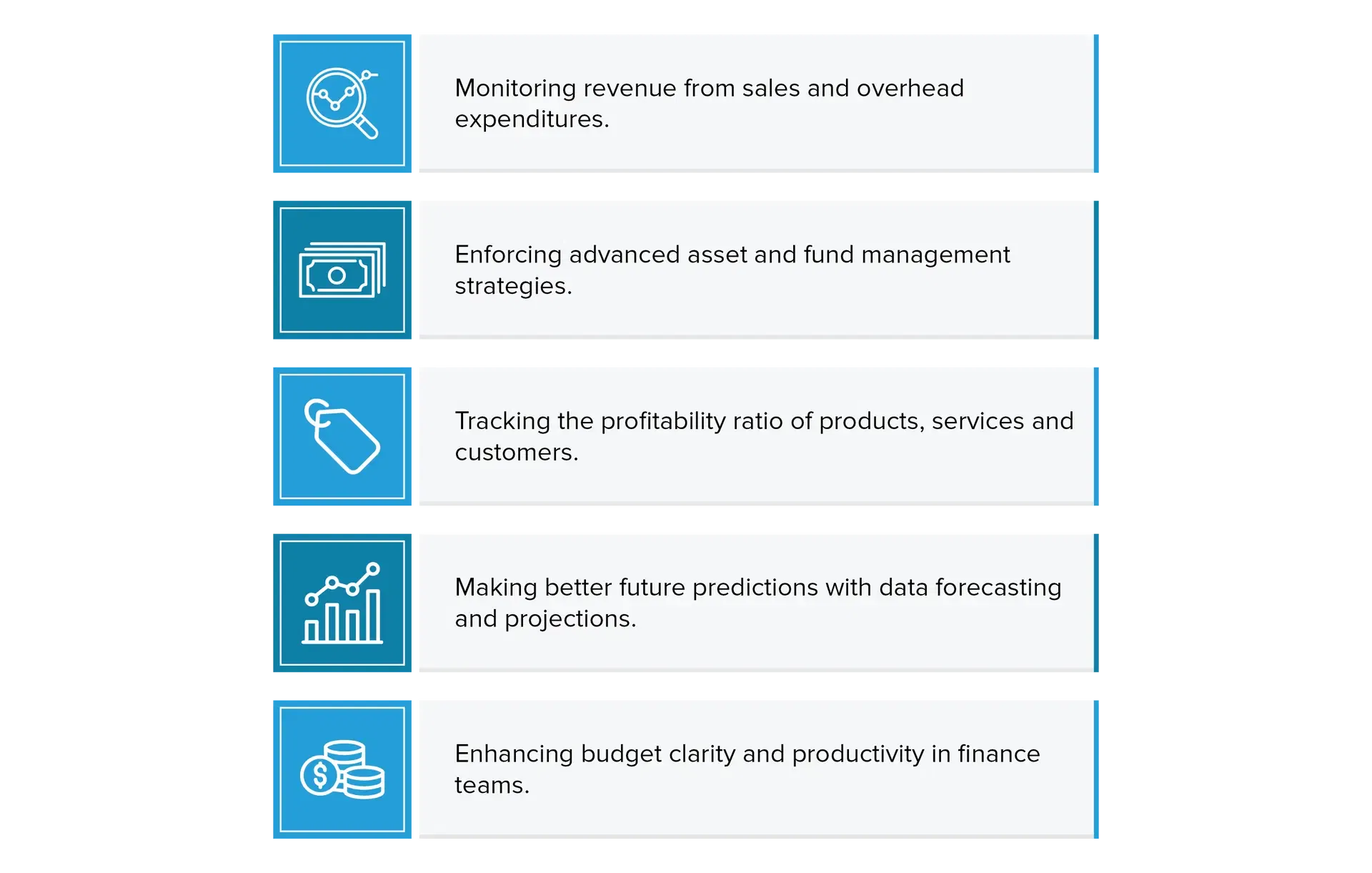
Generating new business opportunities using Power BI analytics
Let us look at some of the financial metrics that can be monitored using Power BI and how this helps BFSI enterprises with generating new business. Using the Power BI dashboard in financial operations, you can easily track and analyze the related financial KPIs and metrics in a collection of interactive and easy-to-use visualizations.
-
Financial performance analytics
Provides a way to convey the key financial metrics of your balance sheet over time to ensure long-term stability and success.
-
Cash management analytics
Opens the door to express the liquidity and cash flow over time.
-
Profit and loss analytics
Offers a roadmap to collect information on the income statement over time, in accordance with the related financial indicators.
-
Fraud detection analytics
Addresses techniques such as stratification of numbers, duplicate transactions testing, falsified numeric values, and validating entry dates to detect suspicious activities.
Nine noteworthy benefits of Power BI consulting services for BFSI organizations
1. Power BI can process large amounts of data, so financial institutions can feed large quantities of data without struggling to process it.
2. The built-in Machine Learning (ML) capabilities of the Power BI platform can analyze data and help BFSI companies to identify valuable financial trends and make well-informed predictions.
3. Information can be visualized using powerful templates to allow BFSI institutions to gain a better understanding of their financial figures.
4. Power BI is a cloud-based platform; therefore, financial organizations can expect intelligence capabilities and powerful algorithms that are updated at regular intervals.
5. Power BI offers excellent personalization capabilities through which organizations can create their dashboards to quickly access any financial data they need.
6. BFSI companies also gain the facility of setting up KPIs to keep their critical metrics and measurements updated.
7. Power BI comes with an intuitive interface that makes it much more user-friendly and easier to navigate compared to complex and time-consuming spreadsheets.
8. Power BI tool easily integrates with other popular business management tools such as SharePoint, Office 365, and Dynamics 365, as well as many other non-Microsoft products, including Spark, Hadoop, Google Analytics, SAP, and Salesforce, so your organization can perform better.
9. Power BI provides granular accessibility controls both internally and externally for data security.
What are the use cases of Power BI?
The uses of Power BI in the finance sector are countless and diverse. Let us see some critical applications of Microsoft Power BI for financial analysis.
1. Consolidate business data with Power Query
It is not easy to orchestrate and bring together a large amount of data from multiple sources. Aggregating data from various sources, such as on-premises servers, Excel sheets, data warehouses, and cloud apps, can impose certain limits regarding complexity, volume, or nature of data. However, in the data-driven financial industry, Power BI offers businesses the opportunity to merge different data sets and consolidate files with Power Query without any limitations.
2. Generate visual/graphical reports
Power BI enables financial professionals to produce interactive visual reports, maps, tables, and charts with the help of its Power View feature. It lets them generate attractive visuals from the existing financial data. So, it can provide you with compelling data reporting, exploration, and presentation experience. Power View allows you to perform insightful ad-hoc reporting in a more appealing and presentable manner. Ultimately, it will help you to make informed, strategic business decisions.
3. Spot the changing data trends and patterns
As the amount of data grows, the need for analyzing and spotting the changing data trends and patterns also increases. Hence, it becomes essential for financial professionals to have a smart BI tool like Power BI. Power BI dashboard has an in-built time intelligence feature to notice critical data trends and spot discreet patterns. Furthermore, it can help you discover changes in data patterns over time, such as profit and loss statements, sales revenue, business expenses, etc.
4. Visual scenarios with what-if parameters
The financial service sector needs critical answers or insights from business data to represent it in visualizations. Hence, the Power BI analytics tool comes with an innovative ‘what if’ parameter or analysis technique. It enables you to make vital decisions based on data forecasting or projections. Thus, it allows you to look historically or forward and analyze how things would have been in a different scenario.
Turn your data into financial advantage
Data is the most powerful asset in finance now and success depends on how it’s used. Power BI enables financial organizations to unify complex datasets, identify hidden risks, and translate raw numbers into meaningful insights that drive agility and strength. By utilizing interactive dashboards, advanced analytics, and predictive modeling, institutions can move from reactive problem‑solving to proactive decision‑making. As the industry continues to evolve, the ability to turn information into foresight will define the leaders of digital finance.