Telecom service provider grew revenue by 50% with Salesforce Sales Cloud implementation
Our client is a telecom service provider. They wanted a solution that could centralize sales operations and provide real-time visibility into forecasts and pipeline movements. We implemented Salesforce Sales Cloud to connect the disconnected sales processes and provide actionable insights for quick decision-making. They achieved 50% revenue growth, a 45% improvement in customer retention, a 30% increase in subscribers, and a 35% rise in lead conversion.
 Industry: Telecom
  Business type: Enterprise
  Services: Salesforce Sales Cloud
 Technology: Salesforce Sales Cloud, Pardot
Client profile
Our client is one of the leading telecom service providers, serving consumers and businesses for over 20 years. They manage a customer base of over 3–5 million subscribers, supporting enterprise and retail segments. Their network handles 10–15 million transactions daily, including service requests, billing events, and customer interactions.
Technical challenges
Our client operated with disconnected systems, making it difficult to identify high-intent prospects or accurately track deal progress. As a result, forecasting became unreliable, and overall sales productivity suffered. Some of their core challenges were:

Limited visibility
Sales teams operated with fragmented customer data and manual tracking, making it difficult to identify high potential prospects. Thus, the lack of visibility resulted in missed opportunities, impacting forecasting accuracy.

Slow turnaround time
Lead response times were delayed due to a lack of structured processes, manual approvals, and disconnected workflows. This lag reduced engagement quality, causing prospects to lose interest or move to competitors.

Incomplete customer view
Customer information was spread across systems, preventing teams from accessing a unified view. This lack of clarity often led to misaligned pitches and reduced customer trust, impacting the sales cycle.

Ineffective pipeline tracking
Pipeline management relied on manual updates and inconsistent reporting practices. Sales leaders lacked real-time insights, which made it difficult to prioritize high-value opportunities. Thus, overall sales productivity suffered.
Our solution
We implemented Salesforce Sales Cloud to centralize sales operations and provide the client with real-time visibility into forecasts and pipeline movements. It helped the sales team make accurate forecasts for the most complex sales territories. Our team defined roles, responsibilities, and timelines to ensure structured execution, aligning the solution with their sales processes.
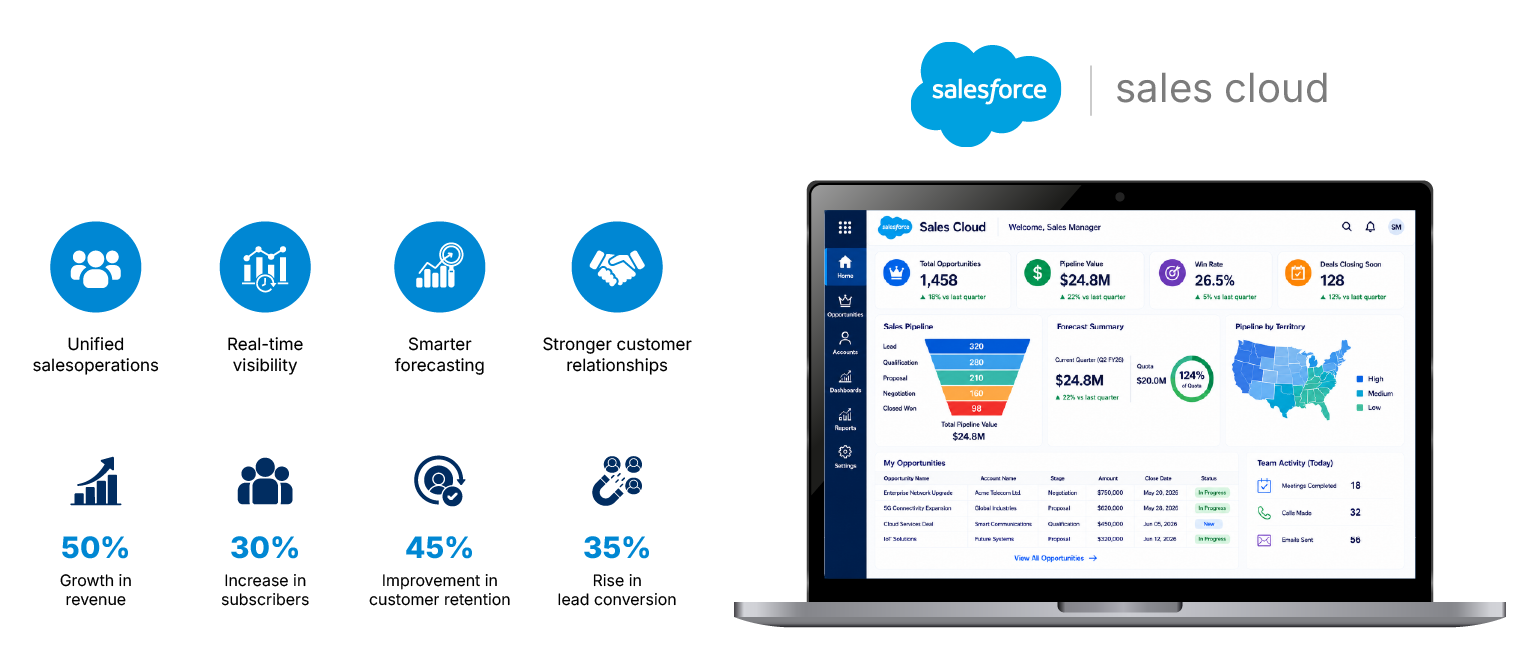
Unified disconnected systems with Salesforce Sales Cloud implementation
Our consultants met with sales directors and regional managers to understand existing workflows. After identifying gaps, we implemented Salesforce Sales Cloud to connect the disconnected sales processes and enhance real-time visibility into pipelines. Our implementation team built custom territory hierarchies for clients’ complex regional structure. This approach provided the client with unified access to sales data, an accurate view of pipeline performance, and enabling data-driven decisions across all sales territories.
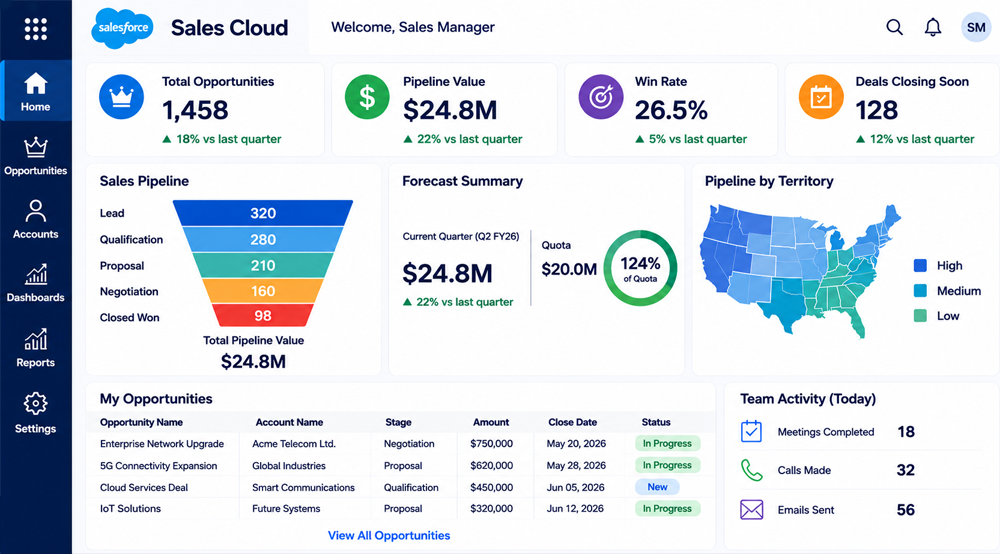
Standardized process flows with Salesforce capabilities
Our team conducted structured workshops with presales leads and account managers to understand decision points and escalation paths. By using these insights, our solution architects designed standardized process flows that aligned with Salesforce capabilities. We also created role-based access to align visibility with responsibilities. This framework was implemented alongside the CRM rollout to eliminate ambiguity in tasks. The result was a unified workspace where presales and account teams collaborate directly on deals, reducing missed handoffs and shortening the sales cycle.
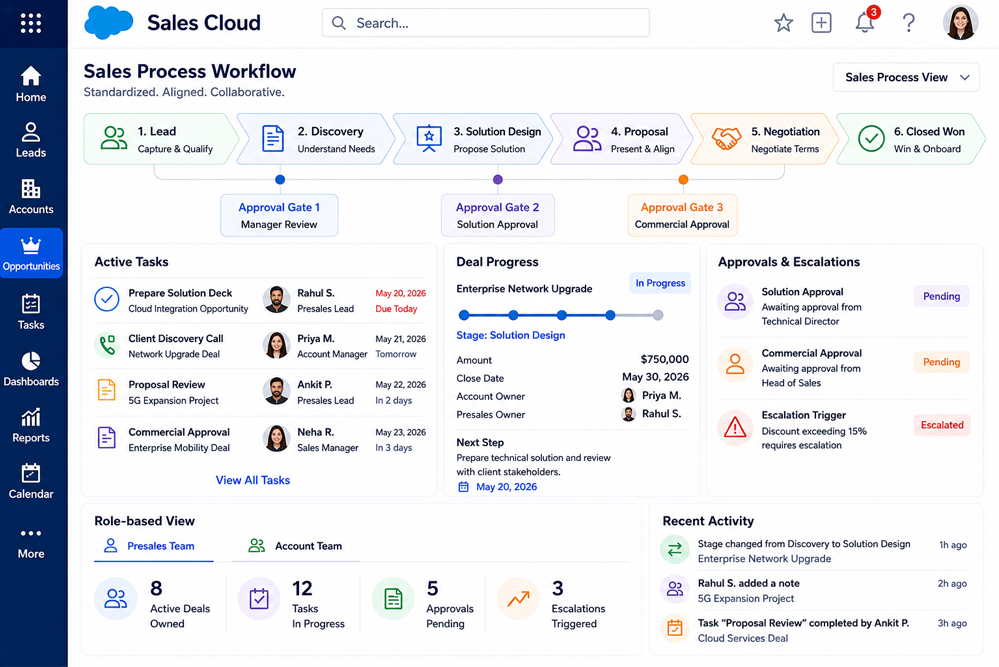
Implemented real-time update to improve visibility
We enabled online opportunity tracking within Salesforce Sales Cloud to replace manual follow-ups and disconnected communication. Our team collaborated with sales representatives to understand how opportunities were currently tracked. Based on this, we configured opportunities for pipelines, activity tracking, and automated alerts. Our developers implemented real-time updates and notifications to ensure that critical deal movements were visible instantly. It ensured faster responses, reduced communication gaps, and allowed teams to act on opportunities without dependency on offline updates.

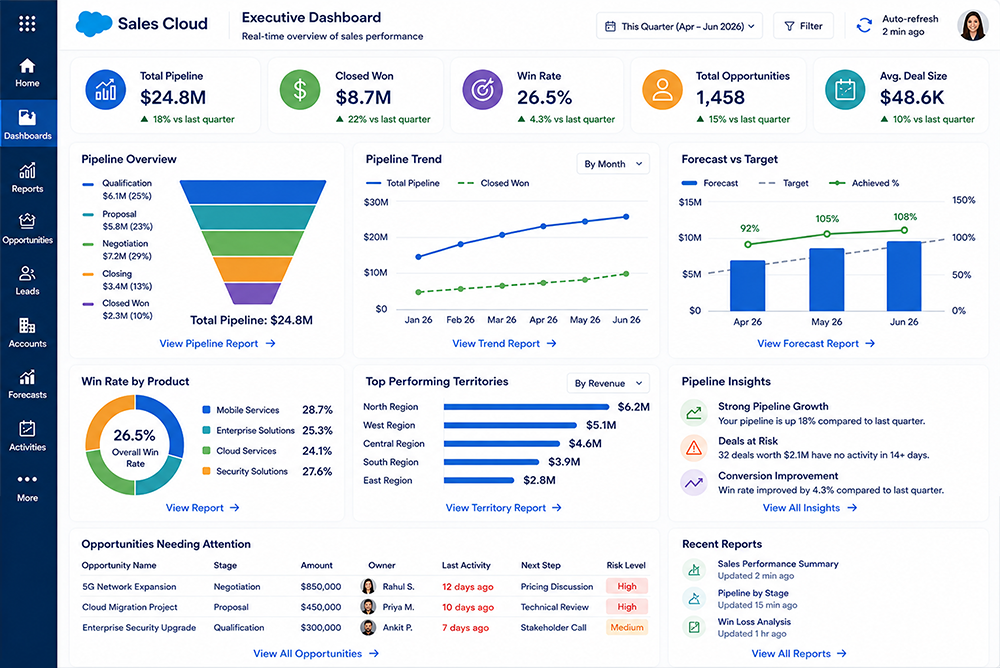
Built customized reports and dashboards
We designed and implemented advanced reporting capabilities using Salesforce dashboards to give sales managers actionable insights. Our analysts worked closely with leadership to identify key performance indicators, reporting gaps, and forecasting challenges. Based on these inputs, we built customized reports, real-time dashboards, and drill-down views within Salesforce Sales Cloud. The implementation included automated data refresh and role-based access to ensure relevance. This solution enabled managers to track performance, identify bottlenecks, and evaluate pipeline health without manual consolidation. It strengthened decision-making by providing accurate, real-time data aligned with business priorities.
Identified duplication issues to optimize data flow
We restructured customer data management by consolidating fragmented records into a unified system within Salesforce Sales Cloud. Our team audited existing databases, identified duplication issues, and mapped customer data flows across systems. Data engineers and Salesforce specialists cleaned, migrated, and standardized records to create a single source of truth. We also configured accounts and contact hierarchies to reflect real-world relationships. This approach improved data accuracy and accessibility, enabling sales teams to understand customer history, preferences, and interactions. It strengthened relationship management by supporting more informed and personalized engagement across the sales lifecycle.
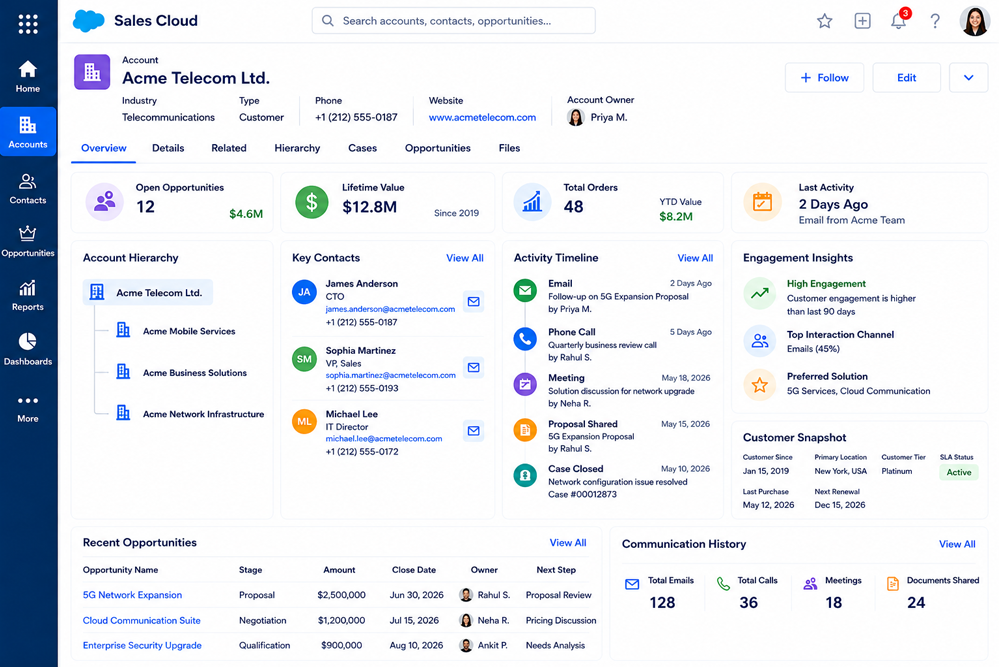
Developed a forecasting territory alignment model for complex sales environments
We developed a forecasting and territory alignment model to improve accuracy in complex sales environments. Our consultants collaborated with regional sales heads to understand territory structures, deal distribution, and forecasting inconsistencies. These insights enabled us to configure forecasting logic, quota assignments, and territory rules within Salesforce Sales Cloud. The implementation included scenario-based forecasting and real-time adjustment capabilities. This ensured that forecasts reflected actual market conditions and sales dynamics. By aligning territories with data-driven insights, the solution improved forecast reliability, balanced workload distribution, and supported strategic prospecting for sustained pipeline growth.
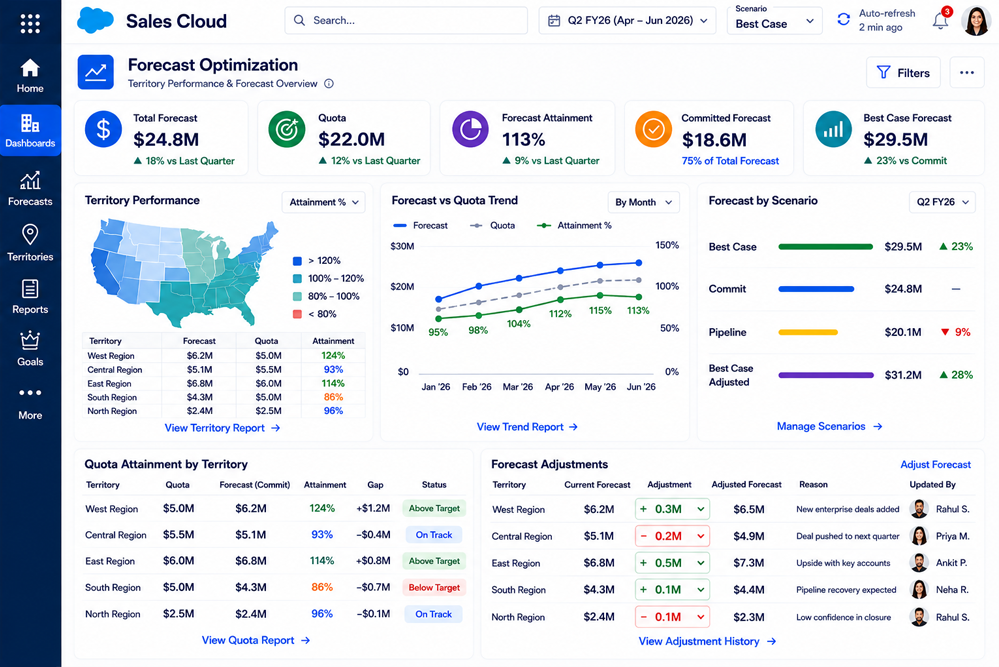
Business goals and measurable outcomes
| Business objective | Business benefit delivered |
|---|---|
| Grew revenue | 50% growth in revenue |
| Increased subscribers | 30% increase in number of subscribers |
| Enhanced retention | 45% improved customer retention |
| Improve cash flow through faster collections | Timely, accurate reminders led to faster customer payments and contributed to a reduction of outstanding balances by approximately 15% within the first quarter post-launch. |
| Boost lead conversion | 35% rise in lead conversion |
Tech stack
- CRM Platform
- Salesforce Sales Cloud
- Marketing Automation
- Salesforce Account Engagement (Pardot)
- Sales Automation
- Salesforce Opportunity Management, Lead Management, Account & Contact Management, Territory Management, Forecasting
- Workflow & Process Automation
- Salesforce Flow, Approval Processes, Process Automation, Assignment Rules
- Reporting & Analytics
- Salesforce Reports, Salesforce Dashboards, Forecast Reports, Pipeline Analytics, KPI Tracking
- Data Management
- Salesforce Data Import Wizard, Data Loader, Data Cleansing & Deduplication, Account Hierarchies
- Integration Technologies
- Salesforce APIs, REST APIs, SOAP APIs, Middleware Integration
- Data Migration
- Salesforce Data Migration Tools, ETL Processes, Data Mapping & Transformation
- Security & Access Management
- Salesforce Profiles, Permission Sets, Role Hierarchy, Sharing Rules
- Customization & Development
- Apex, Lightning Web Components (LWC), Salesforce Lightning Experience
- Cloud Infrastructure
- Salesforce Platform (SaaS / Cloud CRM)
- Collaboration & Productivity
- Salesforce Chatter, Email Integration, Activity Management
Similar case studies
Salesforce customer portal implementation for Fujifilm Sonosite

Driving sustainability and efficiency with supply chain data services
Connect Now
Our experts would be eager to hear you.

