Share
Share
 ChatGPT
 Perplexity
 Claude
 Grok
Grok
 Google AI Mode
Deploying Artificial Intelligence (AI) in electronic component manufacturing is a major milestone. This applies whether it’s used for Automated Optical Inspection (AOI) on Printed Circuit Board Assemblies (PCBAs), predictive maintenance on wafer fabrication equipment, or demand forecasting. However, the real challenge begins post-deployment: proving it generates business value.
Electronic manufacturing demands microscopic precision and high throughput, so standard IT metrics like model accuracy or software uptime are not enough. You need a customized mix of operational and financial Key Performance Indicators (KPIs). These metrics bridge the gap between deploying AI in semiconductor manufacturing and factory floor profitability.
A distinct performance divide has surfaced within the global industrial market. In their 2025 The New AI Imperative in Manufacturing, Capgemini and Microsoft revealed that while 42% of manufacturers have adopted AI in some form, only 5% capture meaningful financial value. This elite 5% group of manufacturers achieves outsized returns because they enforce rigorous post-deployment tracking discipline. For electronic component manufacturers, this discipline requires evaluating AI deployment across three dimensions: operational metrics, financial value, and hidden strategic advantages.
In our previous articles, we discussed the need for AI adoption in electronics component manufacturing, along with best practices for implementing AI in semiconductor manufacturing. We also explored how data, AI, and Machine Learning (ML) improve production yield for semiconductors. In this article, we will take a 360° look at post-deployment measures to ensure your AI investment delivers the best possible ROI.
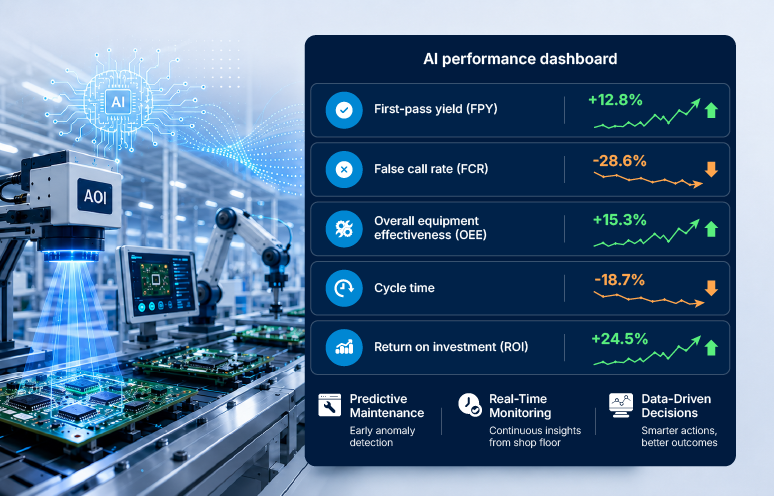
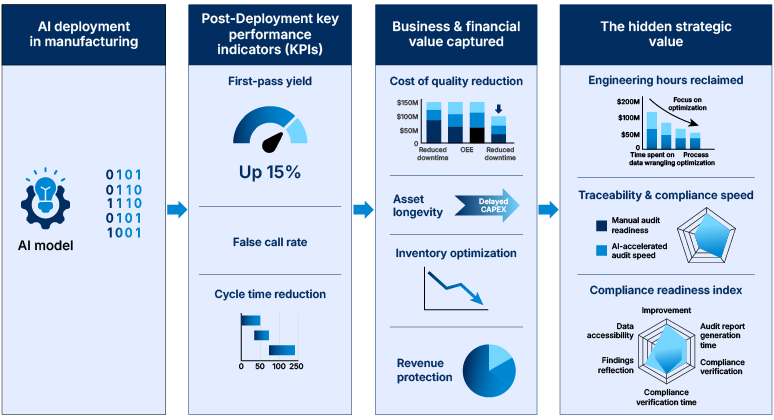
The following image shows how tracking these three dimensions turns your AI investments into sustained high-performance corporate returns.
1. Operational metrics (The plant floor success)
Operational metrics act as early indicators of deployment health because they track physical throughput and line behavior. According to Gartner’s Hierarchy of Manufacturing Metrics, true smart manufacturing value stems from optimizing factory-floor decisions. These targeted metrics prove that the model performs its core technical duties while integrating smoothly with existing Manufacturing Execution Systems (MES).
First-Pass Yield (FPY) uplift
First-Pass Yield stands as the ultimate test of physical efficiency in electronics assembly. AI-driven process optimization or real-time defect prevention should visibly increase the percentage of components that pass inspection without needing rework.
At Bosch’s semiconductor facility in Bamberg, Germany, an AI analytics platform checks automated testing data every 20 seconds. It watches small changes in the process and adjusts upstream machine settings before parts fall outside acceptable limits. By tracking weekly FPY improvements after the system was deployed, Bosch found that the AI catches variances before they become scrap.
False Call Rate (FCR) vs. Escape rate
AOI and wafer testing require balancing two critical inspection parameters:
- False calls (Overkills): The AI flags a perfectly good solder joint or wire bond as defective, forcing unnecessary human intervention.
- Escapes (Underkills): The AI allows genuine defects to slip through, risking catastrophic field failures.
The post-deployment goal is minimizing false calls while holding escapes strictly at zero. Foxconn tackled this at its “Manufacturing Lighthouse” facility in Shenzhen, China, using deep learning to filter rule-based inspection noise. By training vision models on historical component images, Foxconn cut false calls, eased human review backlogs and boosted efficiency by 30%.
At Softweb Solutions, we applied a similar deep learning approach for a semiconductor wafer manufacturer. We achieved a 93.7% defect detection accuracy and cut reliance on manual inspection. Read the full AI-based defect detection case study to learn how deep learning eliminated false positives and enhanced yield.
Overall Equipment Effectiveness (OEE) elevation
When applying AI to predictive maintenance, tracking unplanned downtime reductions directly validates your initial investment.
Infineon Technologies uses edge-AI smart sensors to monitor power modules, ventilation assets, and high-speed manufacturing equipment. Instead of executing maintenance on fixed schedules, algorithms detect structural vibration changes that predict asset failures days in advance. Capturing these windows allows teams to service machinery during scheduled changes, protecting the availability component of OEE.
Cycle time reduction
This metric captures the direct injection of algorithmic speed into complex testing cycles. Intelligent machine learning models triage components or streamline parametric testing and drop total time spent inside test cells.
In advanced semiconductor packaging, testing multi-layered substrates can slow down final shipping speeds. Implementing predictive quality models allows factories to bypass redundant verification steps on wafers flagged as low risk. Success is verified when average testing cycle times fall and expand capacity without requiring new capital equipment.
2. Business and financial value (The C-suite success)
Operational success must translate into financial metrics to justify initial Capital Expenditures (CapEx) and ongoing Operational Costs (OpEx). According to McKinsey’s 2026 semiconductor analysis, top-performing electronic leaders optimize productivity by aggressively automating asset maintenance and leveraging existing infrastructure to secure healthier margins. To demonstrate value to executive leadership, floor metrics must map to established corporate financial drivers.
| Business value driver | Post-deployment metric to track | What it proves |
|---|---|---|
| Cost of Quality (CoQ) Reduction | Drop in scrap costs + warranty claims + rework labor hours. | AI catches errors early in the production line before expensive and irreversible value is added to a bad board. |
| Asset longevity and CapEx savings | Extension of Mean Time Between Failures (MTBF). | Predictive maintenance algorithms maximize asset utility, delaying expensive machine replacements. |
| Inventory optimization | Reduction in raw material and Work-in-Progress (WIP) carrying costs. | Demand-sensing AI models prevent over-purchasing volatile, high-cost commodities like silicon wafers or rare-earth elements. |
| Revenue protection | Service Level Agreement (SLA) fulfillment rate and reduction in customer chargebacks. | Higher manufacturing reliability means fewer late shipments, lower batch recall exposure, and protected client relationships. |
Real-world scenarios and financial impact
- CoQ reduction in action: A manufacturer producing high-reliability aerospace PCBAs implements an AI defect clustering model. By identifying a repeating copper deposition error at the drilling stage, the AI flags the root cause before the boards move to components kitting and reflow. Preventing the addition of expensive microcontrollers and memory chips onto flawed substrates directly reduces the monthly scrap ledger.
- Asset longevity realized: In a silicon foundry running multi-million dollar chemical vapor deposition (CVD) chambers, an AI model tracks plasma stability and gas flow degradation. By predicting precise maintenance windows, the plant extends the operational life of specialized ceramic showerheads and pushes the MTBF out by 20%. Such an extension saves thousands of dollars annually in premature component replacements.
- Inventory optimization via demand sensing: An electronic component supplier integrates an AI forecasting engine that parses global logistics disruptions, component lead-time fluctuations, and historical booking data. Instead of keeping a generic and expensive 30-day cushion of safety stock for volatile flash memory chips, the AI dynamically shrinks or expands the safety stock based on micro-market signals. This optimization frees up millions in working capital previously tied up in warehouse inventory.
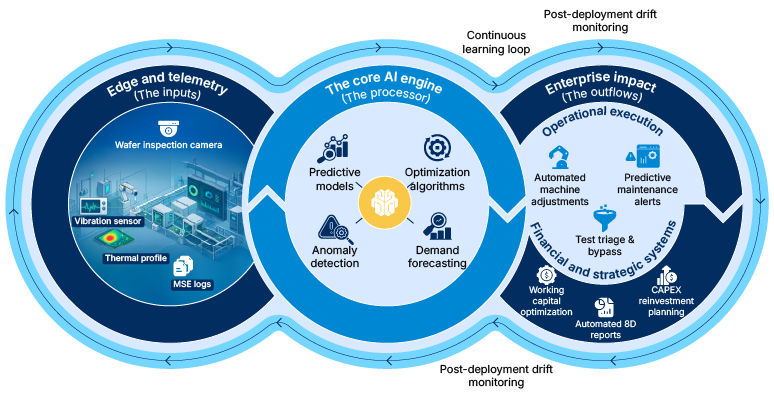
The operational metrics and financial impacts detailed above represent the tangible wins of successful AI deployment. However, to fully appreciate the systemic nature of this transformation, it’s crucial to understand the continuous feedback loop that powers these achievements. The following diagram visualizes this ‘closed-loop AI manufacturing flywheel’. It shows how raw plant floor data feeds into a central intelligence engine, driving automated decisions and business optimizations.
3. The “hidden” strategic value
Beyond immediate line efficiencies and direct balance sheet improvements, successful post-deployment AI yields profound and long-term competitive advantages that protect a manufacturer’s market positioning. These metrics reflect systemic resilience, workforce optimization, and compliance readiness.
Engineering hours reclaimed
Track how much time quality and process engineers shift from manual data wrangling to process engineering. Traditionally, when an SMT line experiences a sudden drop in yield, quality engineers must manually extract logs from multiple machines, clean the data in spreadsheets, and cross-reference timestamps to find the root cause.
Post-deployment, an AI diagnostics tool continuously ingests these logs, automatically identifies that a specific nozzle on a pick-and-place machine is causing 80% of the misalignments, and alerts the team. What used to take hours can now happen in seconds, and engineers can focus on structural line improvements and design optimizations.
Traceability and compliance speed
In highly regulated sectors like automotive (IATF 16949), aerospace (AS9100), and medical electronics, AI automatically clusters and analyzes defect trends. It accelerates audit readiness and failure analysis.
When an automotive OEM customer reports an in-field component failure, the electronic manufacturer is legally obligated to issue a formal 8D (Eight Disciplines) failure analysis report detailing root causes and containment actions. An AI system connected to the factory’s data thread can instantly parse the component’s historical manufacturing profile. It includes cross-referencing its specific silicon lot, reflow thermal profile, and AOI imagery, against historical defect databases.
With deployment of AI in semiconductor manufacturing, the AI accelerates the generation of verified 8D compliance reports from days to minutes. Thus, it protects the manufacturer from costly line-down penalties and preserving customer trust.
Last but not the least: Measuring post-deployment “drift” and sustainability
A frequently overlooked aspect of AI success is sustainability. Electronic manufacturing environments are highly dynamic. Component form factors shrink (e.g., transitioning from 0402 to 0201 passives), supplier material batches change, and silicon nodes continually evolve. If your AI’s precision degrades due to data or model drift, your hard-won business value can quickly evaporate.
To prevent this value erosion, manufacturers must implement a continuous monitoring loop that tracks Model Degradation vs. Yield Stability. If the AI’s precision dips below a pre-set threshold, it must trigger an automated retraining pipeline using the newly collected shop-floor data. Treat AI measurement post-deployment not as a static, one-time project sign-off, but as a continuous scorecard. These practices make those 5% manufacturers AI high performers. By measuring these metrics and business value post-deployment, you will make the best of your AI investment.