Share
Share
 ChatGPT
 Perplexity
 Claude
 Grok
Grok
 Google AI Mode
Semiconductor manufacturers are under constant pressure to increase wafer yields, shorten production cycles, and meet delivery commitments while producing increasingly complex chips. Achieving these goals depends on keeping critical production equipment operating reliably.
Unplanned downtime costs industrial manufacturers an estimated $50 billion annually -Deloitte.
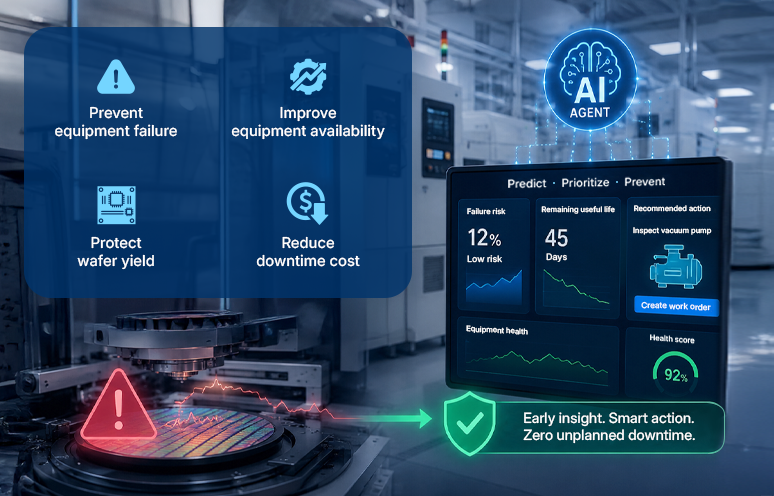
By implementing AI agents, manufacturers can prevent equipment failures before production is affected. Continuous monitoring of equipment telemetry and maintenance history enables semiconductor fabs to identify subtle degradation patterns that conventional maintenance often misses. Machine learning models estimate failure risk and remaining useful life, while AI agents evaluate the operational context, prioritize maintenance activities, and trigger workflows through existing maintenance systems.
This enables maintenance teams to intervene at the right time, reducing unplanned downtime, protecting wafer yield, and improving equipment availability across the fab. In this blog, we will explore why equipment failures create fab-wide disruptions, how AI agents prevent downtime, and how semiconductor manufacturers can build a more resilient maintenance strategy.
Why does a single equipment failure create a ripple effect across the entire fab?
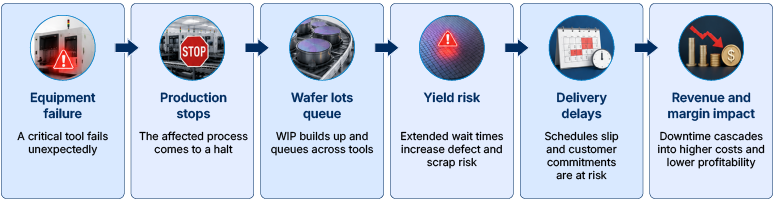
A single equipment failure affects the entire fab because semiconductor production relies on interconnected tools that must operate continuously to maintain wafer flow. Here’s how the disruption spreads across the fab:
Reduced Overall Equipment Effectiveness (OEE)
A semiconductor fab is a tightly synchronized manufacturing environment. When a critical tool fails unexpectedly, the disruption extends beyond that machine, affecting wafer flow, production schedules, yield, and equipment utilization across the fab.
A single equipment failure disrupts the entire production flow
Semiconductor manufacturing follows a sequential process. Each wafer must complete hundreds of precisely controlled operations before moving to the next stage. For instance, if a lithography scanner unexpectedly goes offline, each wafer lot waiting for that process is delayed. Meanwhile, the upstream tools continuously produce wafers and downstream equipment sits idle waiting for material. This creates an imbalance in work-in-progress queues. It increases production cycle times and reduces overall equipment effectiveness.
Equipment degradation often begins long before a breakdown occurs
Equipment failures do not occur suddenly. Components such as vacuum pumps, RF generators, electrostatic chucks, and cooling units gradually deteriorate over weeks or months. For example, a slow increase in chamber pressure and RF power may indicate wear inside an etch chamber. As conventional maintenance relies on fixed thresholds, these early warning signs frequently go unnoticed. Manufacturers will identify the failure only when equipment performance starts affecting process stability and tools stop unexpectedly.
Critical process tools create bottlenecks across the fab
Lithography, deposition, etch, and inspection equipment undergo mandatory manufacturing operations with little spare capacity available. Because every wafer depends on these stages, an unexpected outage quickly causes wafer queues, idle downstream equipment, production delays, and lower throughput throughout the manufacturing line.
Continuous equipment intelligence is becoming essential for modern fabs
Manually identifying early degradation is difficult in semiconductor manufacturing as equipment generates thousands of sensor readings every second. Manufacturers need AI-powered equipment intelligence that connects equipment to telemetry, maintenance history, and process conditions to identify abnormal behavior before production is affected. AI agents predict failure and proactively prevent costly production interruptions instead of reacting after downtime occurs.
Why can’t traditional maintenance keep up with modern semiconductor equipment?
Semiconductor equipment today runs faster and with minimal tolerances than the maintenance systems built to protect it. As fabs move to advanced process nodes with tighter process windows, identifying failures before they affect yield requires a more data-driven approach to maintenance. This creates several limitations for traditional maintenance.
Fixed maintenance schedules do not reflect actual equipment health
A plasma etch chamber processing high-density logic device degrades faster than one running less demanding processes. Servicing both tools on the same schedule can waste maintenance resources and leave critical components operating beyond their optimal condition. McKinsey observes from its work with fabs that semiconductor managers resort to firefighting in 40% to 70% of tool-down instances instead of following a plan. Improving equipment reliability improves tool availability by more than 15%.
Rule-based monitoring cannot detect complex degradation patterns
Fault Detection and Classification (FDC) systems rely on predefined thresholds. They miss gradual degradation across multiple parameters. Small changes in chamber pressure, RF power, and gas flow collectively indicate deteriorating chamber performance. TSMC now uses AI to read hundreds of thousands of process parameters at once, catching patterns no single threshold could see.
Equipment complexity exceeds what engineers can monitor manually
Modern fabs generate enormous volumes of equipment telemetry, inspection data, and process measurements every day. Although engineers remain responsible for equipment qualification and process decisions, manually analyzing thousands of sensor traces across multiple tools is no longer practical.
Samsung is addressing this challenge by applying AI across equipment operations, process control, and yield management. They analyze manufacturing data in real time, detect anomalies earlier, and recommend corrective actions before equipment issues affect production performance.
Reactive maintenance responds after production has already been affected
By the time conventional maintenance identifies a problem, equipment degradation may have already caused process variation, delayed wafer movement, or reduced yield. Research comparing machine learning models for semiconductor downtime prediction found that advanced AI models outperform conventional approaches. It captures complex, nonlinear relationships that precede equipment failures. Thus, enabling manufacturers to intervene earlier and reduce production disruptions.
How do AI agents prevent downtime?
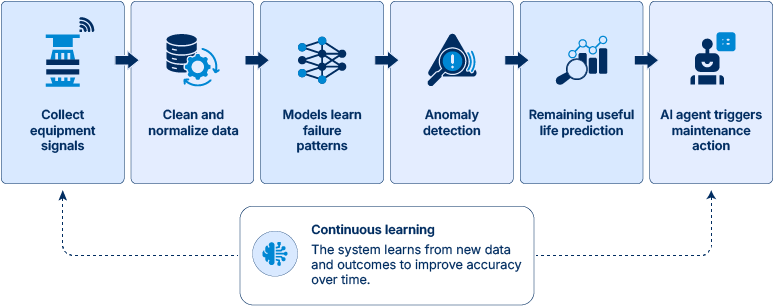
AI agents prevent unplanned downtime by continuously analyzing equipment health, predicting failures before they occur, and automatically coordinating the right maintenance response. They continuously monitor equipment signals, analyze how serious a pattern is, and trigger a fix before a tool fails.
AI agents move beyond prediction to autonomous decision-making
Traditional predictive maintenance systems identify abnormal equipment behavior and notify engineers. AI agents take the next step by evaluating the issue, assessing its urgency, and recommending a specific action through Manufacturing Execution Systems (MES), Computerized Maintenance Management Systems (CMMS), and Enterprise Resource Planning (ERP) platforms. Traditional tools generate an alert and leave engineers to make decisions. AI agents provide contextual recommendations that accelerate maintenance decisions.
AI agents continuously learn equipment degradation patterns
Semiconductor equipment generates thousands of telemetry signals during every wafer run, including chamber pressure, RF power, gas flow, vibration, motor current, vacuum levels, and temperature. Using machine learning technology, AI agents collect, normalize, and correlate these time-series datasets with maintenance history, process parameters, and previous equipment failures. Techniques such as anomaly detection, sensor fusion, failure classification, and Remaining Useful Life (RUL) prediction identify subtle degradation patterns that threshold-based monitoring cannot detect, enabling maintenance teams to intervene before equipment performance deteriorates.
AI agents connect predictive insights with maintenance execution
Once machine learning calculates the failure risk score, the AI agent identifies the appropriate response based on equipment criticality, production priorities, and maintenance schedules. Instead of immediately stopping the equipment, for instance an etch chamber showing early degradation, the AI agent may recommend servicing the equipment before the next planned production changeover. This minimizes disruption while preventing unexpected failure.
AI agents continuously improve prediction accuracy over time
AI agents continuously learn from new operational data and maintenance outcomes. If a bearing failure consistently follows a specific combination of vibration and temperature changes, the model recognizes that pattern earlier in future production cycles. This feedback loop helps reduce false alarms, improves Remaining Useful Life (RUL) estimates, and increases prediction accuracy as equipment ages, operating conditions change, or new process recipes are introduced.
How Softweb builds AI agents for semiconductor fabs?
Softweb builds predictive maintenance by connecting equipment data, training machine learning models on unified equipment data, and putting AI agents in charge of acting on what those models find. It works in five phases.
Step 1: Connect equipment data
We start by integrating real-time equipment telemetry from IoT sensors, PLCs, SCADA systems, MES, Fault Detection and Classification (FDC) platforms, historian databases, and maintenance records into a unified data environment for accurate predictions. This gives every machine learning model a full, connected picture of equipment health. The integrated data environment eliminates data silos and analyzes equipment behavior across multiple production tools.
Step 2: Develop machine learning models for failure prediction
We build machine learning models using historical equipment telemetry, maintenance history, and process data that identify degradation patterns before equipment performance affects production. These models continuously monitor equipment health signals and estimate Remaining Useful Life (RUL), enabling maintenance teams to intervene before an unexpected production stop occurs.
Step 3: Deploy AI agents for intelligent maintenance decisions
At this stage, we deploy the AI agents that continuously evaluate equipment conditions. It prioritizes maintenance activities based on failure risk and production schedules. The AI agent then recommends corrective actions and automatically triggers maintenance workflows. This enables engineering teams to focus on resolving high-priority issues rather than manually reviewing hundreds of equipment alarms.
Step 4: Embed predictive maintenance into daily operations
We then directly integrate AI-driven insights into your existing CMMS, ERP, MES, maintenance scheduling platforms, and technician notification systems. Our team ensures maintenance recommendations become part of your established operational workflows instead of requiring engineers to monitor separate dashboards.
Step 5: Continuously improve model performance
Equipment behavior changes over time due to component aging, process updates, and new production recipes. We retrain the models using real maintenance outcomes, monitor model drift, and improve prediction accuracy over time, so the system becomes more accurate the longer it runs.
What business outcomes can semiconductor fabs expect from AI agents?
When AI agents are implemented effectively, the benefits extend beyond preventing equipment failures. The table below highlights the key operational outcomes semiconductor fabs can expect from an AI agent.
| Business objective | Operational outcome |
|---|---|
| Reduce unplanned downtime | 30–50% fewer unscheduled equipment stoppages |
| Improve equipment availability | Higher Overall Equipment Effectiveness (OEE) |
| Lower maintenance costs | Reduced emergency repairs and overtime maintenance |
| Protect wafer yield | Fewer process disruptions caused by equipment failures |
| Increase equipment utilization | More productive tool uptime and stable production flow |
| Improve maintenance planning | Condition-based maintenance instead of fixed schedules |
| Increase engineering productivity | Engineers spend less time troubleshooting unexpected failures |
Build a more resilient semiconductor fab with AI agents
AI agents are becoming essential for maintaining reliable semiconductor manufacturing as equipment grows more connected and production becomes increasingly complex. Manufacturers should implement AI agents to continuously monitor equipment health, identify early signs of degradation, and trigger maintenance actions before failures disrupt production.
This proactive approach improves equipment availability, protects wafer yield, and reduces costly unplanned downtime while creating more stable manufacturing operations. Softweb helps semiconductor manufacturers accelerate this transition by developing custom machine learning models and AI agents that analyze equipment health signals, predict failures early, and automate maintenance workflows, enabling long-term operational resilience and more predictable fab performance.