 AVIS
AVIS
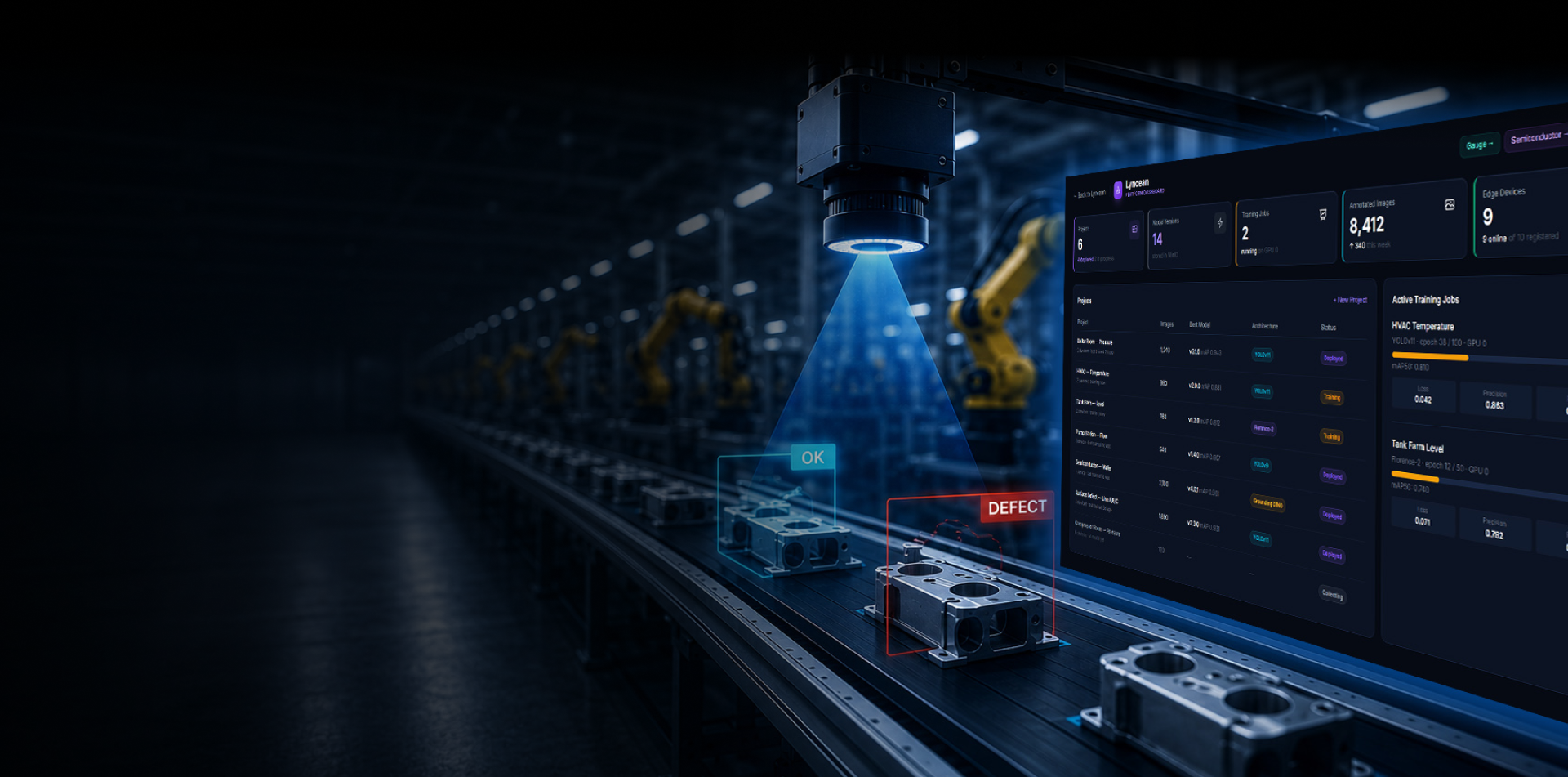
AI-powered visual inspection system
Deploy production-ready visual inspection across any facility and use case, with hardware configured to your environment and models that improve with every shift.
inference latency
models in library
Our Clients






Scale visual inspection across every defect type, every
inspection point, and every facility

At production scale, human inspectors miss 20% to 30% of defects because throughput speed and variable conditions make consistent manual inspection impossible.
ML models compound the problem: accuracy drifts as environments change, and every new inspection task adds another vendor to manage. A single edge-to-cloud platform solves all three.
Softweb Solutions builds and deploys an end-to-end platform where hardware configuration, model deployment, MLOps retraining, and GenAI-powered reporting work as a single connected system.
The Softweb difference in AI-powered visual inspection
The gap between manual inspection and AI-powered inspection shows up in measurable ways. Here is what that looks like across
the metrics that matter most to operations teams.
Faster time to
production
Cut deployment time from 6 to 12 weeks down to
2-3 Days
Fewer defect
escapes
Reduce human inspection escapes from 20–30% to
< 2% with AI vision
Continuous model
improvement
Models retrain and self-improve automatically after every
50–100 samples
Broad out-of-the-box
coverage
Pre-built model library covers industrial vision scenarios up to
90%
Common inspection challenges at production speed

Inspection accuracy becomes difficult to maintain
Human inspection catches only 70% to 80% of anomalies. Even automated models lose accuracy as conditions change, and most operations teams do not have in-house retraining expertise.
Every task requires a separate tool
Defect detection, PPE compliance, and package verification rely on different vendors, SDKs, and integrations, fragmenting visibility.
Compliance records are difficult to maintain
Regulated industries require traceable inspection records. Audit data spread across disconnected systems becomes difficult to govern.
Getting models to hardware takes months
Models train in days but deployment can take 6–12 weeks. Embedded and ML skill gaps further delay rollout.
Production-ready inspection architecture
Edge AI inference engine
Our platform runs visual analysis directly on-device at sub-100ms latency, sending inference results at line speed without cloud round-trip delays. Cloud-trained models reach cameras and gateways through the MLOps pipeline automatically, with no manual configuration required per device.
Multi-model vision pipeline
Our platform brings detection, classification, segmentation, and OCR together across QC, safety, logistics, and retail inspection within a single interface. Every inspection type is covered from a single point of control, consolidating what would otherwise require multiple vendors, SDKs, and integrations.
Pre-optimized model library
Our model library ships with 50+ production-ready models that deploy in one click, and new detection types go live in 2 to 3 days. Each model starts generating inference data from day one without requiring custom training to begin.
Continuous learning loop
The platform feeds operator-validated corrections back into the retraining pipeline automatically, triggering retraining after 50 to 100 new samples as conditions change. With each cycle, accuracy improves without data science involvement at any stage.
GenAI insights and audit trail
Our GenAI layer generates inspection reports and answers operator questions in natural language, logging every detection event with full traceability from detection to disposition. Every compliance report is produced directly from the platform’s detection history without manual data compilation.
How is AI-powered visual inspection used across industrial environments?
Challenge:
Standard optics and rule-based systems miss sub-micron surface defects on wafers and dies, leading to higher yield loss and costly escapes at final inspection.
Solution:
A scientific-grade camera with edge AI runs multi-class defect classification at line speed, with continuous retraining on production data.
- Detects scratches, particles, edge chips, and pattern anomalies in real time
- Deploys a baseline defect model in days and retrains on live production data
- Classifies defect type and location for downstream root cause analysis
- Logs every inspection event with a timestamped audit trail for quality teams

Challenge:
Managing a separate vision tool for each simultaneous quality check increases hardware complexity and creates integration overhead across the production line.
Solution:
A single camera running three detection algorithms in parallel on one edge device, reducing cost and setup complexity.
- Inspects assembly errors, component alignment, and label placement simultaneously
- Reduces hardware requirements without reducing inspection coverage across the line
- Routes task-specific alerts to the correct operator team in real time
- Retrains each algorithm independently as production conditions change

Challenge:
Manual spot-checks at throughput speed miss packaging errors before goods leave the facility, driving customer returns and compliance exposure.
Solution:
Edge-based OCR and object detection verify labels, barcodes, fill levels, and seal integrity at conveyor speed.
- Catches label mismatches, missing barcodes, and fill anomalies before dispatch
- Runs directly on edge hardware at the inspection point without cloud latency
- Feeds every verification event into a centralized compliance and exception log
- Handles multi-SKU lines with model switching managed through the MLOps pipeline

Challenge:
Equipment degradation develops between manual inspection cycles, making reactive maintenance the default and unplanned downtime difficult to prevent.
Solution:
Thermal and standard cameras monitor equipment continuously, with edge AI detecting anomalies and pushing alerts to a live dashboard.
- Identifies thermal hotspots on racks, connectors, and mechanical enclosures early
- Detects visual anomalies including corrosion, cable damage, and structural changes
- Pushes alerts with detection context before failures escalate to unplanned downtime
- Maintains a full historical inspection record for compliance and maintenance planning

Challenge:
Manual compliance checks are episodic and inconsistently documented, making audit-grade traceability difficult to maintain across multiple zones and sites.
Solution:
Continuous computer vision monitoring covers access points, equipment zones, and compliance-critical areas, with GenAI generating audit reports automatically.
- Detects PPE violations, unauthorized access, and zone breaches in real time
- Generates timestamped, searchable audit logs for every inspection and access event
- Answers compliance queries in natural language through the GenAI interface
- Scales across a multi-site fleet without adding inspection headcount

Challenge:
Standard optics and rule-based systems miss sub-micron surface defects on wafers and dies, leading to higher yield loss and costly escapes at final inspection.
Solution:
A scientific-grade camera with edge AI runs multi-class defect classification at line speed, with continuous retraining on production data.
- Detects scratches, particles, edge chips, and pattern anomalies in real time
- Deploys a baseline defect model in days and retrains on live production data
- Classifies defect type and location for downstream root cause analysis
- Logs every inspection event with a timestamped audit trail for quality teams
Challenge:
Managing a separate vision tool for each simultaneous quality check increases hardware complexity and creates integration overhead across the production line.
Solution:
A single camera running three detection algorithms in parallel on one edge device, reducing cost and setup complexity.
- Inspects assembly errors, component alignment, and label placement simultaneously
- Reduces hardware requirements without reducing inspection coverage across the line
- Routes task-specific alerts to the correct operator team in real time
- Retrains each algorithm independently as production conditions change
Challenge:
Manual spot-checks at throughput speed miss packaging errors before goods leave the facility, driving customer returns and compliance exposure.
Solution:
Edge-based OCR and object detection verify labels, barcodes, fill levels, and seal integrity at conveyor speed.
- Catches label mismatches, missing barcodes, and fill anomalies before dispatch
- Runs directly on edge hardware at the inspection point without cloud latency
- Feeds every verification event into a centralized compliance and exception log
- Handles multi-SKU lines with model switching managed through the MLOps pipeline
Challenge:
Equipment degradation develops between manual inspection cycles, making reactive maintenance the default and unplanned downtime difficult to prevent.
Solution:
Thermal and standard cameras monitor equipment continuously, with edge AI detecting anomalies and pushing alerts to a live dashboard.
- Identifies thermal hotspots on racks, connectors, and mechanical enclosures early
- Detects visual anomalies including corrosion, cable damage, and structural changes
- Pushes alerts with detection context before failures escalate to unplanned downtime
- Maintains a full historical inspection record for compliance and maintenance planning
Challenge:
Manual compliance checks are episodic and inconsistently documented, making audit-grade traceability difficult to maintain across multiple zones and sites.
Solution:
Continuous computer vision monitoring covers access points, equipment zones, and compliance-critical areas, with GenAI generating audit reports automatically.
- Detects PPE violations, unauthorized access, and zone breaches in real time
- Generates timestamped, searchable audit logs for every inspection and access event
- Answers compliance queries in natural language through the GenAI interface
- Scales across a multi-site fleet without adding inspection headcount
The gap between a trained model and a live operation is where most programs break
Book a session and get a clear picture of what deployment looks like for your environment.
See how it works ›Production-grade AI inspection capabilities

Edge and cloud hybrid architecture
Our platform runs visual analysis on-device for fast local processing, while cloud resources handle training and cross-facility analytics. You get full inspection coverage across connected and offline environments.

Multi-vendor hardware and OT integration
Our vision models run across NVIDIA Jetson, Hailo, Coral TPU, Sony AITRIOS, Qualcomm, and gateway environments. You can connect inspection events with MES, SCADA, MQTT, and Rockwell ecosystems directly.

Continuous self-improving models
You validate flagged detections in the dashboard, and our retraining pipelines pick up those corrections automatically. Model accuracy improves continuously without a dedicated data science team.

VLM-assisted inspection intelligence
Our vision-language models describe anomalies, summarize detection activity, and organize searchable operational records. Your inspection history stays connected and queryable across every event.

Automated ModelOps
Our platform monitors model accuracy continuously and triggers retraining on a defined schedule. You maintain consistent inspection accuracy across every shift without manual oversight.

Onboard new use case in 2 to 3 days
When your inspection requirements change, our pre-built model library covers 90% of industrial vision scenarios. You can onboard a new detection category in 2 to 3 days using 50 to 100 sample images.
Lyncean: AI-powered visual inspection platform for real-time industrial monitoring
Industrial environments still rely on fragmented inspection workflows that combine manual reviews, conventional vision systems, and disconnected monitoring across gauges, surface conditions, and semiconductor operations. Softweb’s edge AI visual inspection platform, Lyncean, centralizes inspection monitoring, deploys computer vision models on edge devices, and manages real-time inspection workflows across industrial environments.
Common inspection challenges across line-speed operations
- Manual inspection workflows limit continuous operational visibility
- Micro-defects and surface anomalies are difficult to identify consistently
- Distributed inspection systems create operational silos
- Model deployment and retraining require specialized expertise
Platform capability highlights
- Reduce gauge reading intervals from hours to ~3 sec
- Defect inference at sub-20ms, edge-only, no cloud
- Configure new inspection workflows using as few as 50–100 images
- Detection confidence benchmarks reaching 0.93 in controlled environments

Deployment approach for industrial inspection environments
We assess your facility, visit inspection points, evaluate lighting conditions, and map network paths between cameras and edge gateways. Based on these findings, we define the hardware configuration for your use case and environment.
With the configuration confirmed, our installation partners handle hardware procurement, mounting, cabling, power configuration, edge gateway provisioning, and IoT platform connectivity.
Once the hardware is connected, we deploy a pre-optimized baseline model for your use case. Whether for defect detection, thermal monitoring, gauge reading, or classification, the system begins generating inference data immediately without custom training.
As inspection data flows in, MLOps pipelines collect it and retrain the model against actual facility conditions. Operator-reviewed corrections automatically feed back into the pipeline, improving accuracy with each shift.
All pilot points report into a single live dashboard. We close the proof of concept with a findings readout covering detection events, accuracy baseline, and alert performance, giving you documented results before scale decisions are made.
Architecture, models, and pipelines built during the initial deployment carry forward to additional facilities. New locations require incremental hardware and software investment plus a recurring service fee, without rebuilding from scratch.
Why do industrial enterprises trust Softweb to implement AI visual inspection?
21+ years of analytics and automation expertise, with AI implementation experience across industrial, semiconductor, and logistics environments
Deep expertise across modern vision architectures including YOLO26, Florence-2, Grounding DINO, and edge AI inspection workflows.
Certified partnerships with NVIDIA, AWS, Azure, and Microsoft covering hardware infrastructure, cloud training environments, and edge deployment toolchains .
Established working relationships with edge gateway vendors, camera manufacturers, and IoT platform providers for faster hardware procurement.
Proven integration experience across IoT and enterprise device management platforms .
Frequently asked questions
Vision model deployment in your facility takes 2 to 3 days using our pre-optimized model library. Baseline models are pre-built for common inspection scenarios and deplo in one click. MLOps pipelines begin retraining on your production data from day one.
The camera and hardware required depend on your inspection use case. We conduct a site walk to evaluate lighting conditions, resolution requirements, and placement. Based on this inspection, we produce a hardware reference list covering camera type, edge gateway, and cabling. Our installation partners handle procurement and physical setup.
Continuous learning is the process by which the platform retrains its vision models using new production data. When the system flags a detection, your operators validate or correct it directly in the dashboard. Those corrections feed back into the MLOps pipeline automatically. The model updates after 50 to 100 validated samples, with no data science involvement required.
We are happy to help you!
 All our projects are secured by NDA
 100% Secure. Zero Spam.
By submitting this form you agree with the terms and privacy policy of Softweb Solutions Inc.