Share
Share
 ChatGPT
 Perplexity
 Claude
 Grok
Grok
 Google AI Mode
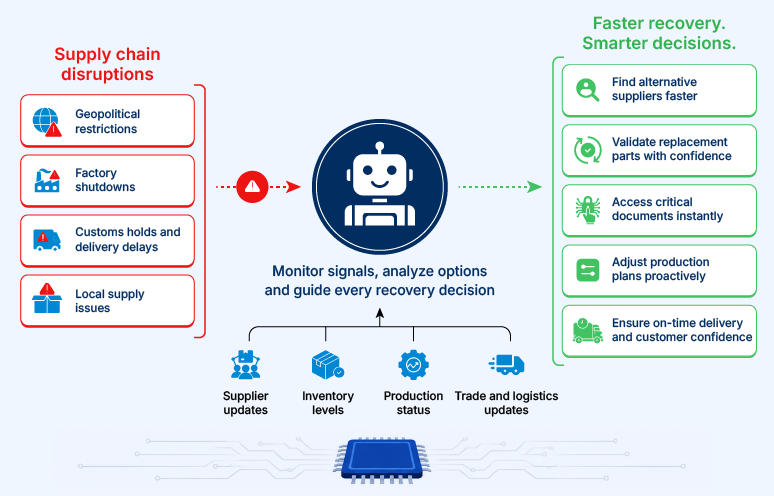
Electronic component manufacturers operate at massive scale, processing more than 1.15 trillion units globally every year. That scale matters because a single product like an electric vehicle depends on up to 3,000 different components, and even one missing microchip or passive component can hold back a much larger assembly operation. AI agents help reduce that risk by tracking supplier, inventory, production, and delivery signals inside enterprise systems. Instead of waiting for teams to manually flag a shortage and search for secondary suppliers, these agents monitor supplier lanes, trade updates, and inventory data as conditions change.
Monitoring those signals only helps when the information reaches the people making the next decision. When a geopolitical restriction, regional factory shutdown, or local supply issue cuts off components at the source, sourcing, engineering, planning, and delivery teams need to understand what changed before the disruption spreads further. Slow manual analysis makes that harder because sourcing, engineering, planning, and customer-facing groups may search separately and respond in isolation. Recovery from these bottlenecks can improve when manufacturers place specialized AI agents where sourcing, validation, documentation, production, and delivery decisions begin to slow.
Let’s look at how these AI agents support supply chain recovery across the connected points where disruption tends to spread.
How do AI agents find your next supplier before procurement runs out of options?
When a supplier delay, customs hold, allocation cut, or regional shutdown affects a required component, procurement needs to know which alternatives are actually usable. The difficulty starts when supplier availability, inventory positions, approved vendor lists, and technical requirements sit in different systems. A buyer can search for options, but the next team still needs to know whether those options meet the product’s sourcing and engineering rules.
Regional supply conditions can change quickly. In the Global Electronics Association’s June 2026 data, none of the surveyed electronics manufacturers in Europe reported rising supplier inventory available to them. Most saw inventory stay flat or decline. APAC looked different, with more than two-fifths of firms reporting increased supplier inventory. For procurement teams, that gap means a component that looks unavailable in one region may still have a sourcing path elsewhere.
A sourcing agent brings those signals into one review path. When availability drops in one region, it can check supplier updates, inventory changes, approved alternates, and logistics constraints before preparing options for procurement review. It can also pass the same technical details to engineering, so component evaluation does not wait for another manual handoff.
Procurement leaders are already moving in this direction. The Hackett Group’s 2026 Procurement Key Issues Study reports that AI-enabled technology is the top transformational force shaping procurement, with many organizations already using agentic AI through pilots or broader deployments. The value is practical: procurement starts with better options, and the next review moves forward with fewer information gaps.
Can AI agents confirm a replacement part is safe to use before your engineers begin?
Finding another source for a constrained component only moves the recovery forward if engineering can confirm that the part will work in the product. A substitute may look available from a sourcing view, but engineers still need to check how it fits the board, performs under operating conditions, and aligns with design and compliance requirements.
Engineering AI agents prepare that review earlier. When procurement shortlists a substitute, the agent checks specifications, pin mapping, package details, lifecycle status, and risk indicators against the original component record. Engineers begin with organized context instead of searching through separate files.
The validation queue grows when those checks wait for procurement to complete every sourcing step. Engineers still need to open datasheets, compare footprints, check electrical and thermal limits, and confirm whether the substitute changes the existing design. AI agents reduce that wait by pulling the technical context into one review packet before the engineer begins the final assessment.
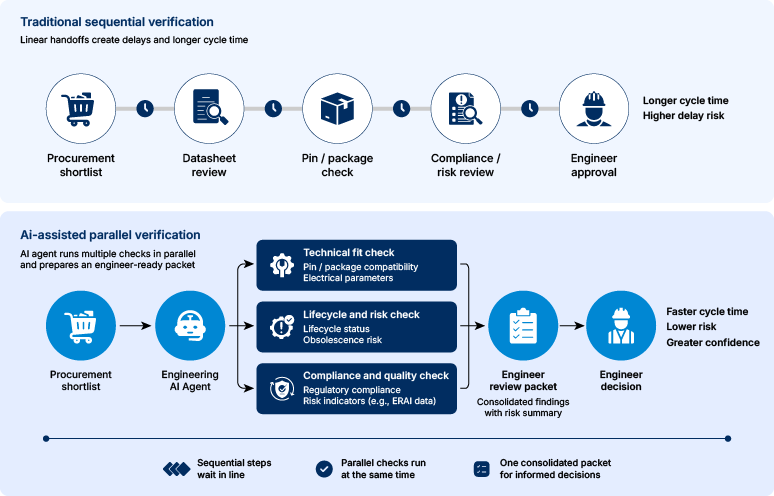
A substitute part may still carry risk even when it is active, available, and technically close to the original component. ERAI’s 2025 reporting shows why: active components accounted for 36.15% of parts reported for suspected counterfeit or nonconforming issues, and 24% of suspect counterfeit parts that underwent electrical testing passed the test. For engineers evaluating a replacement, the check cannot stop at availability or performance alone. AI agents can help prepare a stronger review by checking substitute parts across lifecycle records, supplier history, known-good baselines, and risk indicators before engineers approve the change.
What do AI agents prepare so your documentation is ready before the shipment moves?
A substitute component can clear sourcing and engineering review and still get delayed if its trade documentation is not ready. Compliance teams need to confirm where the material comes from, which rule applies to the shipment, and what evidence must travel with it.
Regulatory AI agents read policy updates against active supplier and shipment records. When a rule affects a component in transit or a planned order, the agent flags the case, prepares the required documentation fields, and sends it to compliance teams for review.
Compliance teams still review the case, but the review becomes stronger when the policy, shipment, and documentation context arrives together. A team may have the right component and supplier, yet an outdated origin record or missing declaration can still delay cargo clearance.
In GEA’s June 2026 report, compliance and documentation ranked among the top two operational areas where manufacturers expect the first practical effects of expanded U.S. policy scrutiny to land. For recovery teams, documentation readiness needs to sit inside the disruption response from the start.
When one component is missing, how do AI agents keep the rest of the line moving?
A production schedule can look stable until one required component misses its arrival window. The line may still have labor, machines, and open capacity, but the planned build cannot move if the required parts are incomplete. Planning teams need a current view of runnable orders, available materials, and the least disruptive schedule change.
A production agent connects live shipment updates with inventory and production data. When an inbound component is delayed, the agent checks whether another build has the required materials ready. It prepares a revised sequence for planners to review, so the plant can shift toward a viable run instead of waiting on the delayed part.
GEA’s June 2026 data shows why that idle time matters. Profit margins recorded a low diffusion index of 96, with more manufacturers reporting declines than improvement. When margins already face pressure, every hour spent waiting for a revised schedule becomes harder to absorb.
Planners still make the scheduling decisions. AI agents reduce the time spent gathering schedule, shipment, and inventory context. With that context ready, planners can decide which production run should move next and which customer commitments need updated timing.
The cost of delay becomes clearer when response time is shown as the trigger for downstream impact. IEOM Society International’s Melbourne 2025 proceedings analyzed manufacturing disruption response and linked faster response with lower disruption cost, reduced expedited freight, and fewer stockout penalties.
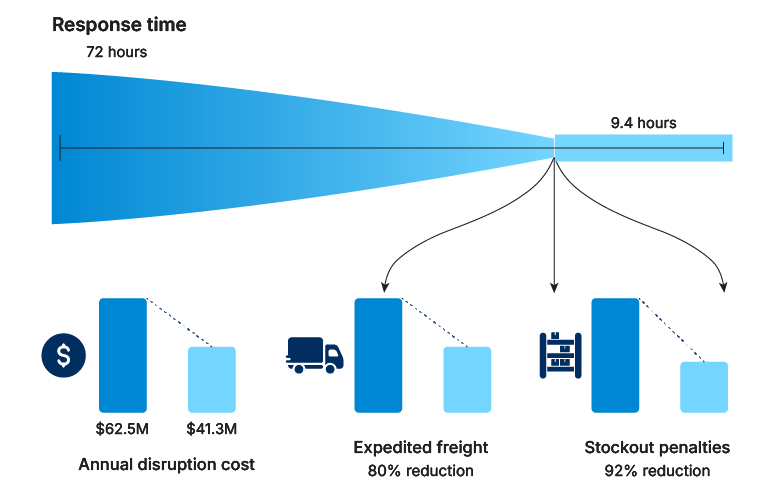
For planning teams, the takeaway is practical: faster response can reduce more than schedule lag. It can also reduce the cost and customer impact that build when recovery decisions move too slowly.
How do AI agents give your customer team a delivery update before the full picture arrives?
A component delay becomes harder to manage when the affected part carries a long replacement timeline. J2 Sourcing’s March 2026 shortage update reported STMicroelectronics lead times of up to 55 weeks for TSX-series and automotive-grade MCUs. Parts like these are difficult to replace because a substitute must match the board, software, qualification, and supplier requirements behind the product. A delay can move from one purchase order to the control board, module, production schedule, and customer delivery plan. An AI agent can prepare that comparison early by checking package fit, pin compatibility, software impact, lifecycle status, and approved supplier constraints before teams spend time pulling those details manually.
Fulfillment AI agents also connect shipment updates, supplier status, and production changes with the systems customer-facing teams use. When a confirmed component delay affects an order, the agent can flag the impacted commitment and prepare an updated delivery view for review.
Customer communication becomes clearer when delivery information comes together before the account team responds. Customer teams may otherwise ask procurement for supplier status while procurement waits for logistics confirmation and planning continues revising the schedule. With a current delivery view available, teams can communicate from the latest recovery plan instead of chasing separate updates.
With that context in place, delivery commitments stay more reliable when they reflect the latest supply and production information, especially when one constrained component can shift several downstream dates at once.
What if AI agents could show you the disruption that started three tiers back?
Immediate disruption response is only one part of resilience. Manufacturers also need to understand where the risk started, especially when a shortage begins several layers below their direct supplier. A specialized substrate, chemical material, connector, or packaging input may affect production before procurement can trace the deeper dependency.
Supply chain mapping changes that view when AI agents connect purchasing history, shipment records, supplier documents, and transaction patterns across the network. As those records come together, the agent can show which materials, suppliers, locations, and production lines may depend on the same sub-tier source.
Tradeverifyd’s 2026 supply chain statistics report states that only 56% of supply chain organizations can trace material origin and batch-level information down to Tier-3 or Tier-4 sources. For electronics manufacturers, that gap matters because one hidden constraint can affect several parts, programs, and delivery commitments.
Gartner named agentic AI among the top supply chain technology trends for 2026 and describes these systems as moving beyond insight toward planning, action, and adaptation. Governance becomes part of the design once agents begin preparing plans and response options. A mapping agent can identify an affected supplier path, show impacted parts and programs, and prepare alternate sourcing scenarios with supporting risk notes. If those scenarios involve supplier replacement, bill-of-material changes, product qualification, or large sourcing commitments, the review should move through defined approval gates.
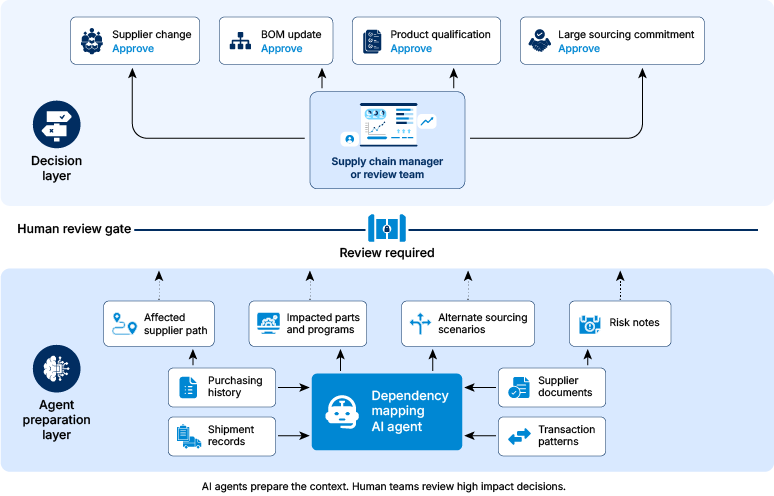
AI Agents can connect supplier paths, affected programs, and alternate sourcing scenarios before the review begins. Human teams then decide which changes should move forward when the decision carries engineering, sourcing, compliance, and business impact.
Find and fix the longest delay before the next disruption does
AI-agent adoption is already moving into core manufacturing workflows, including the supply chain decisions discussed in this article. Google Cloud’s manufacturing ROI report found that 56% of manufacturing executives are actively using AI agents, with 37% having launched more than ten. The next question is practical: where should electronic component manufacturers place agents first?
The practical starting point for AI-agent adoption is finding the longest information wait in the recovery chain. The bottleneck may sit in supplier comparison, substitute validation, compliance documentation, production updates, customer communication, or dependency mapping.
Once that bottleneck is clear, AI agents can prepare the context, flag the risk, and move the next review forward while people still make the final decision.
The balance between agent speed and human decision-making matters because recovery decisions carry technical, commercial, and customer impact. Manufacturers do not need to automate every recovery step at once to see value. They need to place AI agents where delays repeat, where the same information is requested across functions, and where one faster handoff can help the next team act sooner. That is where local speed begins to compound into stronger recovery across sourcing, engineering, compliance, production, and customer commitments.