Share
Share
 ChatGPT
 Perplexity
 Claude
 Grok
Grok
 Google AI Mode
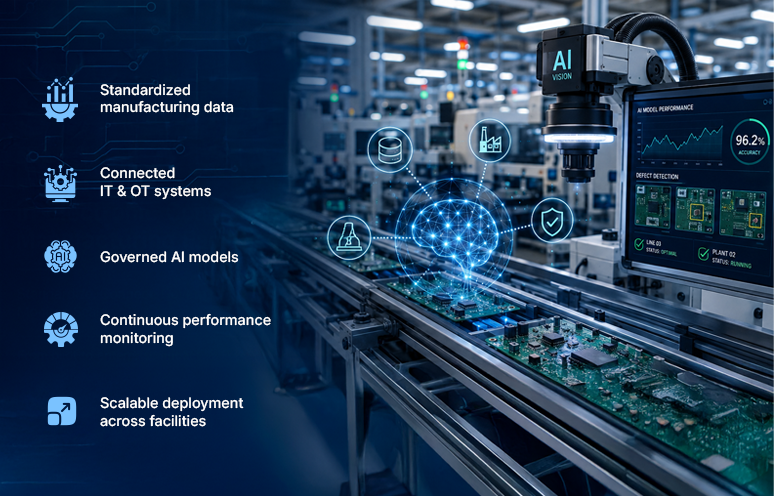
Scaling AI reliably across electronic component manufacturing plants requires standardized manufacturing data, connected production systems, governed AI models, and continuous performance monitoring to deliver consistent results across all production lines and facilities. Manufacturers are under pressure to expand successful AI initiatives across operations, and many struggle to build the operational foundation required for enterprise AI.
Only 2% of manufacturers have fully embedded AI across their operations. Source: McKinsey’s COO100 Survey of manufacturing operating executives.
Nearly two-thirds remain in the exploration or targeted implementation stage. The survey also found that 46% of manufacturing leaders cite limitations in their data and IT/OT infrastructure. The same survey found that most manufacturers lack AI-specific KPIs to govern how their AI deployments perform once live. For an electronic component manufacturer, these gaps take a specific shape.
In this article, we will explore why AI scaling fails, what an enterprise-ready AI deployment looks like, a five-phase framework for scaling AI, and technologies used to scale AI.
What makes AI reliable at scale in electronic component manufacturing?
A reliable AI at scale is built on an operational foundation that enables models to perform consistently across production lines and manufacturing facilities. It must adapt as product designs and production conditions change, without compromising accuracy or operational continuity. Reliable AI scaling can be achieved with standardized manufacturing data, connected IT and OT systems, governed AI models, continuous performance monitoring, and scalable deployment practices. These capabilities enable manufacturers to scale AI reliably while maintaining traceability and operational performance across the enterprise.
Why does AI scaling fails to stay reliable in electronic component manufacturing?
A successful pilot on a particular production line doesn’t work the same way when scaled across the network or plant. Enterprise-wide AI implementations require the model to handle variations in the dataset, feed data quality it doesn’t control, and coexist with other AI tools it was never designed to talk to. Most scaling failures in electronic component manufacturing trace back to one of five points below.
1. AI models lose reliability across product variants
An AI model trained to detect defects on one PCB design learns to reliably identify defects in the pattern of that one board. But it doesn’t have the capability to reliably detect defects for a new BGA package, QFN component, supplier change, or PCB revision, as the AI model has never seen that pattern before. This is why a model that performs reliably for one product needs to be retrained for every new product or upgrade.
2. Manufacturing data becomes inconsistent across plants
Sensors are scheduled differently for different plants. Inspection labels in some plants are typed manually and automated in another. A McKinsey’s COO100 Survey found that 46% of manufacturing operating executives report ongoing limits in their data or IT/OT systems. The report highlighted that inconsistent inspection data acted as a barrier to scaling their AI. An AI model trained on data for one plant performs worse when it’s exposed to poor-quality data from other plants.
3. Disconnected AI systems create operational silos
Most plants run on separate systems for inventory, quality, scheduling, and maintenance. When AI is implemented without connecting these systems, and establishing a unified data flow, AI outputs become difficult to validate and trust. To address this, IPC, the standards body for the electronics manufacturing industry, created IPC-2591 (Connected Factory Exchange), a standard built specifically so machines and systems from different vendors can share data automatically. The result is a collection of smart tools that operate independently without consistent governance or validation.
4. Model performance degrades over time
The patterns an AI model learned during training slowly stop matching reality, reducing model reliability as sourcing shifts, sensors age, and production conditions change. This problem is so evident that Gartner predicts 40% of organizations using AI will adopt dedicated observability tools by 2028 specifically to catch this kind of silent performance drift that affects AI reliability before it causes damage. A model that generates accurate results at launch can lose reliability and accuracy and remain unnoticed until there is a rise in across every production line where it is deployed.
5. Governance becomes difficult as AI deployments grow
Establishing a governance framework for numerous AI models running across several plants is a challenge for electronics manufacturers that should be solved. Grant Thornton’s 2026 AI Impact Survey found that manufacturers use AI in their operations more than any other sector, yet most still can’t govern the new risks that come with it or scale results beyond pilot projects. The same survey found that only 7% of manufacturers have a tested plan for what to do when their AI gets it wrong. AI models remain ungoverned until there is an answer for who owns a model and who’s accountable for its decisions.
What does a reliable, enterprise-ready AI look like in electronic component manufacturing?
An enterprise-ready AI environment for reliable AI scaling should standardize data, govern model lifecycles, establish clear ownership, and continuously monitor AI performance. Without these capabilities, AI becomes difficult to scale reliably. Manufacturers face fragmented AI deployments and inconsistent AI performance across production lines and plants. Here are five things organizations should implement to become ready for reliable AI at scale.
1. Standardized data across every plant
Enterprise AI depends on consistent data collected from MES, ERP, SCADA, AOI, IoT sensors, and quality systems. Standardized data improves model training, enables cross-site scalability, and reduces inconsistent AI predictions.
2. Connected systems
AI should be seamlessly integrated with electronic manufacturing systems rather than keeping it in isolation. Connecting manufacturing systems and quality platforms creates operational data that helps manufacturers make real-time decisions.
3. Active model monitoring in place
Production environments continuously change due to new products, suppliers, and process adjustments. Continuously monitor model accuracy, detect performance drift, retrain models with updated manufacturing data, and manage model versions throughout their lifecycle.
4. Clear ownership for every model
Define policies for model ownership, approval of workflows, audit trails, data access, and human oversight. When you establish strong governance, AI deployment becomes transparent, traceable, and compliant with industry quality and regulatory requirements.
5. Scalable and reliable infrastructure built for reuse
Build AI on a secure, scalable infrastructure that supports edge and cloud deployment, centralized model management, role-based access control, and cybersecurity protection to ensure reliable AI operations across manufacturing facilities.
A five-phase framework for scaling AI across electronic component manufacturing
Scaling AI across the enterprise requires a structured implementation process that aligns data, governance, and operational objectives. The following five-phase framework helps manufacturers scale AI responsibly while maintaining production quality and long-term model performance.
Phase 1: Assess AI maturity and define business priorities
Our AI consultants evaluate your manufacturing processes, data readiness, and existing AI initiatives before recommending use cases. We identify the manufacturing data required for your specific business problem, define measurable KPIs, and build a phased AI implementation roadmap aligned with business priorities.
Phase 2: Build a unified manufacturing data foundation
Our engineers integrate MES, ERP, SCADA, PLM, AOI, IoT, and shop-floor systems using APIs and manufacturing standards. We build secure data pipelines, standardize manufacturing data, and continuously manage incoming production data to provide reliable inputs for AI models.
Phase 3: Develop, validate, and operationalize AI models
Our electronics manufacturing expertise and solutions such as ComponentIQ help you accelerate AI adoption. We integrate AI into existing MES, ERP, quality, and shop-floor systems rather than replacing them, enabling faster enterprise-wide deployment with minimal operational disruption.
Phase 4: Scale AI across production lines and facilities
We expand validated AI models across production lines and manufacturing sites without replacing your existing MES, ERP, or quality systems. Our team integrates AI into current workflows, adapts models to site-specific conditions, and supports enterprise-wide adoption with minimal disruption.
Phase 5: Govern, monitor, and continuously optimize AI
Our experts implement AI observability, governance, and automated monitoring to detect model drift as new production data enters the pipeline. We establish model ownership, retraining workflows, and audit-ready governance to keep AI reliable, scalable, and sustainable across manufacturing operations.
Core components of an enterprise AI architecture
Scaling AI across electronic component manufacturing requires more than high-performing models. Manufacturers need a technology stack that connects production systems, governs AI lifecycles, and ensures consistent performance across facilities. The following technologies form the foundation of a reliable and sustainable enterprise AI environment.
| Components | Purpose | Manufacturing benefit |
|---|---|---|
| Manufacturing data platform | Consolidates data from MES, ERP, PLM, AOI, IoT, and quality systems. | Provides consistent, AI-ready data across plants. |
| Edge AI | Runs AI models directly on production equipment. | Enables real-time inspection and process monitoring with low latency. |
| MLOps | Automates model deployment, monitoring, and retraining. | Keeps AI models accurate as production conditions change. |
| AI observability | Tracks model accuracy, drift, and performance. | Detects issues before they impact yield or quality. |
| Model registry | Manages approved model versions and deployment history. | Maintains consistency and traceability across manufacturing sites. |
| Integration layer (APIs) | Connects AI with MES, ERP, PLM, and CMMS. | Embeds AI insights into existing production workflows. |
| AI governance | Defines policies for model approval, security, and compliance. | Supports responsible, auditable, and compliant AI operations. |
| Cybersecurity | Secures AI infrastructure, models, and manufacturing data. | Protects production systems and intellectual property. |
Make your next phase of AI adoption responsible, scalable, and sustainable
More than 70% of companies investing in AI never move beyond the pilot stage, according to the World Economic Forum’s Global Lighthouse Network. The difference isn’t the AI model itself, but rather the operational foundation supporting it.
Manufacturers that standardize manufacturing data, connect production systems, govern AI throughout its lifecycle, and continuously monitor model performance are better positioned to scale AI across production lines and facilities with confidence. As AI becomes an integral part of electronics manufacturing, success will be defined not by how fast a company adopts it but how reliably AI improves quality, productivity, and operational resilience across the enterprise.