Share
Share
 ChatGPT
 Perplexity
 Claude
 Grok
Grok
 Google AI Mode
Fortune Global 500 companies lose nearly $1.4 trillion annually due to unplanned downtime. By 2033, as many as 1.9 million roles could go unfilled if the skills and applicant gaps aren’t addressed. And the average operational technology (OT) security breach now costs a manufacturer $4.56 million. All these numbers describe a plant that is exposed to cost, labor, and security at once, with no single system watching all three. Most manufacturing leaders treat cost, labor, and security as three separate problems. But they are symptoms of the same underlying gap, poor visibility into operations.
This is why the leading manufacturers that are building operations systems today aren’t buying a maintenance tool, a training platform, or a security tool separately. They’re building one operational layer that absorbs cost, labor, and security at the same time. If a fix that only solves cost while leaving labor and security exposed isn’t a fix. It’s a deferral.
Where does an operations system absorb pressure?
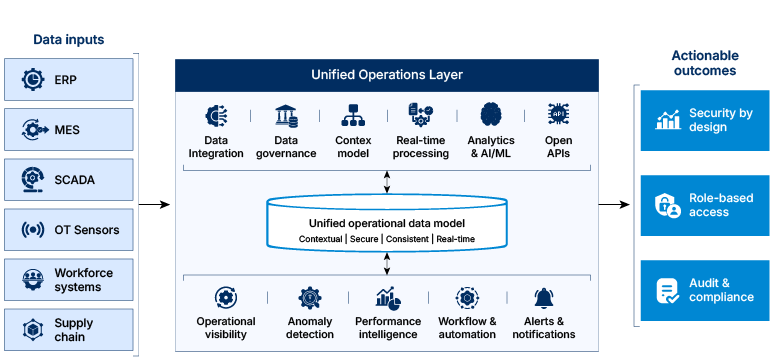
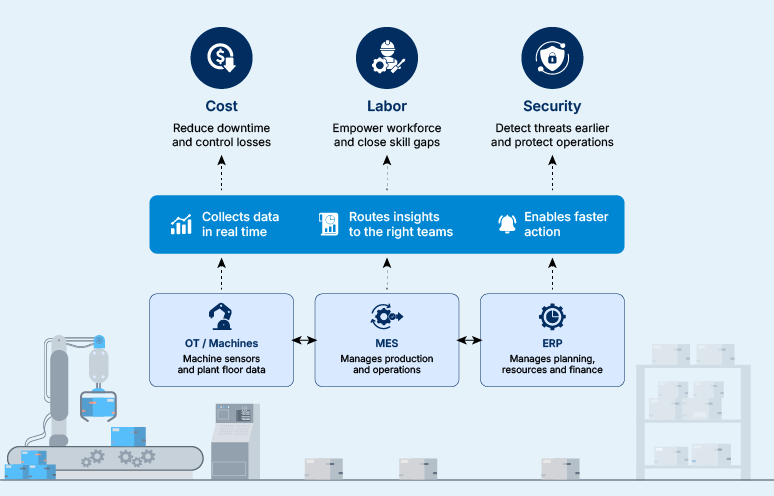
An operations system absorbs pressure at three points: the machine sensors on the floor, the MES that runs production, and the ERP that manages planning and resources. It sits as a data layer between the machines on the factory floor and the people who make decisions. It collects information from machine sensors, MES, and ERP, and routes what it finds to teams such as maintenance, scheduling, or security that need it first. The table below shows what that looks like at each of the three pressure points.
| Pressure point | Where the operations system intervenes | What changes for the plant |
|---|---|---|
| Cost | Connects machine-level sensor data to maintenance and production planning in real time, so a developing fault is flagged before it causes a stoppage | Downtime shifts from reactive (fix it after it fails) to predictive (fix it before it fails), cutting both the frequency and length of unplanned stops |
| Labor | Surfaces standard work instructions, machine history, and troubleshooting guidance directly at the point of work, instead of in a separate manual or a senior technician’s memory | New and cross-trained operators reach competency faster, and the plant depends less on any single person’s tenure to keep a line running |
| Security | Gives IT and OT teams one shared view of what’s connected to the network and how it’s behaving, instead of two teams working from two different tools | Unusual activity on a machine or controller gets flagged and investigated before it can spread, instead of being discovered after production has already stopped |
Building an operations system requires connecting MES, the ERP, or the OT infrastructure that is running the plant. An operations system sits above these three systems, which enables them to share data in real time. For instance, a signal from the plant floor alerts maintenance, staffing, and security teams at the same time to take actionable decisions. This approach avoids the machine signal arriving in three separate systems on three separate schedules.
Challenges that show up when operations systems stay fragmented
When systems are not connected, problems are identified late and cost more to fix. Here’s what that looks like across cost, labor, security, and data.
1. Cost overruns
When maintenance, production, and finance data are stored in different systems, cost overruns become visible after monthly or quarterly reporting. As a result, businesses often resort to broad cost-cutting measures that can affect both efficient and underperforming operations.
2. Disconnected systems
Experienced employees often switch between numerous applications to compare data and gather information. Organizations that are heavily dependent on experienced employees who know how to navigate disconnected systems risk losing that knowledge when those employees retire. Such manual effort reduces productivity, slows decision-making, and increases the risk of errors.
3. Undetected threats
When IT and operational technology (OT) systems are not connected, cyber threats can remain undetected for weeks. According to Dragos’ 2026 OT/ICS Cybersecurity Report, organizations with complete OT visibility detect threats much faster than those with limited visibility. Faster detection helps prevent operational disruptions and reduces the impact of cyber incidents.
4. Inconsistent data
When systems such as MES and ERP show inconsistent data, teams spend valuable time verifying which data is correct before taking action. This delays decision-making and reduces operational agility. Reliable operations require a single, consistent view of production, maintenance, and business data.
Best practices for building a resilient operations system
Building a resilient operations system is about getting the fundamentals right first and following the right implementation sequence, so each step creates a strong base for the next one.
1. Start with a single source of truth before adding new tools
A resilient operations system absorbs cost, labor, and security pressure when it’s connected with data. When every team works from the same operational information, duplicate work, manual reporting, and data inconsistencies are eliminated, reducing operational costs. Engineers spend less time searching for information and more time resolving production issues, helping teams do more with limited resources. A unified operational view also makes it easier to detect equipment anomalies and unusual system activity early, enabling faster responses that reduce the impact of operational and cybersecurity incidents.
2. Treat OT visibility as a prerequisite
Start by creating an inventory of operational technology assets, including PLCs, HMIs, industrial controllers, sensors, and connected equipment. Map how they communicate with MES, ERP, and other OT systems. Continuously monitor their activity to establish a baseline of operations. Once visibility is established, apply zero-trust principles by authenticating every user, device, and application before granting access and segmenting OT networks to limit lateral movement. This approach helps detect unauthorized devices, abnormal communication patterns, and potential threats early, reducing the risk of production disruptions and cyber incidents.
3. Keep a human in the loop for cost and security decisions
Manufacturers should implement AI to identify production risks, cost-saving opportunities, and potential security threats. But high-impact decisions should be taken by humans. Experienced managers should validate recommendations generated through automated tools. These decisions affect production schedules, asset shutdowns, supplier changes, or cybersecurity responses. Combining AI-driven insights with human judgment reduces operational risk and improves decision quality.
A practical path to building an operations system, stage by stage
Building an operational system that absorbs cost pressure, workforce shortage, and security risks is a gradual process. Manufacturers with existing data and technology should focus on integrating these systems. Validate the outcome at each stage and then scale it based on results.
Stage 1: Start with one high-impact challenge
The first step should be to identify a single issue such as unplanned downtime, quality gaps, or production delays that have a significant impact on the business. Define problems clearly as it makes it easier to measure progress. As you solve one problem, you can expand the system to more lines or plants.
Stage 2: Consolidate existing operational data before investing in new tools
According to McKinsey & Company, manufacturers that adopt connected and scalable technology instead of isolated systems are better positioned to expand their digital manufacturing. Manufacturers that collect data from ERP, MES, SCADA, maintenance, quality, and OT systems should connect and standardize their existing data to create a consistent operational view before introducing additional software. A reliable data foundation ensures that generated information is accurate. And thus, improves decision-making.
Stage 3: Pilot on one line before scaling further
Test the approach using a small pilot project before scaling it across the organization. Manufacturers can identify how the integration performs through this small project. It allows teams to identify operational challenges and measure outcomes with less disruption. Pilot projects reduce implementation risk and improve adoption approaches during large rollouts.
Stage 4: Refine the system using measurable operational outcomes
Evaluate the pilot project with clear metrics such as production throughput and maintenance response time. Use this insight to identify gaps and improve workflows before scaling the solution. Continuous improvement ensures systems address real-world operational needs.
Stage 5: Expand gradually while continuously monitoring performance
Scale the system gradually and in phases across plants and business units while continuously monitoring performance and security posture. A phased rollout enables manufacturers to adapt to the changing environment without disrupting the operational process.
Categories of systems and tools for absorbing operational pressure
These four categories cover most of what manufacturers reach for when building an operational system.
| System / tool category | How it helps reduce cost challenges | How it helps address labor challenges | How it strengthens security |
|---|---|---|---|
| Manufacturing data platforms (Industrial DataOps platforms, unified operations platforms, data historians) | Connect ERP, MES, SCADA, and quality data to improve cost visibility, eliminate manual reporting, and identify production inefficiencies earlier. | Reduce time spent collecting and reconciling data across systems so engineers can focus on production improvement. | Create a centralized operational view that helps identify abnormal events and supports faster incident response. |
| OT visibility and cybersecurity platforms (OT asset discovery, network monitoring, zero-trust access, network segmentation) | Minimize production losses by detecting operational issues before they lead to downtime. | Automate OT asset inventory and monitoring, reducing manual effort for operations and security teams. | Provide continuous asset monitoring, enforce zero-trust architecture, and use network segmentation to detect threats early and prevent them from spreading across industrial networks. |
| Workforce management and knowledge-capture tools (Digital work instructions, connected worker platforms, skills management systems) | Improve productivity by standardizing work processes and reducing errors and rework. | Capture institutional knowledge, accelerate employee onboarding, assign work based on skills, and reduce dependence on experienced operators. | Control access to operational procedures through role-based permissions while ensuring critical knowledge remains available even as workforce changes occur. |
| Digital twin and predictive maintenance platforms. Gartner projects over 40% of large companies will adopt digital twins by 2027 | Simulate production scenarios, optimize schedules, reduce unplanned downtime, and extend equipment life to lower operating costs. | Help maintenance teams prioritize work, reduce emergency repairs, and improve planning using predictive insights. | Continuously monitor asset health, detect abnormal operating conditions, and reduce the risk of operational disruptions caused by equipment failures or cyber incidents. |
Connected operations turn pressure into performance
Building an operations system that absorbs cost pressure, labor shortages, and security risks begins with strengthening the operational foundation rather than introducing more technology. The greatest value comes from connecting existing systems, creating a trusted operational view, and improving decisions through consistent, contextualized data.
Rockwell Automation saw a 33% increase in labor efficiency and a 50% reduction in training time after connecting real-time data across one facility.
Manufacturers that treat operational data as a shared business asset, rather than information owned by individual functions, will be better positioned to manage cost pressures, workforce constraints, and emerging security risks as manufacturing continues to evolve.