Share
Share
 ChatGPT
 Perplexity
 Claude
 Grok
Grok
 Google AI Mode
For years, manufacturing leaders invested in technology to close the performance gap between what their operations could deliver and what the business demanded. ERP modernizations, analytics platforms, automation initiatives, and MES upgrades defined a decade of investment, guided by a consistent logic: better tools would produce better operations.
The investment logic from a decade ago still holds, but the environment it was designed for has changed considerably.
Fewer discussions now start with which platform to buy. Most start with how work actually gets done, where it breaks down, and whether the organization is built to act on what the technology makes possible.
AI has changed what it takes to build software. Applications that once required months for planning and specialist teams for execution can now be deployed in a fraction of that time. Dashboards go live in days, copilots get configured without the overhead that once made them cost-prohibitive, and the barrier to building has dropped.
Most organizations have not yet embedded AI deeply enough into their workflows and processes to realize material business impact.
McKinsey, State of AI 2025
Access to the right tools is no longer the source of differentiation. How well an organization’s operations are structured to absorb and sustain them is where the difference is made.
Yet many manufacturers are discovering that faster software does not produce faster operations.
New tools are implemented, but the workflows underneath them remain unchanged. Approval chains still slow decisions. Data moves between teams manually, and handoffs between engineering and production still create delays that compound across the production cycle. The technology is ready before the organization is.
When access to technology stops creating advantage
For most of the last decade, access to enterprise-grade technology was a source of competitive separation.. Building sophisticated digital systems required significant capital, long development cycles, and specialist teams that only the largest organizations could sustain. The manufacturers who could afford it pulled ahead. The rest fell behind.
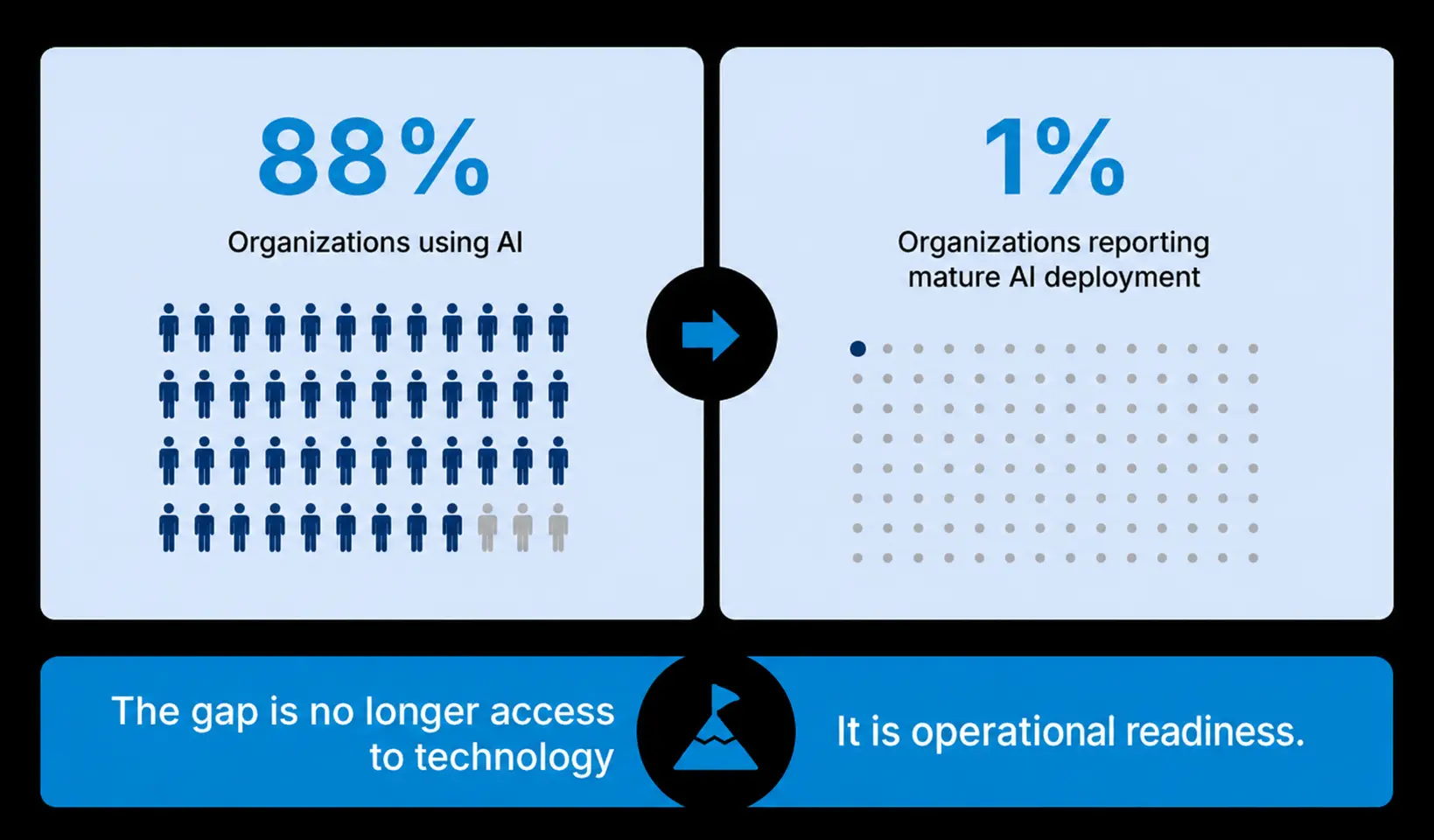
AI has shifted that dynamic. The cost and time required to build and deploy digital solutions have dropped across the board. According to McKinsey’s 2025 State of AI survey, 88% of organizations now use AI in at least one business function, up from 78% the year prior. Adoption is no longer confined to early movers. It is the business norm.
Yet widespread adoption has not translated into widespread value creation. McKinsey’s Superagency in the Workplace research found that only 1% of leaders describe their organizations as mature in AI deployment, where AI is fully integrated into workflows and delivering substantial business outcomes. The gap between experimentation and operational impact remains significant, and it is not a technology gap.
The economics of building have changed. What once required a dedicated development team and a multi-month delivery timeline can now be initiated with smaller teams, shorter cycles, and a fraction of the previous capital requirement. The barrier that once separated technology leaders from the rest of the field has lowered substantially.
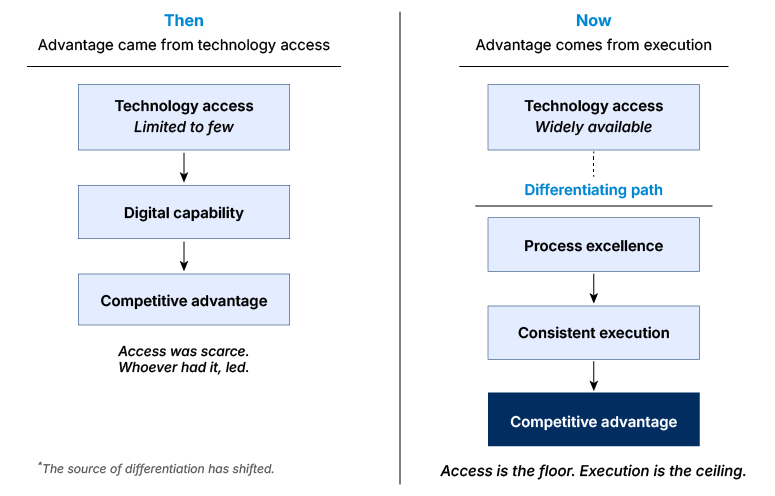
A more pressing question now faces manufacturers investing in AI: If access to technology no longer creates separation, what does?
The answer is execution. Specifically, how well an organization’s operations, processes, and people are structured to absorb new technology, apply it consistently, and generate value from it at scale. Technology has become the starting point. Execution after deployment is where the gap between organizations widens.
Same tools, different outcomes
Consider two manufacturers operating in the same sector with comparable budgets and similar technology investments. Both run modern ERP systems, cloud-based analytics platforms, and automation across key production areas. Both are actively adopting AI tools. On paper, their technology foundations are nearly identical.
The results are not.
One is improving throughput, reducing defect rates, and hitting shorter launch timelines. The other is watching pilots stall before full deployment, absorbing technology investment, and seeing incremental gains at best. Same stack. Measurably different outcomes.
So where does the gap come from?
In many manufacturing engagements, the discussion no longer starts with technology selection. It starts with understanding how information moves across the operation, where approvals slow things down, and which workflows create the most friction. Technology enters the conversation shortly afterward, but rarely as the first question. What surfaces first is almost always process.
McKinsey’s 2025 State of AI research confirms the pattern. AI high performers are nearly three times more likely to fundamentally redesign how work gets done when implementing AI. The majority of organizations deploy new tools onto workflows that remain largely unchanged. The high performers change the process alongside the technology, or before it. Redesigning the workflow, not just deploying the tool, is where the performance gap originates.
No ERP, analytics platform, or AI tool can perform better than the process it is running on. Technology executes a process. It does not replace one.
The technology gap between manufacturers is narrowing. The process gap is not. Understanding where that gap costs the most requires looking at something most technology initiatives never touch: the spaces between systems, where decisions slow down, handoffs break, and value quietly leaks out of the operation.
Where manufacturers lose value today
What McKinsey’s 2026 research on AI in operations makes clear is that the real productivity lift from AI will come from automating coordination, specifically handoffs, approvals, and escalation, rather than individual tasks. Most technology deployments do not touch coordination. They improve what happens inside systems. The losses that persist in manufacturing operations accumulate in the spaces between them, in the gaps between teams, and in the moments where a decision that should take hours takes days instead. Losses of this kind do not show up in error logs or trigger alerts. They continue, largely invisible, long after a new platform goes live.
Five coordination gaps account for the majority of value leakage in manufacturing operations.
| Transition stage | Friction point | Consequence |
|---|---|---|
| Engineering to Production | Disconnected design updates |
|
| Production to Quality | Stale planning data |
|
| Quality to Supply chain | Delayed quality flags |
|
| Supply chain to Customer | Fragmented supplier coordination |
|
| Across the operation | Manual escalation loops |
|
None of these are technology problems. Each one is a process that was never designed to move at the speed the business now requires. Faster tools deployed into these gaps do not resolve them. They make the consequences arrive sooner.
The new manufacturing value equation
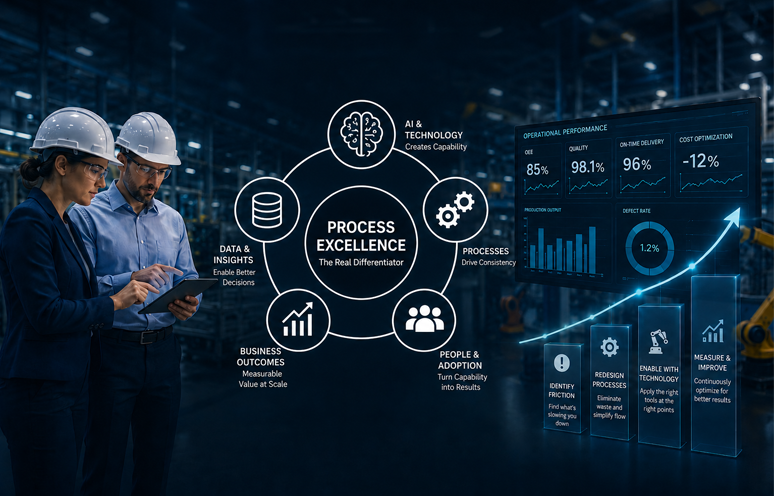
Understanding why similar technology investments produce different results requires a different lens. Technology, process, and adoption are not independent variables. They are multipliers. Value does not accumulate by improving one while leaving the others unchanged. All three need to move together.
Technology creates capability: the ability to collect data, automate decisions, surface insights, and execute at speed.
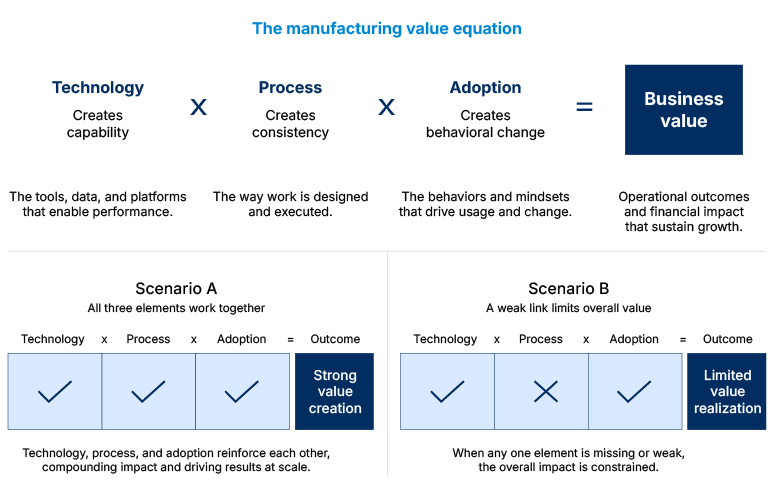
Process creates consistency: the conditions under which that capability gets applied reliably, at the right points, by the right people. Adoption converts both into business outcomes: the actual behavioural and operational change that determines whether capability and consistency translate into results the business can measure.
A strong technology investment paired with a fragmented process does not produce moderate returns. It produces poor ones, because the technology amplifies whatever the process does, including its failures. Manufacturers who are not seeing returns from their technology investments rarely have a technology problem. They have a process problem that a modern stack has made impossible to ignore.
Strengthening technology without addressing process is not a partial solution. It is an expensive way to accelerate an existing constraint.
What process excellence looks like in an AI-enabled manufacturing environment
The manufacturers creating the most value from AI rarely look dramatically different from the outside. They run many of the same systems as their peers. They have invested in similar platforms and tools. The difference becomes visible only when you look at how decisions actually move through the organization, how information gets from one team to the next, and whether the process was designed to support the speed the business now requires.
Process excellence is visible in how work actually moves through an organization: whether decisions reach the right people fast enough, whether information crosses team boundaries without friction, and whether the operation is structured to keep pace with what the business needs.
According to IDC’s 2025 AI MaturityScape research, the most advanced organizations do not treat AI as a discrete tool deployed against specific problems. They treat it as an enabler of enterprise-wide transformation. Reframing maturity this way changes what it actually means to measure it. Maturity is not counted in the number of tools deployed. It is measured in how deeply those tools are integrated into the way work flows.
In manufacturing organizations generating the most value from their technology, five characteristics tend to appear together.
Can your operational managers make decisions without waiting for approval?
In organizations where process excellence is real, frontline teams have access to current, accurate information and the authority to act on it. Decisions do not travel upward to resolve what the data already makes clear.
Does information move between your systems without manual intervention?
When one part of the operation updates, the parts that depend on it see it automatically. Data does not require extraction, translation, or re-entry to cross a team boundary.
Are your production, quality, and supply chain teams working from the same data?
There is one source, it is current, and no one is reconciling conflicting reports before a decision can be made.
Do problems surface in time to be addressed, or after they have already cascaded?
Early exception detection is a design characteristic of the process. It does not depend on individual vigilance or the right person happening to notice.
Does process improvement occur continuously, or only when a major initiative forces it?
Small improvements get identified, tested, and embedded regularly because the organization is structured to allow it, not because a project team was assembled to make it happen.
An organization either has these qualities or it does not, and the gap between the two shows up directly in what the technology delivers.
Building process excellence alongside AI adoption
Manufacturers that create the most value from AI do not start by redesigning everything. They start by understanding what is actually slowing them down.
The most consistent pattern among organizations that have successfully improved both their processes and their technology outcomes is a phased approach. Phased not in the sense of delaying progress, but in the sense of moving deliberately: identifying where friction costs the most, addressing it specifically, measuring what changes, and then expanding from there.
The starting point is always the current process, not the documented version, but the actual one. Where do decisions slow down? Where does information stop moving cleanly between teams? Where do exceptions consume time that should be going toward something else? The answers to these questions determine where improvement will produce the most immediate and measurable impact.
From that understanding, improvement targets become specific rather than general:
Instead of “improve quality”: surface quality flags before the finishing stage.
Instead of “speed up planning”: reduce the lag between production actuals and the next planning cycle.
Specific targets produce measurable outcomes. Measurable outcomes build the organizational confidence to move to the next use case.
Technology and process improvement move through this cycle together. Each process improvement creates better conditions for the technology to perform. Each technology capability creates new opportunities to improve the process further. The organizations pulling ahead have recognized this as a continuous loop, not a one-time project with a defined end state.
Process excellence is not a destination. It is the operating condition that determines how much value every future technology investment can deliver.
Technology got you here. Process determines what comes next.
The manufacturers generating the most value from AI are not the ones with the most advanced technology. They are the ones that gave equal weight to process and technology, moving forward with each as part of the other. Narrowing the gap between process maturity and technology capability is where the performance difference begins.
As software adoption becomes faster and more accessible, the differentiator is no longer the stack. It is the process the stack is running on. Manufacturers that redesign how decisions get made, how information moves, and how improvement takes hold will produce stronger returns than those that simply add more tools.
The question is no longer whether to invest in technology. It is whether the operations underneath it are ready to absorb what it makes possible. Organizations that align process and technology today are establishing the operating model their competitors will spend years trying to catch up with.