Share
Share

 ChatGPT
 Perplexity
 Claude
 Grok
Grok
 Google AI Mode
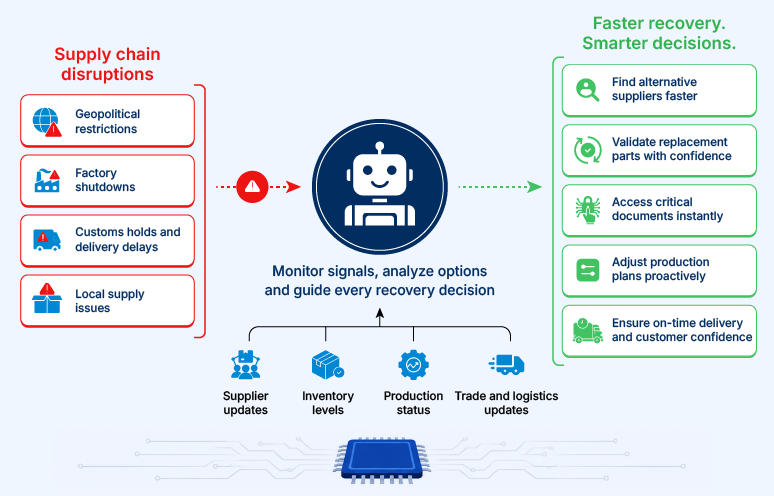
Aftermarket service operations run on a sequence of decisions made simultaneously across disconnected systems: which asset gets attention first, which customer gets priority, which technician gets dispatched, which warranty claim moves forward. Agentic AI is changing how those decisions get made, and the manufacturers deploying it now are restructuring the economics of their service operations as a result.
The manufacturers building this capability are constructing product excellence and service excellence in parallel. The service contracts, parts supply, warranty programs, and maintenance agreements tied to manufactured assets in the field have become the highest-margin segment of the industrial business and the second front where competitive separation is now building.
Manufacturers already applying agentic AI on the production side are extending that capability into service, rewiring how the aftermarket runs from the inside. The gap between those leading this shift and those still operating reactively is widening on both fronts simultaneously.
Why the traditional service model is hitting a ceiling
The reactive service chain has a logic to it. A signal arrives from a technician’s report, a customer complaint, or a scheduled inspection, and the organization responds. Parts get sourced, a visit gets scheduled, and a warranty claim enters a review queue. At limited scale, human coordination holds this together because the people inside the model carry the operational knowledge the systems do not.
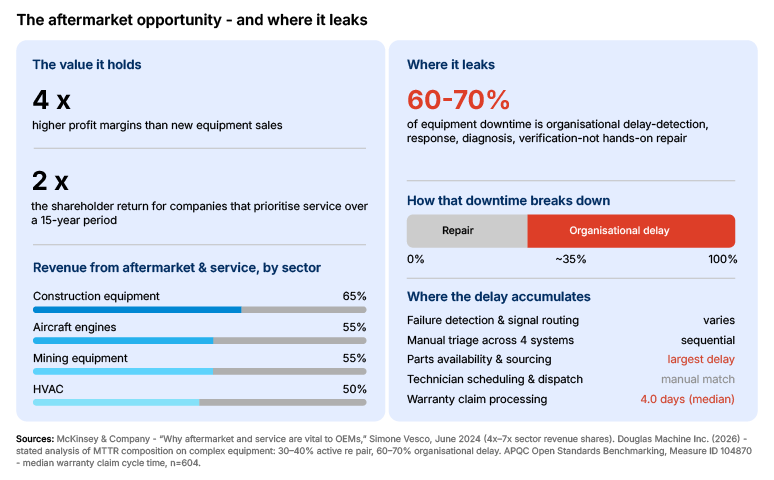
The constraint is architectural. Every decision in the reactive chain sits with a service coordinator weighing competing priorities, such as customer urgency, technician availability, and parts requests, across systems that were never built to share information. When an issue enters the service chain, inventory data has to be pulled from the ERP, the field schedule checked on a separate platform, SLA terms located in a contract management system, and warranty status retrieved from yet another channel. Each step depends on that same coordinator manually bridging the gap between systems that hold partial pieces of the same picture.
As the installed base grows, that model reaches a hard limit. The volume of concurrent decisions increases faster than the people available to handle them. A team managing 500 assets cannot scale to 2,000 under the same operating model. Service visits get delayed, first-time-fix rates fall, and parts shortages that were occasional disruptions become a regular cost of running the operation. The architecture that worked at one scale becomes the constraint at the next.
Four decisions agentic AI is already changing
The shift from reactive to connected service starts at specific decision points where autonomous action produces the clearest gains. Four decisions are already being reshaped across industrial manufacturing: detecting wear before the equipment reports it, adjusting service commitments to reflect actual use, validating warranty claims from operating history, and coordinating parts, inventory, scheduling, and logistics as one connected system. Each produces value independently. What happens when all four operate together is where the larger shift becomes visible.
1. Detecting wear before the equipment reports it
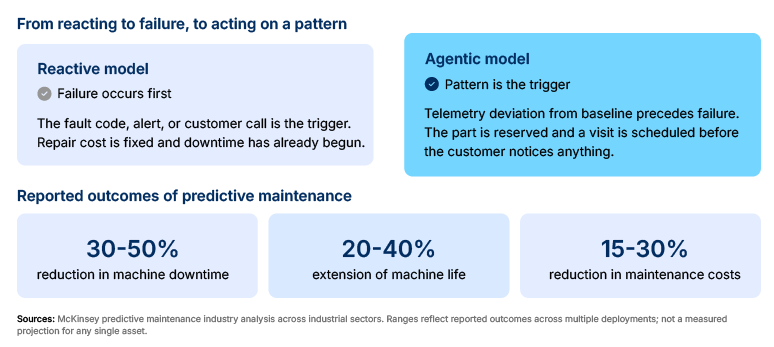
Most service organizations learn about equipment wear when a fault code fires or a customer calls. By that point, the failure mode is established, the repair cost is fixed, and the customer has already experienced disruption.
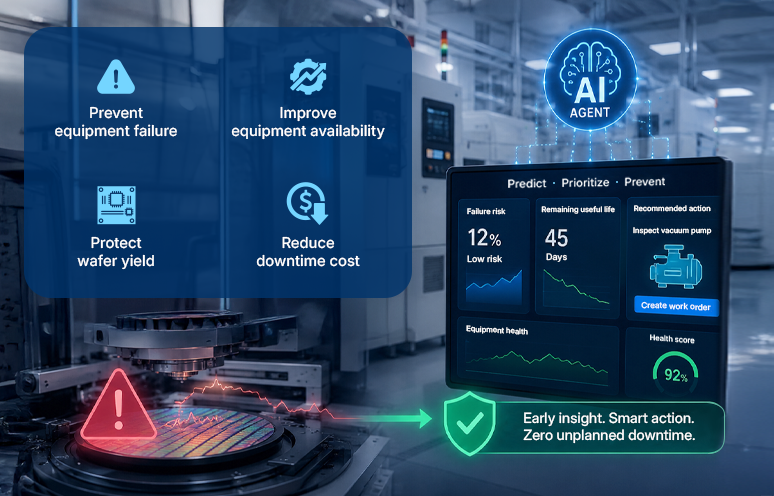
Agentic AI moves detection upstream by analyzing telemetry continuously, including load cycles, operating temperatures, vibration patterns, and deviation from baseline performance, identifying components that show early signs of wear before failure occurs. Once wear is confirmed, the agent checks parts availability, reserves the required component, schedules a service visit at the next appropriate window, and prepares an action plan for the service team. The customer receives a proactive maintenance communication. The manufacturer captures a billable service event that would not have existed under the reactive model.
2. Adjusting service commitments to reflect actual use
A service agreement written at the time of sale reflects expected conditions at that moment. They rarely get updated when those conditions change. Consider a bulldozer contracted for standard construction work that moves into a quarry operation running three shifts a day. The contract remains as it was. The wear rate, failure probability, and cost exposure the manufacturer is now absorbing do not.
An agentic monitoring layer closes that gap by evaluating actual operating conditions against contracted parameters continuously. When utilization significantly exceeds the contracted baseline, the agent validates the pattern against equipment data, calculates the revised risk profile, and surfaces a service tier recommendation with supporting evidence for human review. Once approved, the adjustment takes minutes. The manufacturer recovers margin that should have been priced into the original contract, and the customer receives a service tier that reflects the actual demands being placed on the equipment.
3. Validating warranty claims from operating history
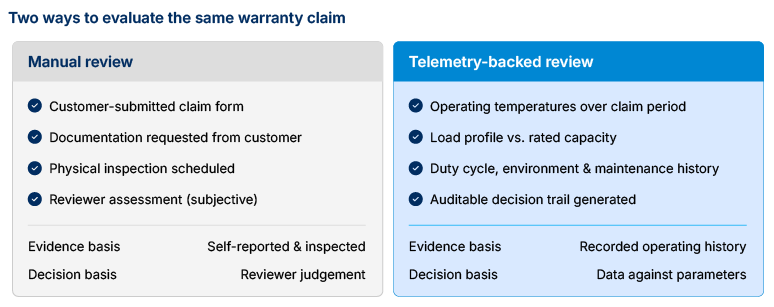
Most organizations process warranty claims the same way: a claim arrives, documentation is requested from the customer, a physical inspection may be scheduled, and a reviewer makes a judgment call based on what was submitted. According to APQC benchmarking data across 604 organizations, the median time from submission to decision is four days. The process is slow because the evidence it depends on is incomplete, reflecting what the customer reported rather than what the equipment recorded.
When an asset has been generating continuous telemetry, the evidentiary basis changes entirely. The agent starts with the equipment’s own operating history: temperatures over the claim period, load profiles against rated capacity, and usage patterns in the weeks before the reported failure. It produces an auditable decision trail documenting exactly which parameters were evaluated and what the data showed. Because the evidence is consistent and machine-generated, decisions become more defensible and faster to reach. When patterns emerge across multiple claims tied to the same component or operating condition, they become visible at scale and feed directly into product development and risk pricing decisions, extending the value of the warranty function well beyond claims resolution.
4. Coordinating parts, inventory, scheduling, and logistics as one system
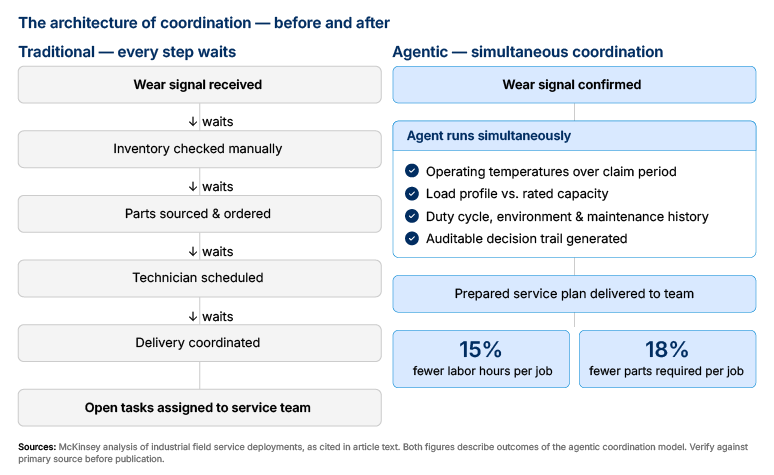
In a conventional service operation, a confirmed wear signal triggers a sequential coordination chain. Inventory is checked, parts are sourced, a technician is scheduled, delivery is arranged, with each step waiting for the previous one to complete. In a large operation managing hundreds of concurrent service events, those handoffs compound into a throughput constraint that additional headcount alone does not resolve.
An agentic coordination layer runs those steps simultaneously, checking depot inventory across all locations while identifying the nearest qualified technician. Parts delivery is timed to arrive before the service visit, and the customer’s SLA status and service record update in the same sequence. The handoff overhead built into the conventional service chain is removed from the equation entirely, and the service team gains capacity without expanding headcount.
When the decisions start talking to each other
Each of the four capabilities above produces measurable value independently. Connected, they produce something categorically different.
Consider a single service event across a linked system. A wear pattern confirmed in the telemetry stream updates the asset’s risk profile. The SLA monitoring layer reads that update and reassesses service priority. The adjusted priority feeds the coordination layer, which sequences technician availability, parts delivery, and logistics timing simultaneously. When the visit is completed, outcome data feeds back into the wear detection model, improving prediction accuracy on that asset class. The warranty layer draws on the same equipment history if a claim follows.
In connected deployments, accuracy improves because each service interaction generates structured data that informs the next decision. Over time, the system develops a clearer picture of which failure modes precede which outcomes, which parts are required for which asset types, and which situations can be resolved remotely. The longer the system operates across a connected installed base, the more precisely it performs.
Most aftermarket organizations have sufficient data. The gap is not in what exists but in how it connects. Telemetry that is not linked to service records cannot inform maintenance scheduling. Inventory levels that are invisible to the scheduling layer cannot prevent parts mismatches. Warranty submissions that arrive separately from operating history cannot be evaluated against what the equipment actually experienced. Each source has value on its own. Routed into a connected service chain, they create the feedback architecture that makes the system more accurate with each interaction rather than plateauing at its initial configuration. The same connection extends upstream into production. Wear and parts demand aggregated across the installed base give manufacturers a clearer signal for how many replacement components to produce, turning field data into a planning input rather than a reactive order.
The manufacturers building that architecture now are constructing a competitive advantage that widens with use. Prediction models improve with each completed service event, and the gap between them and organizations still running disconnected systems grows in one direction.
Mapping the decisions before mapping the technology
Most organizations approaching agentic AI in aftermarket services begin by evaluating platforms. The sequence feels logical but consistently produces the wrong foundation. Organizations that deploy successfully begin with their decision architecture instead.
Every aftermarket operation is already making the four decisions described above. The open question is where they live, who owns them, what data they draw on, and which are suited to autonomous action versus which require human judgment to stay in the loop. Clarifying that picture before selecting any technology grounds platform requirements in operational reality rather than general capability comparisons.
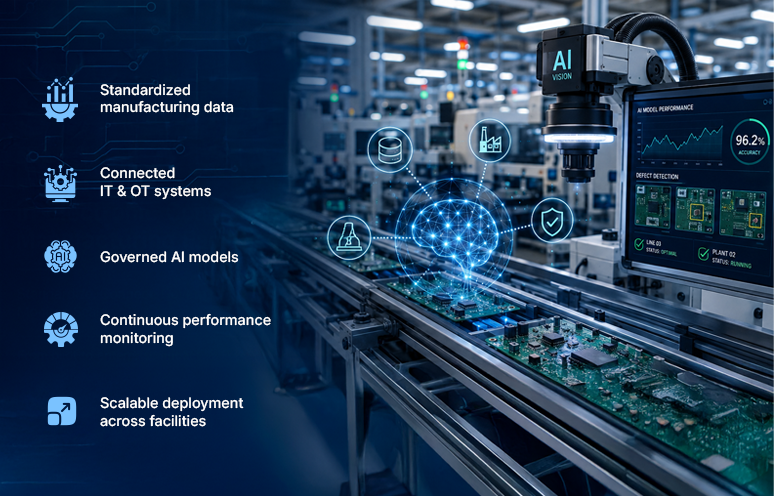
The data most organizations need already exists across their ERP, field service platform, contract management system, and warranty portal. The missing element is connection between those sources. Identifying which connections each decision point requires turns an abstract integration challenge into a specific, sequenced set of prerequisites.
The persona layer matters equally. Each decision point has a human owner today: a coordinator, a warranty analyst, a dispatch scheduler, a service planner. Those people carry knowledge about exceptions, edge cases, and risk thresholds that no system specification captures automatically. Surfacing that knowledge before deployment, rather than discovering its absence afterward, is what separates implementations that scale from those that stall at the pilot stage.
Build the decision architecture that will capture the aftermarket advantage
Wear signals get reviewed, service priorities get set, warranty claims move through queues, and parts and technicians get coordinated, every day, inside every aftermarket organization. The gap between organizations that lead on aftermarket margin and those that follow is not in whether these decisions happen. It is in how they are made, on what data, and whether they inform each other or operate in isolation.
Agentic AI does not introduce new decisions into the service chain. It rewires how the ones already there get made, connecting them across systems and creating a feedback loop where each interaction improves the accuracy of the next. Manufacturers investing in that rewiring now are closing the gap between the margin their installed base can generate and what their operation is currently equipped to capture.
The starting point is not a platform selection. It is a clear-eyed map of where decisions live today, who owns them, and where autonomous action is appropriate. Organizations that begin there build something that scales.
The aftermarket advantage has always been available. The architecture to capture it is what separates the manufacturers who hold it from those who watch it narrow.