How Softweb Solutions eliminated days of manual invoice work for a global manufacturer
Our client is a large OEM with 5000+ products in their portfolio. They wanted a solution that could speed up their chip design process without compromising quality. We built a GenAI solution that helps them test design variations and then optimize them without manual efforts. They achieved 81% higher design accuracy and 95% improved design quality, which resulted in 42% faster time-to-market.
 Industry: Manufacturing
  Business type: Large enterprise
  Services: Generative AI solution
 Technology: Python, LangChain, Azure Cloud, and LLM
Client profile
Our client is a USA-based enterprise OEM that specializes in semiconductor and electronics manufacturing. They manage a portfolio of 5000+ products and operate large-scale chip design and engineering processes. With a team of 2000+ employees, they support high-performance hardware development across multiple industrial and consumer applications.
Technical challenges
Our client followed manual workflows to explore design variations and optimize them all the while managing complex engineering components. It caused product development delays and resulted in less time-to-market. Some of their core challenges were:

Complex design requirements
Our client manages complex components that require intricate design optimization, like thermal management and signal integrity. Therefore, it was challenging to manually explore all possible design variations and find optimal solutions.

Lengthy verification cycles
Each design had to go through multiple validation and simulation stages. It was a time-consuming and effort-intensive process that slowed down the final design approvals and increased time-to-market.

Dependency on engineering skills
All of their design decisions heavily relied on experienced engineers and domain experts. It created bottlenecks during large-scale design evaluation and refinement processes.

Limited scalability across product portfolio
They were managing hundreds of products in a primarily manual manner, which made it difficult to maintain consistency, track design progress, and streamline engineering workflows. And scaling product lines was their business priority.
Our solution
We created a GenAI solution that speeds up the design process without compromising quality. As a part of Avnet, we understand the semiconductor industry and the complexity involved in product development. Therefore, we started with a clear understanding of our client’s challenges and developed a foolproof solution.
Captured design workflow details and discussed business goals
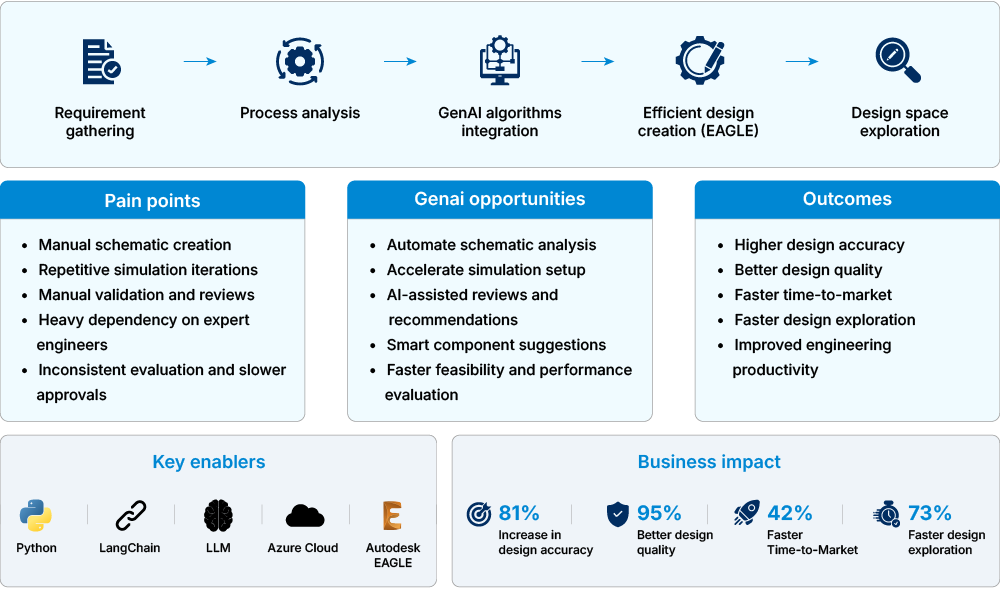
We took a structured approach to capture all the right information required to create a solid GenAI solution. Our semiconductor consultant ran a workshop with our client’s team: design lead, hardware architect, validation engineers, and product engineering manager. They discussed their chip design workflows and identified specific pain points, limitations, and business objectives for the next five years.
In-depth analysis of existing design and production processes
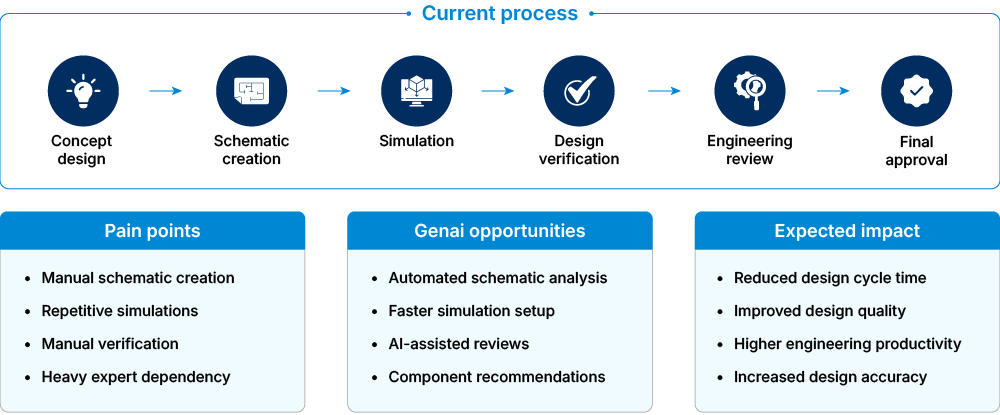
We conducted a detailed analysis of how their existing design, validation, and engineering workflows to understand how designs moved from concept to final approval. Our team studied their schematic creation process, simulation cycles, design verification stages, and dependency on manual engineering reviews across multiple product lines.
Together, we identified operational bottlenecks like repetitive manual validation tasks, slower exploration of design variations, dependency on experts for decision-making, and inconsistent evaluation process. The goal was to pinpoint specific problems that slowed down their design optimization.
We wanted to figure out where GenAI could create the highest impact for our client. Therefore, we analyzed historical data, engineering documents, and validation patterns. Based on the assessments, we identified opportunities to automate schematic analysis, accelerate design variation testing, and optimize component-level decisions.
AI models to automate design exploration and optimization
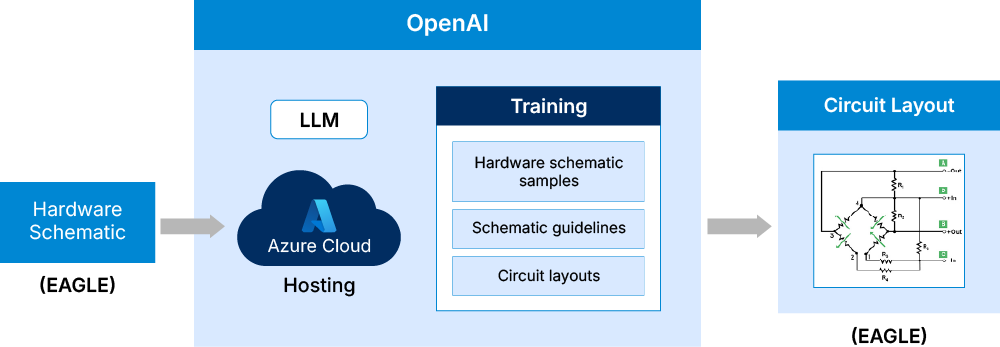
We used AI algorithms to automate schematic analysis and design optimization. They were trained on our client’s historical design data, ideal scenarios, engineering rules, validation patterns, and component-level dependencies so that everything they generate is accurate for their product requirements.
Instead of manually testing every possible configuration, engineers could now evaluate multiple design alternatives within a shorter timeframe. The solution automatically analyzed parameters like thermal performance, signal integrity, component placement, and design constraints to recommend the most efficient design options.
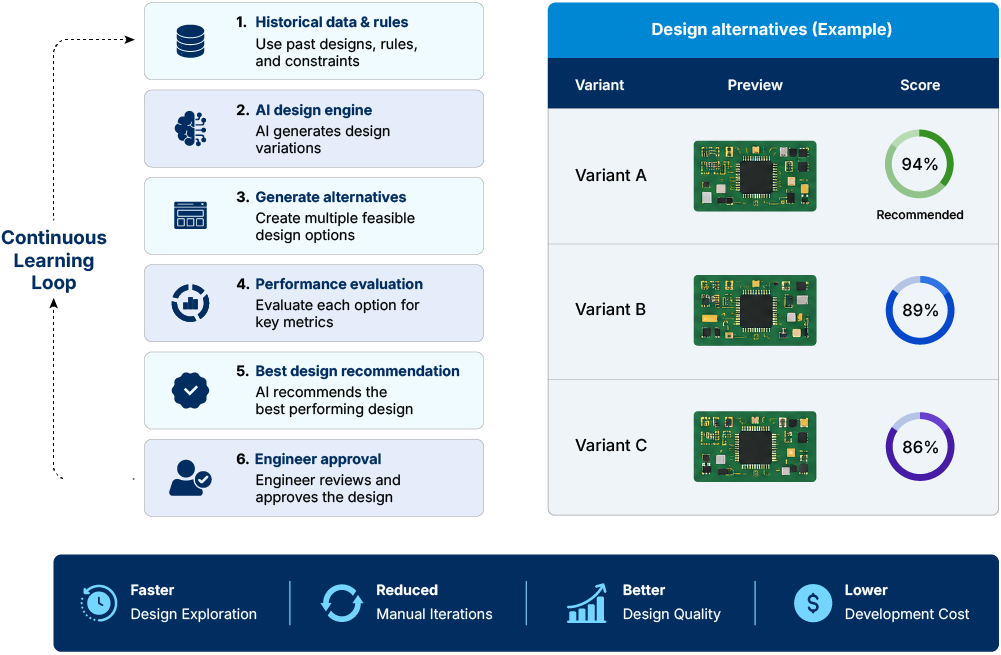
We also built a feedback mechanism that continuously improved design recommendations based on validation outputs and engineering approvals.
Created accurate hardware schematics and circuit layouts using EAGLE
We used Autodesk EAGLE to create hardware schematics and convert them into production-ready circuit layouts. The platform helped engineers efficiently place components, establish circuit interconnections, and validate schematic structures across different hardware configurations.
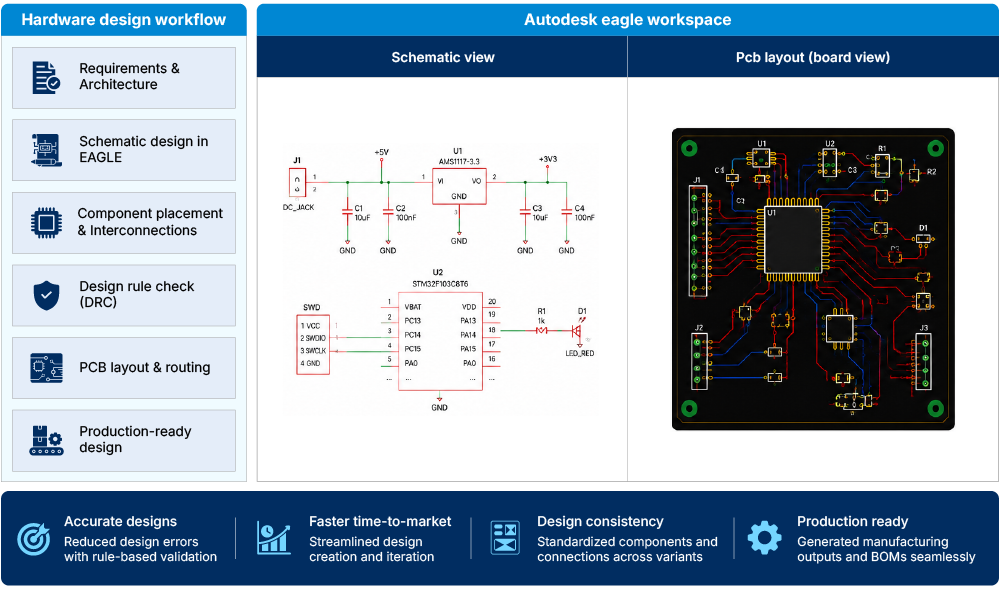
We also streamlined the representation of critical components like sensors, actuators, processors, and control units to maintain design consistency and reduce manual design efforts during layout creation and refinement stages.
Design variation testing and feasibility analysis
We integrated the Generative AI model with Autodesk EAGLE to rapidly explore multiple design variations within defined engineering constraints. It could generate different schematic and layout possibilities based on parameters like component compatibility, thermal limits, signal integrity, and performance requirements.
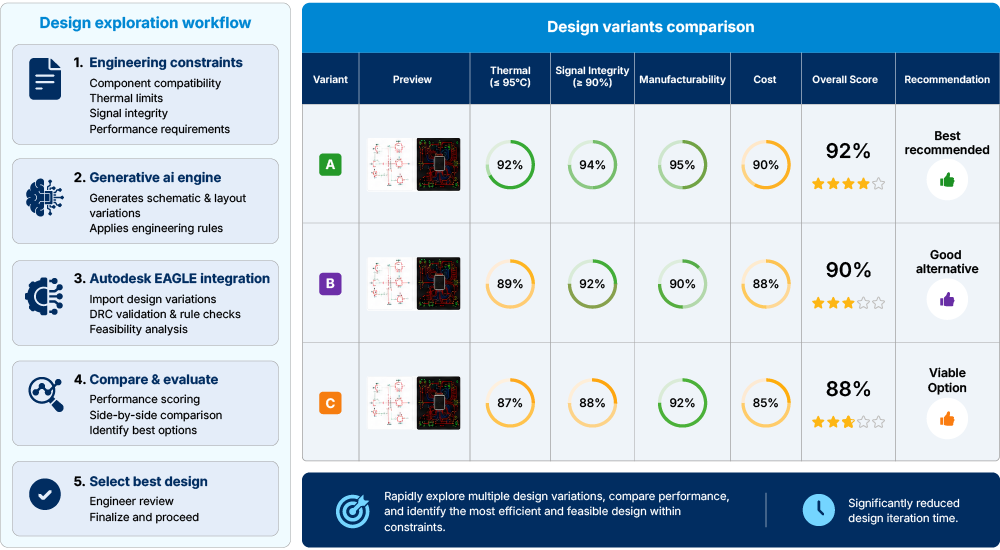
These design variations were automatically imported into EAGLE for further analysis and feasibility evaluation. Therefore, their engineers could compare multiple configurations, validate performance, and identify the most efficient design options within a significantly shorter timeframe.
Business goals and measurable outcomes
| Business objective | Business benefit delivered |
|---|---|
| Improve design accuracy | 81% increase in design accuracy |
| Launch products faster | 42% faster time-to-market |
| Improve overall design performance | 95% better design quality |
| Rapid design iteration | 73% faster design exploration and evaluation |
Tech stack
- Automation platform
- Python, LangChain, Azure Cloud, LLM
- ERP system
- SAP ERP (aging report export, invoice and payment modules)
- Data processing
- Microsoft Excel (structured data manipulation and matching)
- Email delivery
- Microsoft Outlook (personalized automated email dispatch)
- Credential management
- Secure vault-based credential handling within Power Automate Desktop
- Scheduling
- Power Automate Desktop scheduled run cadence
- Exception handling
- In-flow error detection with automated team alert notifications
- Testing methodology
- User Acceptance Testing with real customer data and edge case simulation
Similar case studies
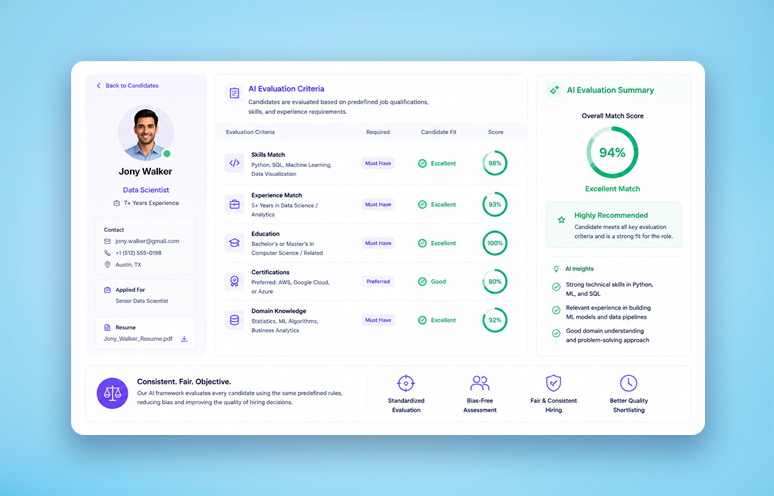
Recruitment firm accelerated hiring by 30% with Gen AI-powered candidate screening
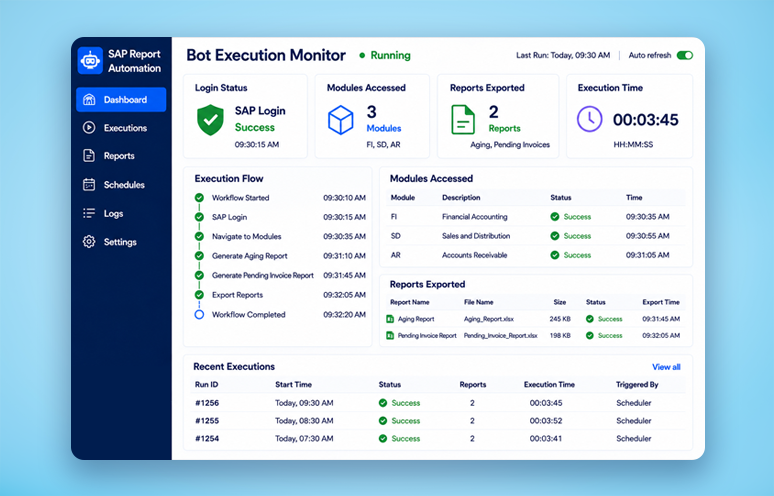
Automating SAP Invoice Management with Power Automate Desktop
Streamlined data integration with Databricks
Connect Now
Our experts would be eager to hear you.

