Share
Share
 ChatGPT
 Perplexity
 Claude
 Grok
Grok
 Google AI Mode
A single infrastructure issue can escalate into a costly outage when organizations lack visibility into how interconnected systems behave. Intelligent infrastructure monitoring improves data center reliability by continuously analyzing infrastructure health. It identifies emerging risks early and enables operations teams to resolve issues before they affect critical services.
According to Uptime Institute, the average cost of data center outages has risen to $5,600 per minute, costing organizations millions of dollars.
The reliability of modern data centers has become increasingly difficult to maintain as organizations expand across hybrid cloud environments, virtualized infrastructure, containers, and distributed applications. Modern systems span thousands of servers, process petabytes of data, and support millions of users simultaneously. In such environments, even minor disruptions can trigger cascading failures across multiple infrastructure layers.
This blog explores how intelligent infrastructure monitoring helps organizations reduce downtime, improve operational resilience, and maintain reliability across increasingly complex infrastructure environments.
What is intelligent infrastructure monitoring?
Intelligent infrastructure monitoring is the automated process of continuously tracking and analyzing the performance of data centers, including servers, networks, virtual machines, containers, and databases, using AI and machine learning.
Modern infrastructure rarely fails at once. Problems like a memory leak or a sudden increase in latency can go unnoticed until they disrupt operations. Traditional monitoring may not recognize these issues early. Predictive infrastructure monitoring analyzes data to identify risks and patterns and provides insights on what will happen in the future using machine learning technology. Conventional monitoring systems generate alerts based on predefined rules. Whereas intelligent monitoring continuously analyzes infrastructure behavior to uncover patterns and risks. AI-powered infrastructure monitoring helps organizations:
- Analyze baseline behavior: It learns what normal performance looks like for each system and highlights meaningful changes instead of every temporary spike.
- Recognize patterns across telemetry data: It examines metrics, logs, and traces together to uncover issues that might otherwise remain hidden.
- Correlate events: It connects related incidents across different infrastructure layers to identify the actual root cause instead of treating every sign as a separate problem.
- Enable predictive maintenance: It detects early signs of performance degradation and helps teams address issues before they lead to outages.
- Prioritize alerts: It ranks incidents based on their potential business impact, so engineers can focus on the most critical problems first.
By connecting data across multiple layers of infrastructure, intelligent data center management reduces downtime and accelerates root cause analysis. This enables engineers to focus on strategic work. For modern enterprises with hybrid or multi-cloud environments, predictive infrastructure monitoring has become the foundation of data centers, rather than just an upgrade.
Why data center reliability matters in modern enterprises
Data centers support the applications, services, and business operations that organizations rely on for their efficient functioning. As digital environments become more complex and interconnected, maintaining reliable infrastructure is essential to minimize disruptions, sustain productivity, and ensure business continuity.
Growing business impact of downtime
According to Uptime Institute’s Annual Outage Analysis 2025, 54% of organizations reported that their most recent significant outage cost more than $100,000, while 16% experienced losses exceeding $1 million.
The institute’s research also found that 80% of respondents believed their most recent serious outage could have been prevented through better operational practices and oversight. These findings highlight the impact of poor data center reliability, extending beyond service outages and financial losses.
Hidden operational costs of poor reliability
Infrastructure issues create operational inefficiencies and reduce overall productivity. Minor failures, such as component degradation or connectivity issues, keep the IT team engaged in troubleshooting recurring incidents and slow down deployment timelines.
Having a reliable infrastructure enables operations teams to be proactive by planning future capacity and improving performance, supporting business growth. As enterprises are adopting digital infrastructure, maintaining data center reliability has become essential to sustain operational efficiency and maximize productivity.
Why is data center reliability harder to maintain today?
Modern digital environments are more dynamic and provide flexibility. But they also introduce reliability risks that are difficult to identify and manage using conventional monitoring approaches.
1. Infrastructure complexity
Modern enterprises adopt hybrid and multi-cloud strategies to operate across physical infrastructure, virtualized environments, cloud services, and edge locations. A failure in one layer can affect multiple interconnected systems. This makes it difficult for operations teams to understand which layer is the most affected and how it is spreading across the environment. Troubleshooting must be done across multiple systems. Teams must evaluate how multiple technologies interact and influence overall performance.
2. Limited visibility across environments
Many organizations rely on separate tools to monitor different parts of their infrastructure, such as monitoring networks, servers, and cloud resources. The fragmented approach, such as one platform monitoring network performance, while others tracking infrastructure components like power and cooling systems, creates a siloed environment. This prevents the operations team from gaining real-time visibility for data center health.
3. Alert fatigue and root-cause identification
Traditional monitoring tools generate large volumes of alerts that originate from interconnected systems. Analyzing whether the alert is for a particular issue or for a common issue requires manual investigation. As a result, engineers spend more time investigating signs, and they have less time solving the actual problem. Operations get significantly affected if it takes a long time to identify the root cause of the issue.
4. Managing capacity constraints and resource utilization
As enterprises grow, it becomes difficult to identify if the infrastructure resources are adequately provisioned. An unexpected increase in traffic and new application requirements can strain compute, storage, and network resources. Without clear visibility into resource consumption, organizations struggle to identify emerging capacity issues. Storage bottlenecks, CPU saturation, memory shortages, and bandwidth limitations degrade service quality and cause downtime if left unaddressed.
How intelligent infrastructure monitoring enhances data centre reliability?
Intelligent infrastructure monitoring helps organizations maintain data center reliability by providing real-time visibility, early risk detection, and proactive issue resolution. It enables operations teams to identify potential problems before they affect critical services, reducing downtime, and improving overall infrastructure performance.
Real-time visibility across critical infrastructure components
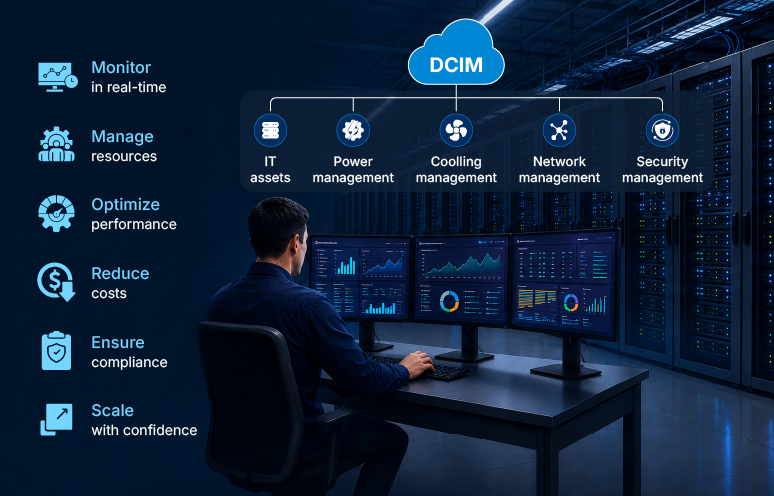
Maintaining data center reliability requires real-time visibility. Intelligent infrastructure monitoring provides a unified view of critical infrastructure, enabling operations teams to understand how issues in one area affect the rest of the environment.
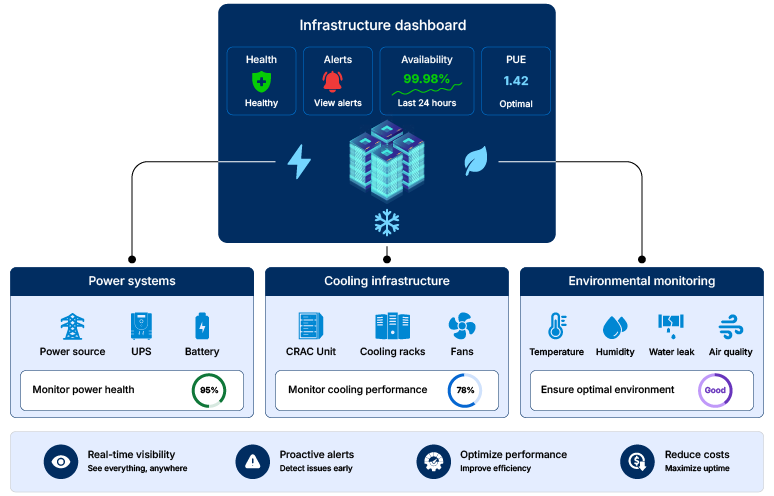
- Power systems: Continuously monitoring uninterruptible power supplies (UPS), generators, batteries, and power distribution units (PDUs) helps organizations identify voltage fluctuations, battery degradation, and capacity issues before they affect critical workloads.
- Cooling infrastructure: Intelligent monitoring provides real-time insights into cooling equipment performance, temperature variations, airflow efficiency, and potential thermal hotspots. Identifying cooling efficiency at an early stage prevents overheating, equipment damage, and unexpected downtime.
- Environmental monitoring: Factors such as humidity, temperature, water leaks, and air quality can significantly influence data center performance and equipment lifespan. Monitoring these environmental conditions enables teams to respond quickly to abnormal situations and maintain optimal operating conditions.
Predictive analytics for early issue detection
Many infrastructure failures show warning signs before they affect business operations. Performance degradation, abnormal resource consumption, temperature fluctuations, and recurring network anomalies often indicate underlying problems that can worsen over time.
Intelligent monitoring analyzes historical and real-time operational data to identify patterns that may indicate emerging risks. It helps engineers recognize unusual behavior early and investigate potential issues before they result in outages. Taking such a proactive approach reduces unplanned downtime and makes your infrastructure reliable.
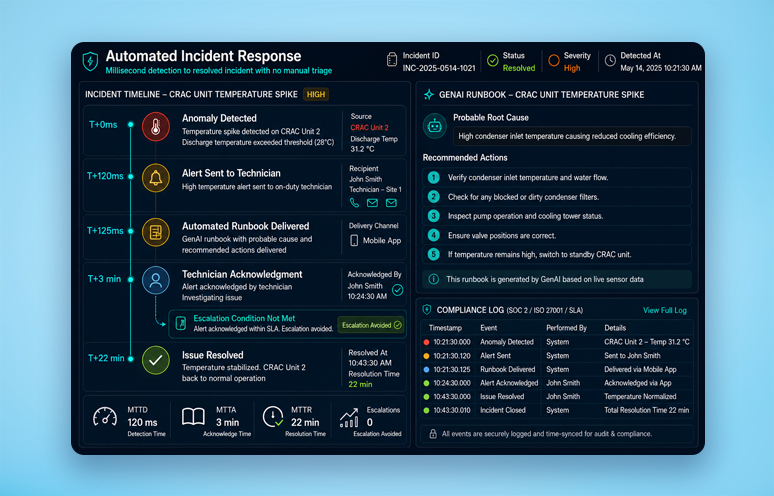
Automated alerts and incident response
Traditional monitoring generates large volumes of alerts, making it difficult for teams to prioritize which incidents require immediate attention. Intelligent monitoring improves incident management and provides a unified view of events across infrastructure layers.
It also highlights the alerts most likely to affect service availability. Engineers can now prioritize response efforts and accelerate issue resolution. Some platforms can also trigger predefined workflows to streamline routine response activities and reduce manual intervention.
Proactive infrastructure health monitoring
Organizations miss opportunities to address performance issues and unexpected outages because warning signals are buried within large volumes of operational data spread across multiple monitoring tools. Intelligent monitoring continuously evaluates infrastructure health across systems, services, and operational dependencies to identify emerging risks before they disrupt operations.
By analyzing infrastructure behavior in real time, monitoring platforms help teams detect performance degradation, recurring anomalies, and infrastructure weaknesses at an early stage. This enables engineers to investigate issues sooner, schedule maintenance activities, and address potential problems before they affect service availability.
Resource utilization and capacity forecasting
To maintain infrastructure reliability, organizations must balance resource availability with changing business demands.
Intelligent monitoring provides visibility into resource consumption patterns across compute, storage, network, power, and cooling systems. These insights help teams understand usage patterns, anticipate future requirements, and make informed capacity planning decisions. By aligning infrastructure resources with operational needs, organizations can support growth while maintaining consistent performance and reliability.
Tools for infrastructure monitoring
| Tool | Usage |
|---|---|
| Datadog | Infrastructure, application, and cloud monitoring |
| AWS | Monitoring AWS infrastructure and cloud workloads |
| IoTConnect | Monitoring physical infrastructure, sensors, power, cooling, and environmental conditions |
| Prometheus | Metrics collection and monitoring |
| Grafana | Dashboards and infrastructure visualization |
What is the role of AI and machine learning in infrastructure monitoring and data center reliability?
The growing complexity of modern data centers has made it difficult for conventional monitoring methods to manage the data center with reliability. AI-powered infrastructure monitoring eliminates a reactive approach and brings predictive discipline. It identifies risk earlier, understands the impact, and thus maintains reliability across complex environments.
1. Continuous monitoring
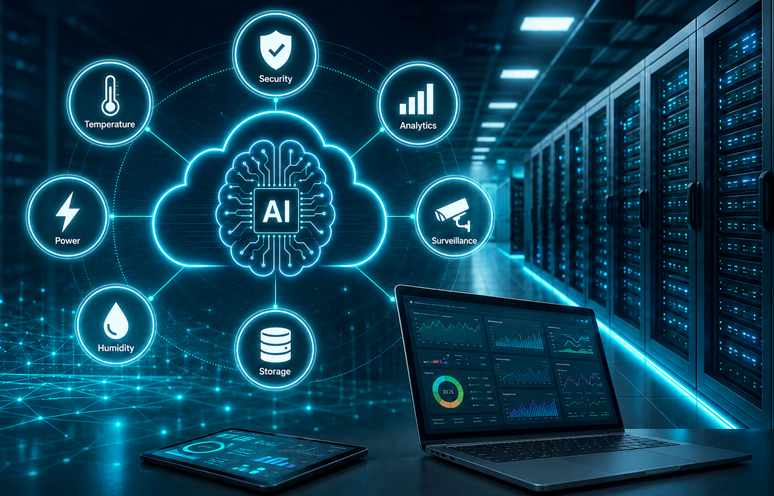
Artificial intelligence and machine learning continuously analyze operational data and identify patterns that may not be visible through conventional monitoring methods. These technologies don’t rely on predefined rules. They learn how systems behave and identify deviations that could signal emerging issues.
2. Anomaly detection
AI-powered infrastructure monitoring identifies unusual resource consumption, temperature fluctuation, or performance degradation and alerts the operations teams in advance. It also alerts the team to which server will break down and when. This proactive approach enables the operations team to investigate potential risks and take corrective action before users experience the disruptions.
3. Root-cause analysis
AI technology also enables the team to improve their root cause analysis by examining the infrastructure with multiple layers. Intelligent data monitoring systems unify data from various sources so that operations teams can understand whether the issue is generated from storage, applications, networks, power, or other systems. And this analysis enables the team to reduce troubleshooting time and improve incident resolution.
4. Predictive analysis
Machine learning analyzes historical performance trends. It enables organizations to anticipate equipment failures, identify infrastructure components approaching operational limits, or forecast future resource requirements. The operations team can use these insights to make informed decisions and reduce unexpected downtime.
What are the best practices for implementing data center monitoring solutions?
Implementing an infrastructure monitoring solution is the first step toward improving data center reliability. Organizations must adopt a strategic monitoring strategy that provides complete visibility across infrastructure components. It should also support proactive decision-making and align with operational objectives. The following best practices can help maximize the value of infrastructure monitoring initiatives.
Establish end-to-end infrastructure visibility
Effective monitoring requires visibility across the entire infrastructure ecosystem. Organizations must use data center monitoring tools that correlate various data sources such as infrastructure facility health, power system capacity, and network topology into unified dashboards. A unified view enables operators to understand how different systems interact and identify issues before they affect the infrastructure.
Monitor both IT and facility infrastructure
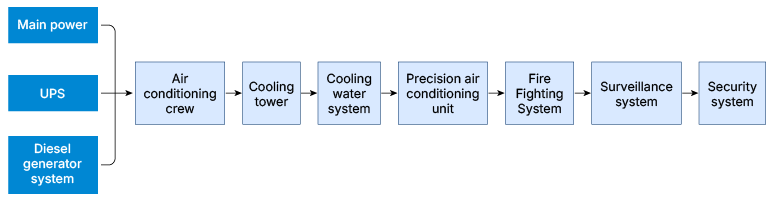
Data center reliability depends on infrastructure monitoring that provides adequate energy support without excessive energy consumption. Supporting systems such as Uninterruptible Power Supplies (UPS), generators, cooling systems, and environmental sensors play a critical role in maintaining availability. Physical infrastructure, regardless of its severity, impacts IT operations. Monitoring digital and physical infrastructure, including energy consumption management, helps organizations detect potential risks early and reduce the likelihood of service disruptions caused by facility-related issues.
Prioritize critical assets and services
Not all infrastructure components have the same impact on business operations. Organizations should identify critical systems, applications, and infrastructure assets that support essential services and ensure they receive the highest level of monitoring coverage. Prioritizing these assets helps teams focus their efforts on areas that have the greatest influence on uptime and operational continuity.
Use analytics to identify issues early
As organizations expand, their infrastructure requirements also evolve. Conventional monitoring generates excessive alerts or misses early warning signs in a growing business environment. Intelligent monitoring platforms use AI and behavior analytics to detect abnormal patterns, deviations in performance, and identify potential risks before they escalate. By implementing this proactive approach, organizations can resolve issues earlier and reduce unplanned downtime.
Continuously review capacity and performance trends
Data centers must be designed to scale as business requirements evolve. Monitoring resource utilization, performance metrics, and capacity trends on an ongoing basis helps organizations identify potential bottlenecks before they affect service quality. The IT team must prioritize forecasting and capacity planning to make informed resource allocation decisions.
What are the future trends in intelligent data center monitoring?
The future of intelligent infrastructure monitoring lies in moving beyond issue detection toward predictive, automated, and context-aware operations. Emerging technologies are enabling organizations to identify risks earlier, optimize resource utilization, and maintain reliability across increasingly dynamic infrastructure environments.
Reinforcement learning applications
Reinforcement learning is one of the most promising techniques for system reliability enhancement. Next-generation applications use autonomous agents to continuously optimize system configuration parameters based on operational outcomes.
Deep reinforcement learning approaches can develop unique resource allocation strategies that outperform human-designed heuristics. Meta-reinforcement learning approaches can rapidly adapt to new environments without extensive retraining, addressing the challenge of constantly evolving distributed systems.
Self-improving AIOps frameworks
These frameworks represent the evolution from static to continuous learning systems. It implements meta-learning capabilities that autonomously improve predictions and learning processes. Automated machine learning components dynamically select and optimize model architectures based on operational outcomes.
The most advanced frameworks implement hierarchical learning systems where generalist models integrate insights across domains while specialist models focus on specific subsystems. These self-improving frameworks can reduce false positives per month during their initial deployment phase, with improvement rates stabilizing as models mature.
AI-driven predictive operations
Monitoring platforms will increasingly predict failures, capacity bottlenecks, and performance degradation before they affect services. AI will move monitoring beyond anomaly detection toward operational decision support.
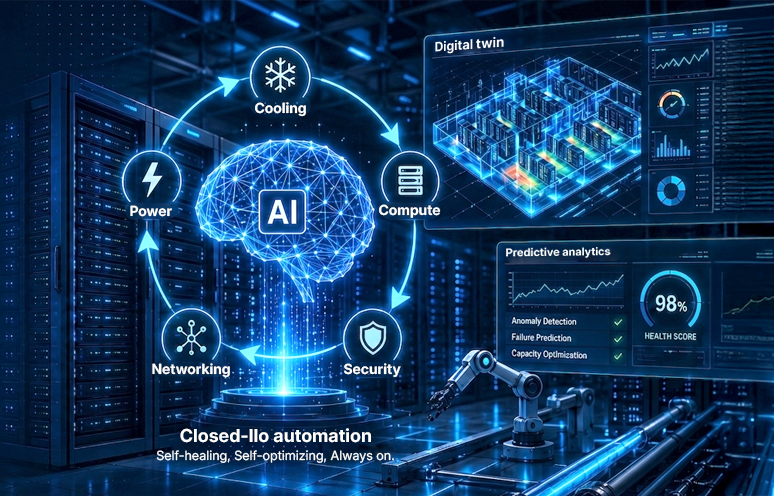
Self-healing infrastructure
Future monitoring systems will automatically initiate corrective actions, restart services, adjust workloads, and trigger remediation workflows without requiring manual intervention.
Power and sustainability monitoring
Power availability is emerging as a critical challenge for modern data centers. Monitoring platforms will provide deeper visibility into energy consumption, cooling efficiency, carbon impact, and power utilization.
Edge and hybrid infrastructure visibility
As workloads become more distributed, monitoring solutions will provide unified visibility across on-premises infrastructure, cloud environments, hyperscale facilities, and edge locations.
Autonomous capacity optimization
Future monitoring platforms will continuously analyze resource consumption and recommend or execute capacity adjustments to maintain performance while controlling costs.
Building reliable data centers with intelligent monitoring
Adoption of artificial intelligence and machine learning in infrastructure monitoring is helping organizations maintain reliability across increasingly complex data center environments. However, achieving reliability at scale requires a unified monitoring platform that provides visibility across both physical and cloud infrastructure. Solutions such as IoTConnect and AWS enable organizations to monitor critical assets, identify risks earlier, and respond proactively to emerging issues. As infrastructure environments continue to evolve, intelligent monitoring platforms will play a critical role in reducing downtime, improving operational efficiency, and maintaining consistent service reliability.