How Softweb Solutions built a sensor-driven automation solution that transformed data center operations
Our US-based colocation services client wanted to replace manual inspection rounds and reactive maintenance practices with a unified monitoring approach. Softweb Solutions built an IoT-powered data center operations automation solution on /IOTCONNECT™ and AWS. The solution automates infrastructure monitoring, predictive maintenance, energy optimization, and incident response across multiple facilities.
 Industry: IT Infrastructure and Technology Services
  Business type: Large enterprise
  Services: DCOA (Data Centre Operations Automation)
  Technology: AWS, /IOTCONNECT™, Python, Node.js, React.js
Client profile
Our client is a large-scale colocation data center operator headquartered in the United States. With more than fifteen years of experience, the company provides managed colocation services to enterprises across a broad range of industries. It operates four Tier III data center facilities along the eastern seaboard with a combined critical floor space exceeding 120,000 square feet.
The client supports over 700 active customer deployments and manages roughly 6,000 physical assets across its portfolio. With a technical operations workforce of 320 engineers and annual revenue of more than $180 million, the company competes on uptime guarantees and operational efficiency. Any decline in either affects SLA commitments and customer retention.
Technical challenges
The scale and complexity of the client’s infrastructure had outgrown the tools they were using to manage it. The company needed a more efficient way to manage operations at scale.

Siloed monitoring systems
Building management, DCIM, power and environmental monitoring tools operated independently with no unified data layer.

Reactive maintenance model
Failures on CRAC units and UPS strings were discovered after they had already caused degraded performance or partial downtime.

Manual inspection rounds
Operations technicians conduct physical walkthroughs every four hours to record temperature, humidity, and power readings by hand.

Stranded capacity
Limited visibility into actual power usage prevented the company from accurately assessing available capacity.
Our solution
Our team worked with the client’s data center operations managers, facilities engineers, and capacity planning leads. We walked on each facility floor, mapped every monitored system and documented where visibility gaps created operational risk.
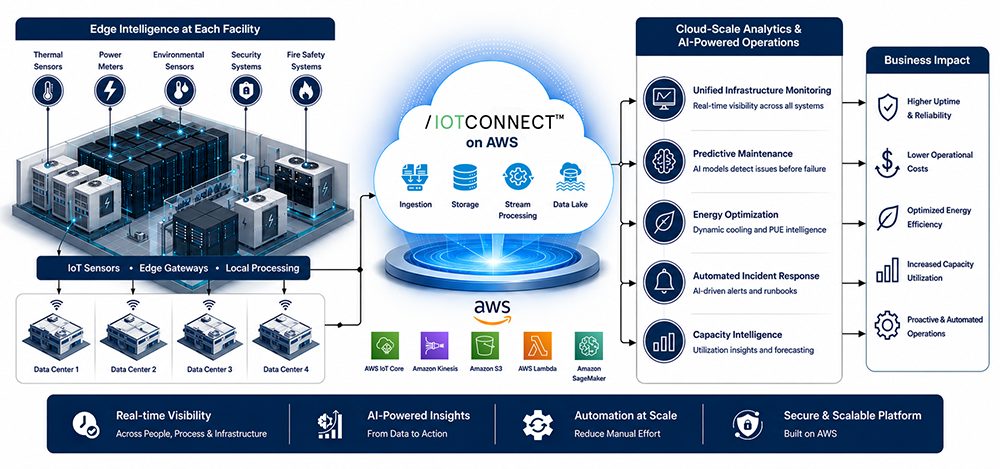
The result was a sensor-driven automation solution built on IOTCONNECT™ and AWS. It brought together edge computing at each facility along with cloud-scale analytics and AI-powered operations capabilities.
Continuous sensor coverage across all facility systems
We deployed a sensor network across four facilities covering thermal, power, environmental and mechanical systems. IoT sensors mounted on CRAC and CRAH units, cooling towers, AHUs, UPS systems, PDUs and fire suppression panels feed readings into /IOTCONNECT™ every few seconds.
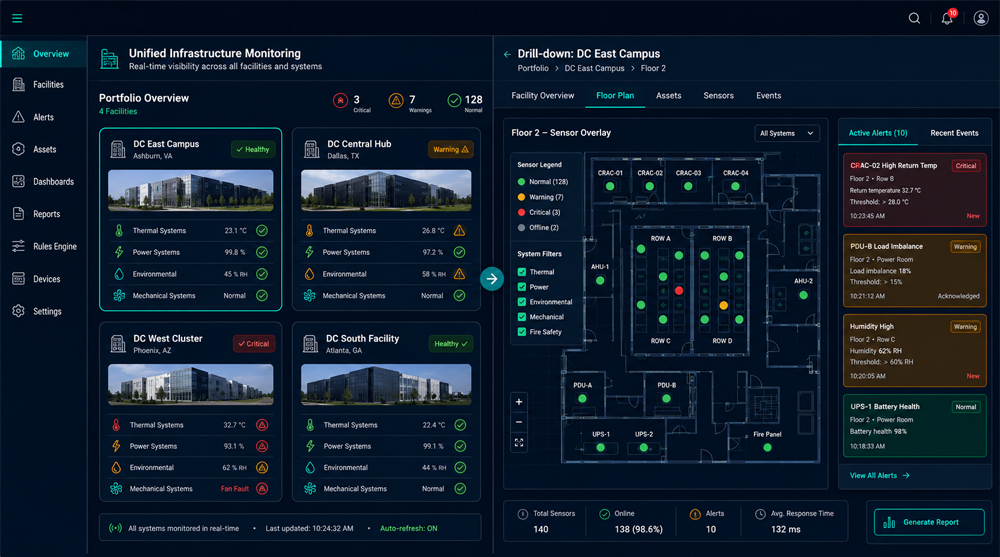
The /IOTCONNECT™ rule engine evaluates every incoming reading against configurable thresholds. It triggers alerts within milliseconds of a drift event. Operations managers receive a real-time single-pane-of-glass view that drills from portfolio level down to individual racks or devices.
Runtime-based fault detection before failure occurs
We deployed vibration, temperature, and pressure sensors on every CRAC unit, chiller, AHU, and cooling tower across the portfolio. The /IOTCONNECT™ platform captures continuous sensor baselines for each unit and uses AI models running on AWS SageMaker to identify degradation signatures.
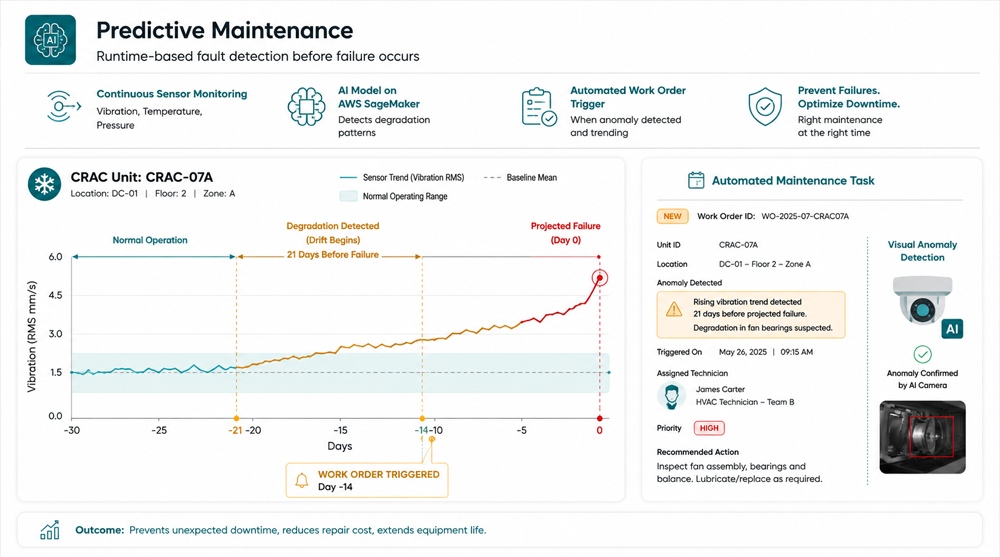
Maintenance work orders trigger automatically when sensor patterns indicate a unit is trending outside its normal operating envelope. The system targets each unit for service when condition data indicates it is needed. It prevents under-maintenance failures and unnecessary planned downtime.
Dynamic cooling and PUE intelligence across the portfolio
We integrated live rack-level temperature data from the sensor network with the control systems for CRAC and AHU units at each facility. The solution dynamically modulates cooling output based on actual heat load.
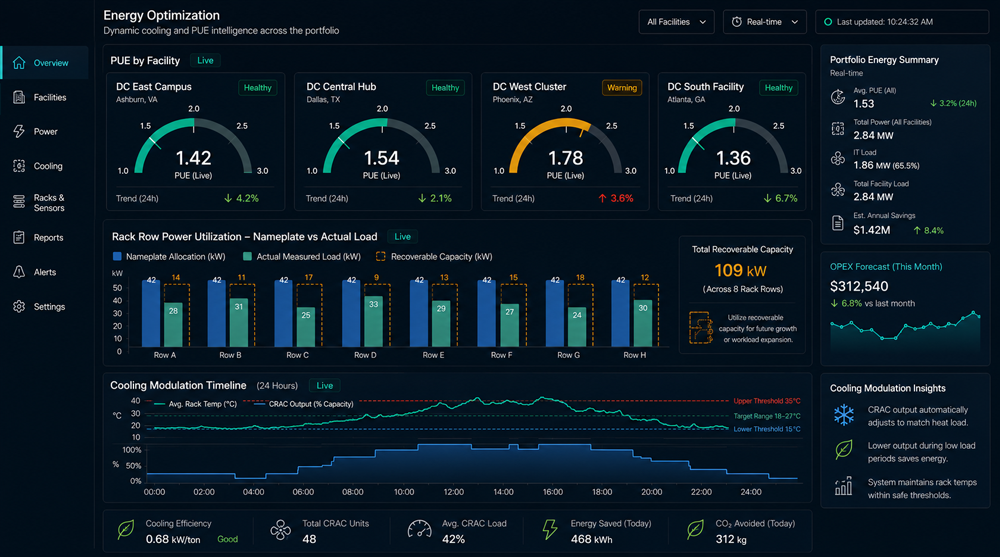
When rack temperatures remain within safe thresholds, cooling units reduce output. When load increases, output scales to meet demand without operator intervention. PUE is tracked live across all power feeds at each facility with automated trend analysis. Smart meters across PDU and UPS systems generate automated consumption reports for OPEX forecasting.
Millisecond detection to resolved incident with no manual triage
We built an automated incident response layer that classifies fault severity and identifies the affected system within milliseconds of detection. It then automatically triggers the appropriate escalation workflow and ensures that the right teams are notified without delay. Technicians receive alerts with full sensor context attached.
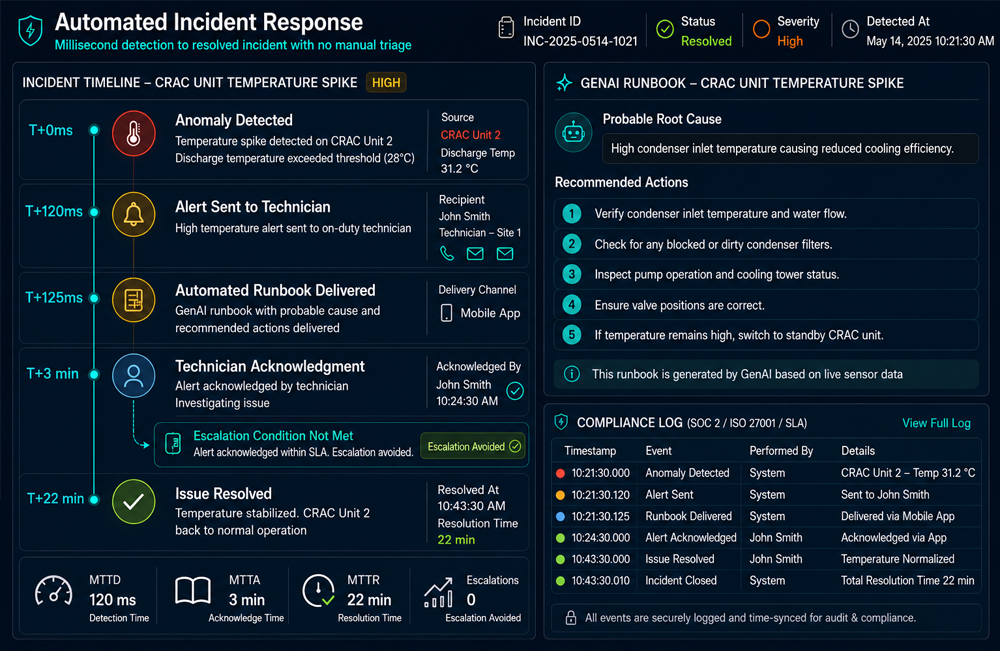
Unacknowledged alerts escalate automatically from the on-duty technician to the site operations manager and then to the regional director. Every alert, acknowledgment, escalation action and resolution event is timestamped and logged automatically for SOC 2, ISO 27001 and SLA compliance reporting.
Live capacity data replacing estimates with measured reality
Power, cooling and space utilization update in real time as assets are provisioned, de-provisioned or reconfigured. Capacity managers now operate from a live view of every rack and room across the portfolio. The solution’s predictive layer models capacity consumption trends and projects when critical thresholds will be approached at current growth rates.
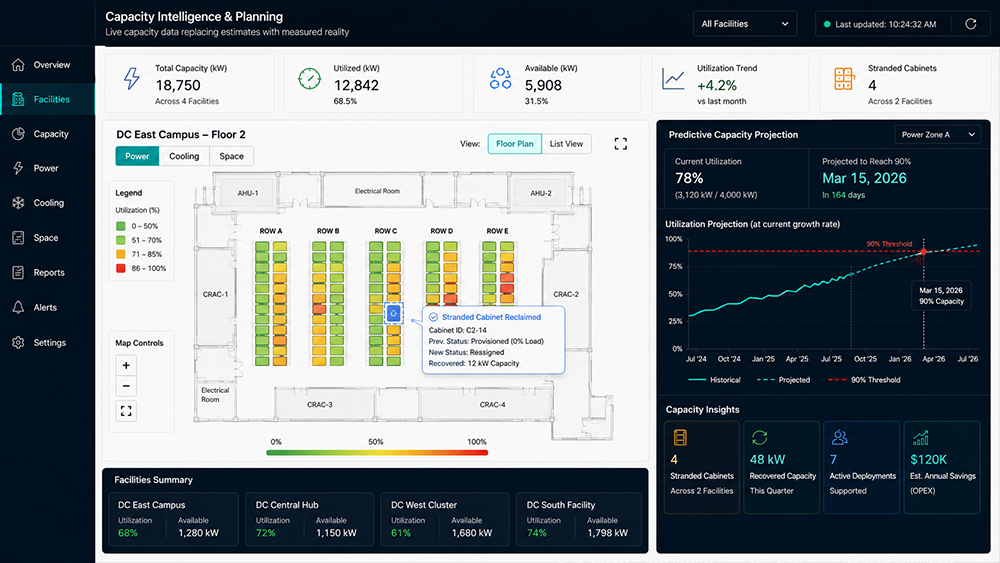
The client uses this capability to identify four fully stranded cabinets across two facilities that were classified as provisioned despite carrying zero active load. The recovered capacity is then reassigned to active customer deployments within the same quarter.
Business goals and measurable outcomes
| Business goals | Business benefit delivered |
|---|---|
| Eliminate manual inspection rounds | Continuous sensor coverage replaced manual walkthroughs. Every system is monitored and logged automatically 24/7. |
| Move from reactive to predictive maintenance | AI-driven anomaly detection provides 14–30 days of advance warning on mechanical degradation events. |
| Reduce energy waste and improve PUE | Dynamic cooling modulation reduces cooling energy waste and provides live PUE visibility. |
| Accelerate incident detection and resolution | Automated fault classification, escalation and GenAI-assisted runbooks reduce mean time to resolution. |
| Reclaim stranded capacity and defer capital expenditure | Real-time load data helps identify unused rack and power capacity, reducing unnecessary expansion costs. |
Tech stack
- IoT platform and edge computing
- /IOTCONNECT™, AWS Greengrass
- Cloud and AI services
- AWS SageMaker, AWS Bedrock, AWS Lookout for Equipment, AWS Cognito
- Sensor and instrumentation layer
- Vibration, temperature, pressure, and humidity sensors, smart PDU and UPS metering, AI vision cameras
- Backend and API layer
- Python (FastAPI), RESTful APIs, MQTT
- Integrations
- DCIM, ServiceNow CMDB, ITSM automation, BMS and SCADA adapters
- Operations dashboard
- React.js, real-time visualization, RBAC, 2D/3D facility simulation overlays
- Reporting engine
- Automated capacity and compliance reporting, SLA and PUE analytics
- Security and compliance
- X.509 certificates, encryption, RBAC, SOC 2 and ISO 27001 audit logging
Similar case studies
Connect Now
Our experts would be eager to hear you.

