Share
Share
 ChatGPT
 Perplexity
 Claude
 Grok
Grok
 Google AI Mode
The modern data center has reached a critical tipping point. For decades, data center infrastructure management followed a linear path. Human operators monitored dashboards, responded to threshold-based alerts, and manually adjusted cooling, power, and workloads. However, the explosive rise of generative AI, High-performance Computing (HPC), and hyper-dense chip architectures has shattered the viability of manual oversight.
Today’s enterprise infrastructure is simply too vast, dynamic, and complex for human reaction times. As compute loads spike in milliseconds and thermal profiles fluctuate across thousands of multi-kilowatt racks, businesses realize that traditional infrastructure management is an operational bottleneck. To survive, enterprises are shifting from human-led monitoring to closed-loop, self-healing, and autonomous data center operations.
In this blog post, we will deep dive into why this architectural evolution is happening and how industry leaders are implementing it at scale. We will also explore how your enterprise can navigate the transition toward true operational autonomy.
What is an autonomous data center?
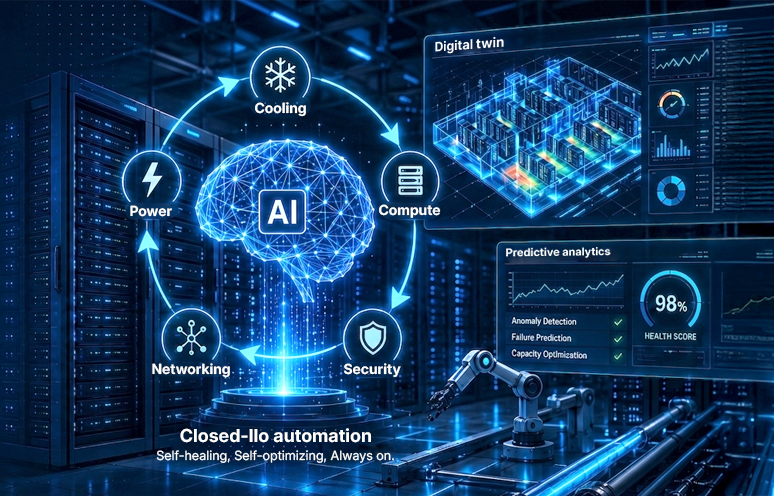
An autonomous data center is a self-managing, self-healing, and self-optimizing infrastructure environment. It leverages Artificial Intelligence (AI), Machine Learning (ML), and closed-loop automation to oversee facility operations without requiring human intervention.
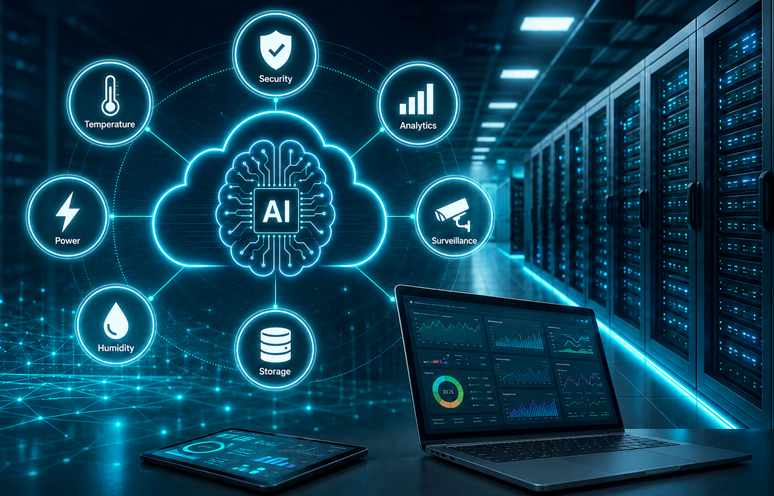
These facilities continuously ingest millions of real-time telemetry data points, including thermal metrics, power distribution, and network performance. Using this constant stream of data, the autonomous data center dynamically executes real-time operational adjustments. This allows the system to optimize efficiency, prevent hardware failures, and balance unpredictable computing workloads on the fly.
To understand where your infrastructure stands, it is helpful to view autonomy through a structured evolutionary framework. This progression tracks your journey from manual processes to full machine independence:
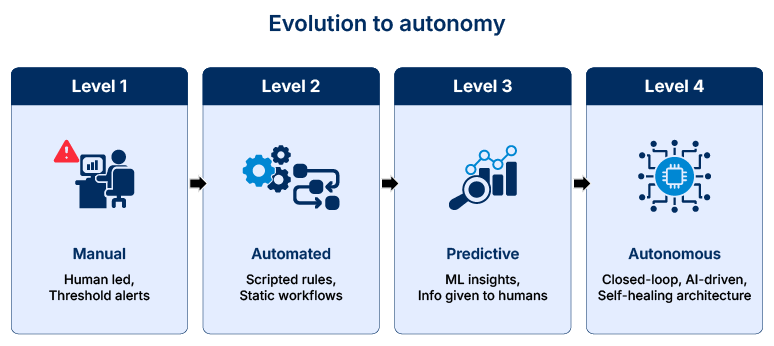
- Level 1: Manual operations: Staff-heavy monitoring relying entirely on historical threshold alerts (e.g., SNMP traps). If an asset exceeds a set temperature, a human technician must manually intervene and diagnose the root cause.
- Level 2: Automated operations: Introduction of basic scripted rule engines. If a server goes offline, automated workflows might trigger a standard reboot sequence or route traffic to a secondary node based on pre-defined static logic.
- Level 3: Predictive operations: ML models process historical and real-time telemetry to predict anomalies, structural wear, or upcoming hardware faults. But the system does not take action. It notifies or creates a ticket for human approval.
- Level 4: Fully autonomous operations: The ultimate goal. The AI engine operates in a complete closed loop. It detects anomalies, calculates failure probabilities, and evaluates safety parameters. Machine intelligence instantly executes complex fixes on its own, such as adjusting chiller plant frequencies or live-migrating thousands of virtual machines.
What drives the shift to autonomous data centers?
Why are global organizations aggressively modernizing their data center facilities toward Level 4 autonomy? The transition is driven by three macroeconomic and technical reasons.
1. Thermal complexity and high-density cooling
Standard air-cooling systems were designed for historical workloads, averaging just 5 kW to 15 kW per rack. But modern AI clusters, with dense GPU architectures, can easily demand 40 kW to upwards of 100 kW per rack. To manage these loads, enterprises must shift to advanced liquid cooling topologies, such as direct-to-chip or immersive cooling.
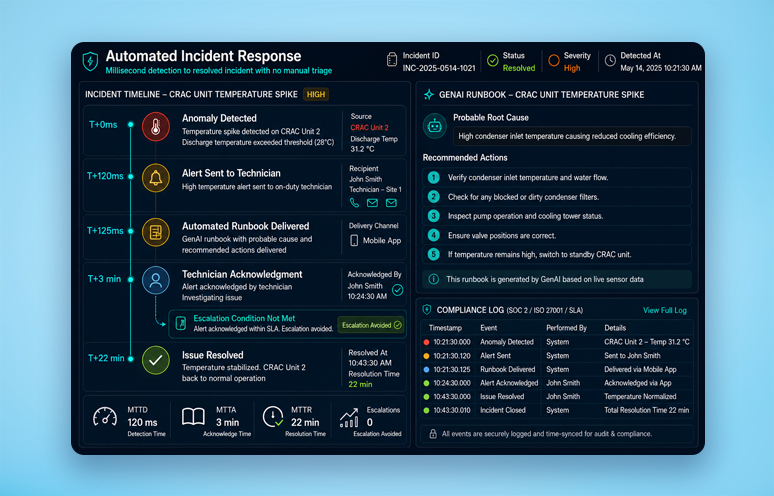
In these environments, thermal margins are thin. If a cooling pump experiences transient cavitation or a fluid loop drops in pressure, temperatures can spike to damaging levels within seconds. Humans cannot open tickets, hold triage calls, and manually adjust valves fast enough to stop a thermal runaway event. Therefore, autonomous control loops are mandatory to modulate liquid flow rates dynamically alongside real-time compute fluctuations.
2. Human errors
Uptime’s 2025 Annual Outage Analysis Report shows that 58% of human error-related date center outages were caused by staff members simply failing to follow established procedures. This includes improper configuration changes during routine maintenance, misread dashboard alerts, or delayed responses to electrical anomalies. According to the report, 80% of operators agree that these exact incidents were entirely preventable.
Autonomous systems do not suffer from cognitive fatigue or miss subtle anomalies hidden across different systems. They execute complex fixes exactly the same way every time, whether the event occurs at noon or at 3:00 AM.
3. Sustainability mandates and carbon penalties
Strict green laws make data center sustainability mandatory across Europe, the US, Asia, and the Middle East. Regulatory bodies globally are forcing date centers to report exact Power Usage Effectiveness (PUE) and carbon intensity metrics.
How these strict policies are rolling out globally:
- Europe: The European Union’s Energy Efficiency Directive (EED) and Data Center Energy Efficiency Package mandate exact PUE tracking. New rules aim for total carbon neutrality for data center facilities by 2030.
- United States: State-level laws, like California’s Title 24 and new grid-capacity restrictions, mandate extreme energy and water efficiency benchmarks.
- Asia: Malaysia has announced power tariffs for data centers to enforce efficiency. China’s “East Data, West Computing” strategy promotes concentrating computing facilities in western regions rich in green power.
- Middle East: The UAE and Saudi Arabia tie operating licenses directly to green energy. Their national Net Zero visions mandate strict PUE metrics.
Lowering PUE toward the ideal 1.0 limit requires balancing constantly shifting factors. Data center owners and operators must simultaneously manage power distribution, outside weather, cooling settings, and fluid IT workloads. These variables change non-linearly. Hence, static human scheduling cannot maximize efficiency. Only a continuous ML loop can trim down tiny fractions of PUE overhead in real time.
What are the steps to transition your data center infrastructure to autonomy?
Deploying an autonomous operations framework does not require your enterprise to have the massive capital or scale of a tier-1 hyperscaler. We approach data center modernization as a modular and phased journey designed to yield immediate ROI at every single step.
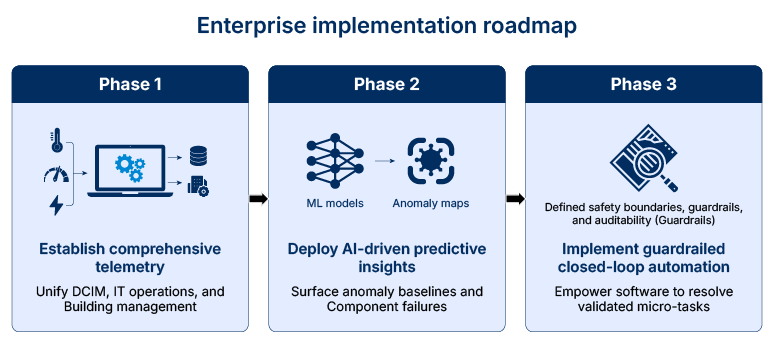
Phase 1: Unifying the telemetry data
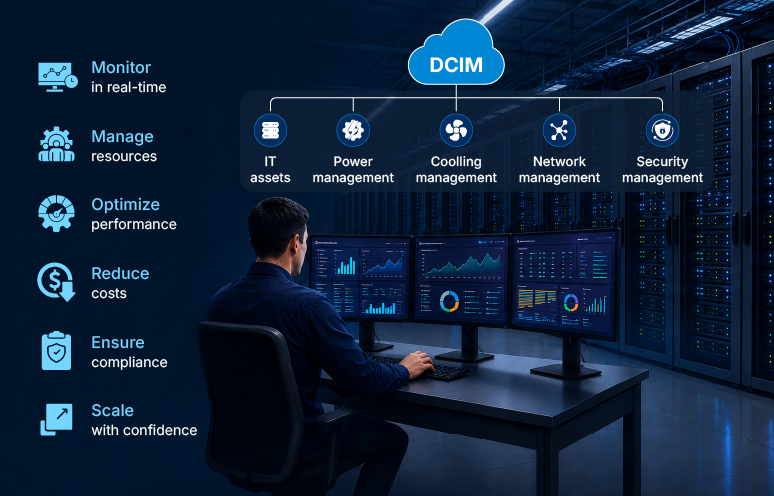
Most enterprises operate in structural silos: the facilities team monitors cooling plants via isolated Building Management Systems (BMS), while the IT team monitors compute workloads via separate APM software. We can help you with breaking down these data siloes by integrating a unified Data Center Infrastructure Management (DCIM) ingestion plane. By aggregating data across both hardware and facilities into a single source of truth, you create the foundation required for machine learning analytics.
Phase 2: Introducing predictive diagnostics
With a unified telemetry pool established, we introduce ML anomaly detection models customized to your infrastructure baselines. During this phase, the system actively identifies anomalies, predicts impending server failures, and flags cooling inefficiencies. These actionable insights are delivered directly to your current team via structured dashboards, which immediately reduces your Mean Time to Detection (MTTD).
Phase 3: Activating closed-loop automation
Once your team gains confidence in the predictive accuracy of the models, we begin shifting operational responsibility over to closed-loop automation. We start with low-risk, high-frequency tasks. Examples include automating server reboots, scaling fan speeds based on compute demand, or isolating faulty network ports. The system operates entirely within strict software guardrails. These automated boundaries allow your IT staff to simply review logs after successful self-healing events rather than performing the manual tasks themselves.
How global tech leaders use autonomous operations in their data centers
Google, Meta, and Microsoft use AI to fully automate their large-scale data center infrastructure.
Their software instantly manages power distribution, system cooling, and sudden workload spikes without human help.
How Google uses autonomous cooling engines to cut energy consumption
Google’s global data centers support massive search volumes, hyper-scale cloud applications, and intensive AI training clusters. These computing demands shift rapidly across continents, making facility thermal profiles highly volatile and non-linear.
Google addressed this by integrating an advanced cloud-based artificial intelligence agent developed alongside DeepMind. This platform functions via a continuous, five-minute closed feedback loop:
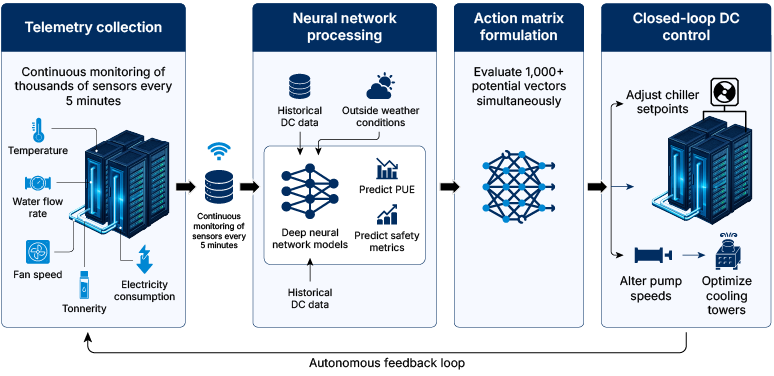
- Data ingestion: Every five minutes, the autonomous system pulls thousands of real-time data points from the data center’s supervisory control and data acquisition (SCADA) systems. It includes air temperatures, water flow rates, fan speeds, electricity consumption, and ambient outside weather conditions.
- Predictive neural networks: An ensemble of deep neural networks processes raw time-series data. The models are trained to predict how different combinations of operational actions will impact PUE over the next hour.
- Algorithmic optimization: The system evaluates more than a thousand potential control vectors simultaneously. It isolates the specific operational configuration that will yield the lowest possible energy consumption while maintaining strict internal safety margins.
- Closed-loop action: The AI sends optimization vectors directly to the physical facility control system instead of a manager’s inbox. The local infrastructure autonomously alters pump speeds, chiller setpoints, and cooling tower operations.
Google’s autonomous cooling system achieved a sustained 40% reduction in cooling energy consumption. The system also lowered overall PUE overhead by 15%. More importantly, the system discovered non-intuitive optimization methods. It leverages cold winter air in configurations, which human operators had never attempted. It also proves that machine intelligence can easily uncover efficiencies hidden from human analysis.
How Meta uses autonomous software to fix hardware errors
Operating global infrastructure supporting billions of daily active users across Instagram, WhatsApp, and Threads, Meta requires an unimaginable scale of hardware. For Meta, manually identifying, isolating, and troubleshooting individual server component degradation is mathematically impossible for their staff ratio.
To counter this, Meta built an infrastructure remediation framework driven by two core software systems: FBAR (Facebook Auto-Remediation) and RepairBrain.
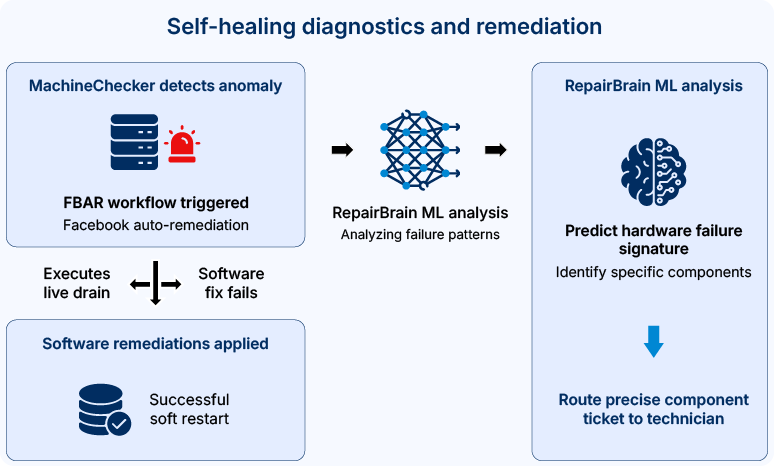
- Continuous health auditing: Every bare-metal asset runs a lightweight background binary called MachineChecker. This silent background program constantly monitors kernel ring buffers, PCIe bus parity errors, memory controller ECC corrections, and network interface card drop rates.
- Automated remediation execution: If MachineChecker identifies a degrading component or a soft-lock fault, it flags the asset to FBAR. FBAR instantly orchestrates a sequence to safely drain all live user traffic off the degraded server without interrupting app performance. Once isolated, FBAR executes a library of automated scripts to resolve the issue. It can be from performing a clean kernel re-execution, flashing outdated firmware, to rebuilding corrupted system blocks.
- Predictive hardware diagnostics: If FBAR’s software remediations fail to clear the error, the server is automatically passed to RepairBrain, Meta’s ML-driven diagnostic platform. RepairBrain parses the exact failure logs and matches them against historical failure patterns across millions of servers. It accurately predicts which physical component, such as a specific DIMM slot or NVMe controller, is dying.
- Targeted human routing: The system creates a highly specialized repair ticket detailing the exact part location and automatically assigns it to a data center floor technician. The technician walks to the exact rack, replaces the pre-identified hot-swappable part, and walks away. The system retests the hardware and restores it to the active pool autonomously.
By replacing traditional triage with automated software self-healing and predictive hardware diagnostics, Meta mitigates millions of micro faults behind the scenes. The software minimizes system degradation and protects applications from downtime. This allows Meta to maintain an industry-leading ratio of servers managed per system administrator.
How Microsoft uses predictive health models to eliminate cloud downtime
For Microsoft Azure, ensuring hyper-scale cloud availability means eliminating unplanned downtime before it physically manifests. Traditional preventative maintenance operates on calendar schedules. It results in either maintaining hardware unnecessarily or failing to catch a component that wears out prematurely.
Microsoft shifted from preventative schedules to real-time predictive health modeling by combining IoT edge telemetry with digital replication technologies.
- IoT structural sensing: Microsoft has installed IoT sensors into every mechanical and electrical asset within their data centers. These assets are massive Uninterruptible Power Supplies (UPS), diesel generators, chiller compressors, and power distribution units (PDUs). IoT devices capture changes in equipment vibrations, acoustics, voltage ripples, and thermal variances.
- Azure digital twins integration: Real-time data from across the facility is continuously fed into Azure Digital Twins. The system uses this live stream to build exact virtual replicas of the entire data center layout.
- Anomaly prediction: ML algorithms continuously contrast the real-time sensor streams of the active data center against the nominal operating baselines of the digital twin. The anomaly detection engine triggers if a chiller compressor exhibits a micro-vibration deviating by fractions of a millimeter. It will also flag minor issues like a subtle voltage sag in a UPS battery string during routine tests.
- Autonomous workload deflection: The autonomous management platform communicates with the cloud hypervisor instead of waiting for a physical component to fail completely. The hypervisor orchestrates live migrations to move critical customer workloads and virtual machines off the at-risk hardware. These workloads shift to healthy and geographically distinct sectors of the cloud fabric without any loss of connectivity or performance.
Through these autonomous actions, Microsoft Azure systematically neutralizes unplanned critical facility downtime. Maintenance crews transition away from arbitrary calendar intervals and instead service physical equipment precisely when machine learning models indicate structural wear. This precise timing saves millions in capital expenditure and preserves strict enterprise SLAs.
The following table compares the autonomous strategies applied to data centers by Google, Meta, and Microsoft.
| Company | Primary focus area | Underlying technical mechanism | Business breakthrough |
|---|---|---|---|
| Google & DeepMind | Thermal dynamics and cooling optimization | Deep reinforcement learning ensemble models and closed-loop SCADA control | 40% reduction in total facility cooling energy consumption. |
| Meta (Facebook) | Fleet up-time and server self-healing | Automated FBAR script orchestration and RepairBrain ML diagnostics | Millions of automated software fixes without manual triage and maximized admin-to-server ratios. |
| Microsoft Azure | Infrastructure availability and fault deflection | IoT anomaly detection and Azure digital twin synchronization | Continuous operational uptime via automated live workload migration prior to component failure. |
Transitioning to autonomous operations is the future of data center infrastructure
Autonomous operations are no longer a luxury reserved for hyper-scale cloud providers. Instead, they are a basic requirement for any business dealing with complex modern computing. By removing manual data center infrastructure management, your enterprise can eliminate human error and downtime. Eliminating these manual tasks cuts operational overhead and allows you to scale effortlessly to meet high compute demands.
The journey toward a resilient, self-healing, and fully optimized data center starts with a clear data and automation strategy. Partner with Softweb Solutions to assess your existing infrastructure and get an operational roadmap. We will help in transitioning your data center operations into a high-efficiency, autonomous infrastructure.
Contact data center modernization experts at Softweb Solutions today to schedule your comprehensive optimization consultation.