Share
Share
 ChatGPT
 Perplexity
 Claude
 Grok
Grok
 Google AI Mode
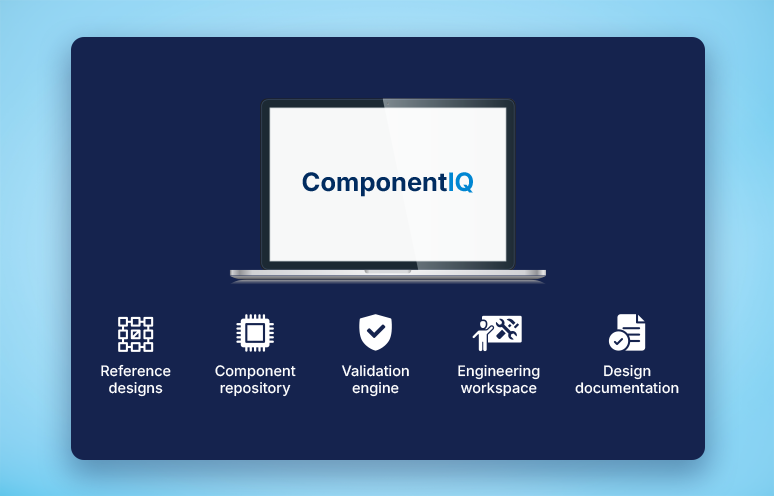
ComponentIQ is a cloud-based platform for designing electronic hardware products or circuit boards from block-level design information. A field application engineer (FAE) can start with a reference design and customize it with their preferred vendor parts. In the same session, they can validate every component and export a shareable Bill of Materials (BOM). This single session workflow saves the one resource that matters most in semiconductor parts design, time.
While modern chips routinely contain 100 billion transistors, NVIDIA’s Rubin GPU leads the industry with 336 billion. At this scale, precise component design becomes essential for yield, performance, and reliability. Since chip design takes roughly two years, according to Semiconductor Industry Association (SIA), semiconductor suppliers who save design time gain critical market advantage.
ComponentIQ is a software-as-a-service platform, built specifically to reduce design time for semiconductor suppliers. This blog post answers how and explains exactly where design time typically gets lost in traditional chip design work. It also covers the key benefits ComponentIQ brings to semiconductor design teams. Let’s start with why chip design requires smarter software support.
Why is there a need for software in chip design?
The scale at which chips are produced is massive. Every minute saved in design saves millions in production costs and weeks in time to market. Intel’s Fab 52 in Arizona produces about 30,000–40,000 chips every hour. Texas Instruments designs and manufactures 80,000 types of integrated circuits across its facilities. Such a massive manufacturing scale is common for Integrated Device Manufacturers (IDMs) or contract foundries like Taiwan Semiconductor Manufacturing Company (TSMC). Therefore, saving time in chip design matters across the semiconductor industry, from IDMs and contract manufacturers to fabless companies like Qualcomm, Nvidia, and AMD.
Design time varies hugely by chip complexity. A simple analog part can take 6–12 months from concept to production-ready design. While a complex mixed-signal or embedded processor can take 2–4 years. Most engineering teams, working with FAEs, design chips with the components that already exist. Still, the narrowest task moves slowly when it’s spread across disconnected tools. The following are recurring friction points where design time normally slips away:
- Tool silos: Reference design work, part research, and documentation live in separate tools.
- Manual BOMs: Bills of materials get built and cross-checked by hand. They rarely sync automatically with design files.
- Slow updates: Changing a vendor or a part requires retouching the design and every document tied to it, manually.
- Limited part insights: Teams lack visibility into demand trends or inventory signals hidden inside their design activity.
- IP risk: Designs and client data get passed around over email and shared drives without consistent access controls.
The scale of the underlying problem shows up in the numbers. A March 2026 Accuris survey found that 77% of 439 engineers spend five or more hours a week reading datasheets to compare components. IDC research shows knowledge workers spend roughly 2.5 hours a day searching for parts, specifications, and supplier data. When combined, sourcing, validation, and documentation, it takes longer than the actual design work.
ComponentIQ is the solution to all such design-related challenges.
What is ComponentIQ?
ComponentIQ is a cloud-based, software-as-a-service design platform built for semiconductor suppliers and the FAEs who support their customers’ design work. It’s developed by Softweb Solutions, an Avnet company with more than two decades of engineering experience. The platform runs on Avnet Design Hub.
Unlike traditional EDA or CAD software, ComponentIQ works at the block level rather than full schematic capture. It’s focused on giving suppliers full control over the collaborative design process. It includes an end-to-end design process, from customizing reference designs, validating component choices, to exporting a finished BOM.
The following image illustrates how ComponentIQ shifts engineering teams from fragmented, serial workflows to a unified, real-time collaboration canvas. It accelerates time-to-market.
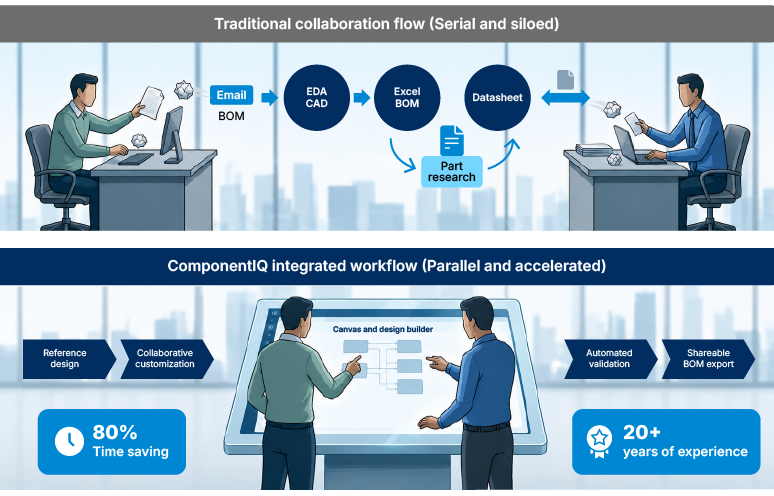
How ComponentIQ saves time while designing semiconductor parts
ComponentIQ addresses each recurring friction point, from tool silos to IP risk, through its four modules.
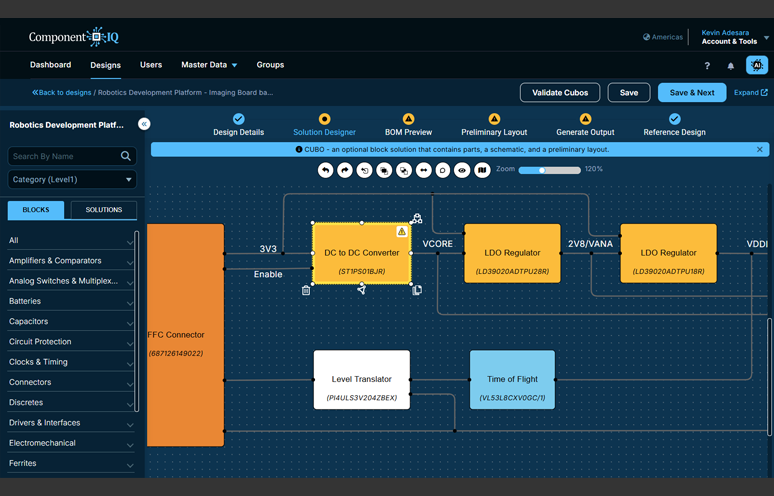
1. Canvas and Design Builder: Engineers and FAEs start from a reference design on a shared engineering canvas instead of a blank page. They drag and drop components onto the canvas. And they customize the design collaboratively in real time rather than back and forth between teams.
2. Product Configurator: This is where preferred vendors get ranked and prioritized. Instead of a design being locked to one supplier’s catalog, teams can set vendor preference order up front and let the platform apply it consistently across a design.
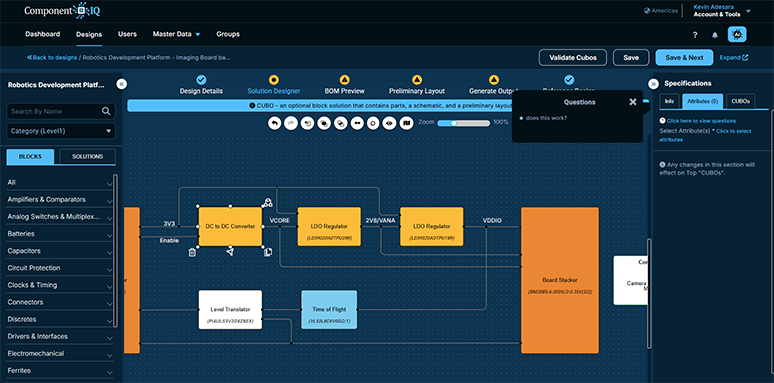
3. Pathfinder: It searches for components by metadata specification across an organization’s PIN (parts information) database. That makes part discovery faster and keeps sourcing anchored to parts a supplier carries and trusts. Engineers can visually select, configure, and evaluate components within the interactive design canvas as shown below.
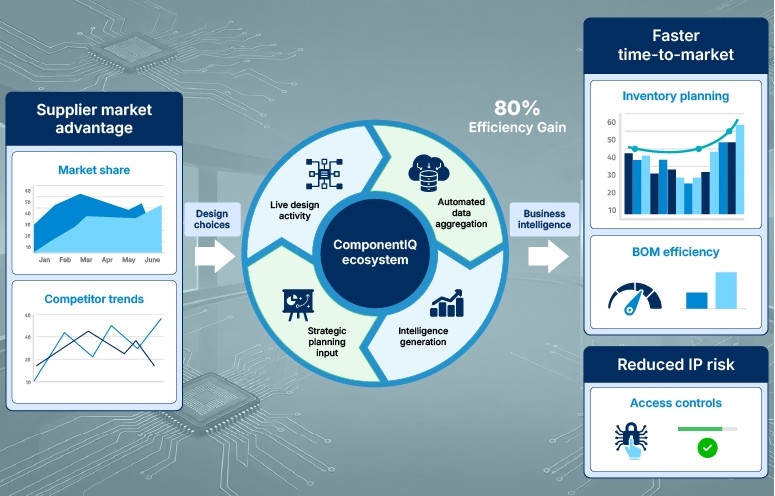
4. Insight Builder: This module turns design activity into business intelligence. It surfaces demand trends and inventory signals based on what’s being selected and configured across projects. It’s the module that extends ComponentIQ beyond an engineering tool into a planning input for the business side.
Validation takes place throughout the process rather than as a separate manual step. The platform checks components against expiry and compatibility rules as they’re placed. Therefore, issues appear immediately instead of during a final audit. Once a design is ready, ComponentIQ exports a complete package, which includes a BOM, schematic layout data, and a shareable document, from the live design.

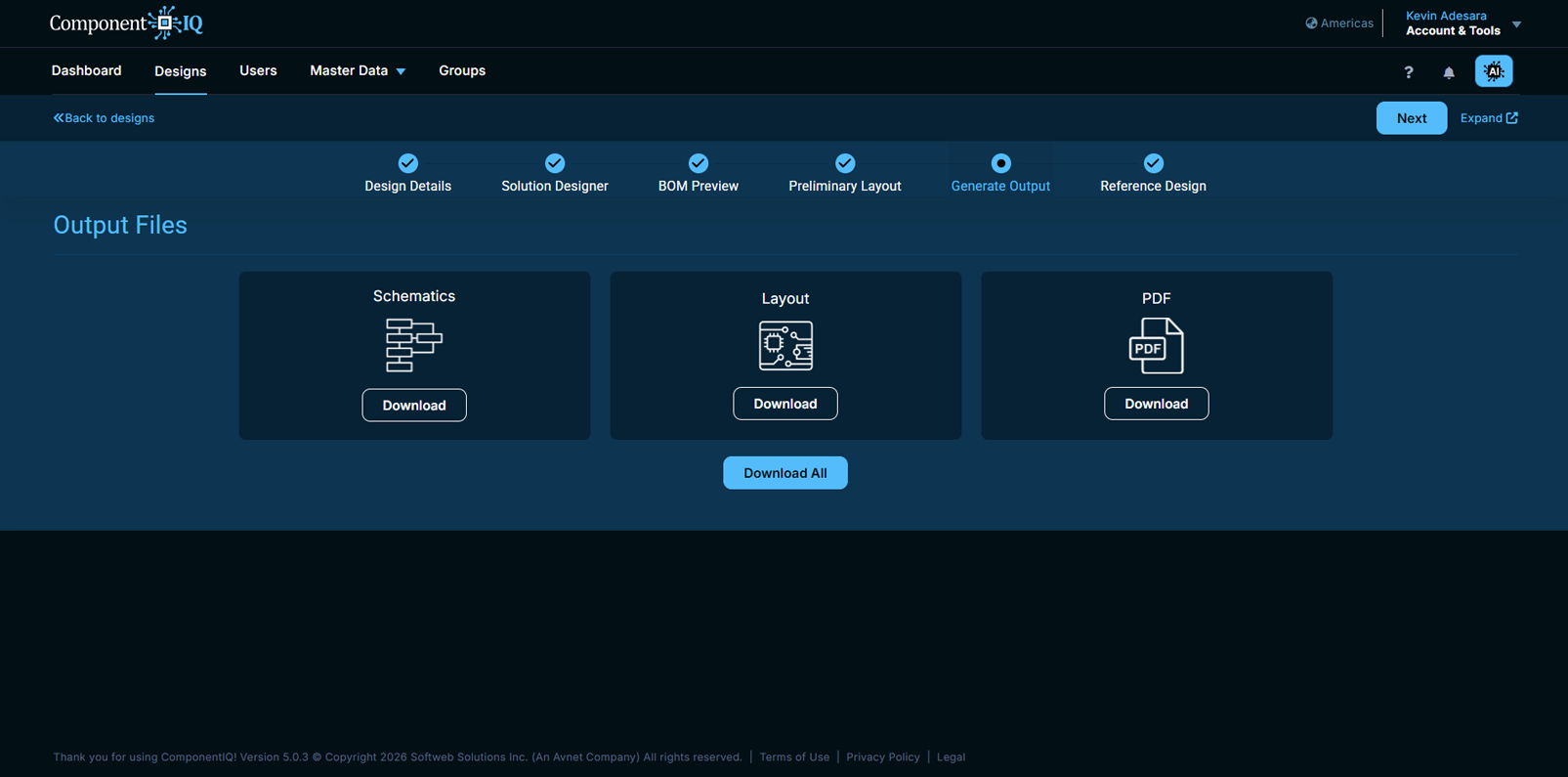
The table below maps each traditional pain point where design time gets consumed to how ComponentIQ can save time.
| Traditional process step | Where time typically gets lost | How ComponentIQ helps | Where ComponentIQ saves time |
|---|---|---|---|
| Design collaboration | Tool silos across design, research, and documentation | Canvas and Design Builder bring reference designs, components, and collaboration into one shared workspace | Eliminates tool switching and reduces coordination time |
| Supplier switching | Manual re-sourcing when a preferred vendor isn’t available | Product Configurator ranks preferred vendors and enables consistent supplier selection | Reduces supplier switching from hours or days to minutes |
| Component research and selection | Slow part research across scattered catalogs | Part Finder performs metadata-driven search across supplier PIN databases | Cuts hours spent searching and comparing components |
| Demand and inventory planning | Limited visibility into part availability and demand trends | Insight Builder surfaces demand forecasting and inventory signals automatically | Improves planning decisions and reduces supply-related delays |
| BOM and documentation | Manual BOM assembly and documentation | MExport stage automatically generates a finished BOM and shareable design package from live design data | Removes an entire documentation cycle per project |
ComponentIQ is not only a theoretical framework. A semiconductor supplier used the platform to streamline reference design management. The company cut time spent on repetitive setup work across projects. Read the full case study on reference design management for the specifics.
What are the benefits of ComponentIQ?
ComponentIQ offers several benefits based on comparable design projects.
- Faster design creation: Starting from a reference design on a shared canvas removes repetitive foundational work from every project.
- Improved team collaboration: FAEs, account managers, and engineering teams work from the same live design instead of emailing files back and forth.
- Reusable design frameworks: Reference designs can be adapted and reused across projects instead of rebuilt each time.
- Faster part discovery and simplified validation: Metadata-driven search through Pathfinder, paired with automated checks, cuts down on manual datasheet comparison.
- Demand forecasting and inventory visibility: Insight Builder turns ordinary design activity into planning intelligence.
- Reduced IP risk: Role-based access and a single controlled workspace replace ad hoc file sharing.
The accompanying diagram shows how live design activity generates real-time business intelligence for executive-level strategic planning.
How to get started with ComponentIQ
A sound approach is adopting ComponentIQ in phases, starting with one pilot project before a wider rollout rather than switching every team over at once. Softweb Solutions guides this through three onboarding stages:
1. Define: Aligns ComponentIQ with your workflows, product categories, and suppliers while reviewing existing component libraries, BOM templates, and design files.
2. Audit: Configures the workspace around your hierarchy, roles, and permissions, then imports reference designs and approved component libraries for teams.
3. Configure and roll out: Runs a pilot project to validate workflows and train users, then expands company-wide with ongoing monitoring and adoption tracking.
Before starting that process, semiconductor suppliers should confirm a few things specific to their environment. How cleanly ComponentIQ’s Pathfinder maps to their existing PIN database, whether current vendor and supplier relationships carry over without disruption, and whether the platform’s access controls meet their IP and compliance requirements. Getting these right upfront shortens the define and audit stages considerably.
To understand how ComponentIQ can help you save time in design, request a demo from our ComponentIQ team.