Fragmented to structured: How Softweb unified systems to build a centralized Product Information Management (PIM) platform for a global semiconductor enterprise
Our client, a global semiconductor manufacturer, managed a large and growing portfolio of analog, power, and mixed-signal devices across multiple business units. They partnered with Softweb to consolidate fragmented product data into a unified PIM, bringing consistency to catalogs and improving how product data is discovered and used across channels.
 Industry: Semiconductor
 Business type: Enterprise
 Services: Data warehouse solution
 Technology: Snowflake, Power BI
Client profile
The company operates in the semiconductor industry, designing and supplying analog, power, and mixed-signal components for engineering and manufacturing use. With a broad product portfolio and a strong presence across industrial, automotive, and communications markets, their operations depend on accurate and accessible product data.
Over the years, the organization expanded through acquisitions, building a diverse ecosystem of systems, teams, and processes. Their global distribution network and direct sales channels span multiple regions and rely on structured product information across engineering, procurement, and partner ecosystems.
Technical challenges
The client relied on multiple product data systems, including legacy PIM tools, ERP, PLM platforms, and document repositories, to manage product information. These systems supported individual functions but lacked alignment, consistency, and integration needed for a unified catalog. As their product portfolio expanded, inconsistent attributes, manual updates, and disconnected workflows made it difficult to maintain reliable product data at scale.

Multiple, overlapping product data stores
Product data across PIM, ERP, PLM, and local systems used different formats and attributes, resulting in duplicate records.

Inconsistent attributes and descriptions
Parameters like voltage, current, and package type varied by business unit, making part comparison and catalog consistency difficult.

Document-driven product updates
PDFs and spreadsheets acted as source data, requiring scripts for extraction, which slowed updates and increased error risk.

Developer-dependent web content
Marketing pages required developer handling for updates, which slowed content changes and created dependency on development teams.
Legacy ERP and PLM platforms
Older systems lacked APIs and required custom data handling, making integration and centralized data management difficult.
Limited ecommerce and search experience
Incomplete filters and inconsistent data made it difficult for engineers to find parts or rely on catalog information.
Knowledge concentrated in expert teams
Insights on alternates and compatibility remained with experts, limiting access and slowing resolution when support was needed.
Our solution
We designed and implemented a centralized product information management solution that unified product data across systems while keeping core transactional platforms unchanged. The approach focused on creating a consistent product structure, consolidating data, and enabling reliable distribution across channels.
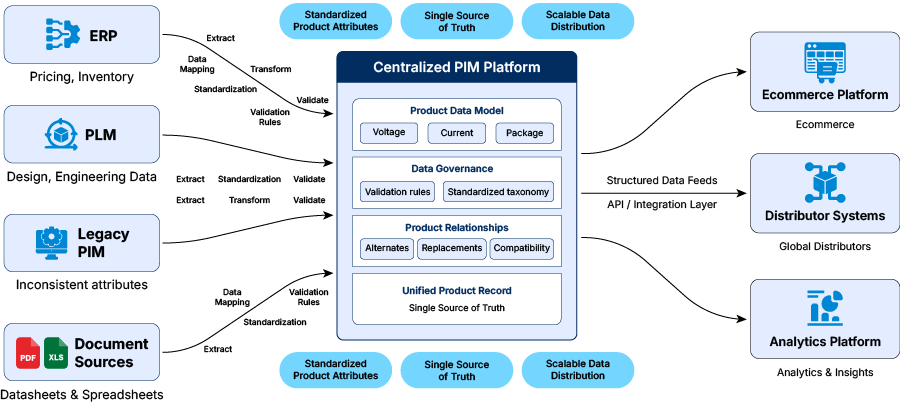
The implementation brought together a structured product model and connected legacy systems through controlled data pipelines. Product data moves through these pipelines into the PIM and is made available to ecommerce platforms, distributor networks, and analytics systems in a consistent format. Product, engineering, and catalog teams now work with a single, governed dataset that supports both operational and customer-facing needs.
Standardized semiconductor product model across portfolios
We worked with engineering, product marketing, and business intelligence teams to define a unified product model that reflects the complexity of semiconductor devices. It included electrical parameters, thermal characteristics, packaging details, compliance data, and lifecycle attributes.
A shared reference was established across product lines to guide how new products are onboarded and how existing data is aligned. The model also defined how product attributes are structured and maintained across systems and digital channels.
Centralized product data into a unified PIM system
We consolidated product data from legacy PIM systems, ERP, PLM platforms, and spreadsheet-based sources into a central PIM. During this process, field-level mapping, validation checks, and controlled value sets were applied so units, naming conventions, and attributes aligned across sources.
Product, engineering, and catalog teams now work with a single product record maintained within the PIM. Data updates follow defined mapping and validation rules, and changes are propagated to connected systems through controlled data flows.
Connected legacy ERP and PLM systems through structured pipelines
We designed ETL pipelines to extract, stage, and transform data from legacy ERP and PLM systems that lacked modern integration capabilities. These pipelines run on scheduled intervals, moving updated product data into the PIM without interrupting existing operations.
Existing ERP and PLM systems remain in place, with the PIM acting as the structured data layer. Product data flows through defined pipelines into the PIM, where it is standardized and prepared for use in downstream applications.
Enabled consistent product data across ecommerce and distributors
The PIM connects with the client’s global ecommerce platform and distributor systems so product data remains consistent across all touchpoints. Structured feeds keep descriptions, attributes, and lifecycle details aligned for every partner consuming the data.
Product data is distributed from the PIM to ecommerce platforms and distributor systems through structured feeds. Each channel consumes aligned attributes, descriptions, and lifecycle data based on predefined data formats and integration rules.
Structured product relationships, alternates, and compatibility data
We expanded the product model to include alternates, replacements, and compatibility links between devices. Information that previously sat with a few experienced engineers is now recorded as structured data within the catalog.
Product relationships such as alternates, replacements, and compatibility links are maintained as structured data within the PIM. These relationships are defined as part of the product model and updated through governed data processes.
Connected product data with analytics and customer insights platforms
We integrated the PIM with analytics systems and the customer data platform to provide visibility into product performance and usage patterns. Data from web activity, product views, and sales outcomes is now connected to structured product information.
Product data from the PIM is connected to analytics systems and the customer data platform through defined data pipelines. Usage, interaction, and sales data are linked with structured product attributes to support downstream analysis and reporting.
Business goals & measurable outcomes
| Business Objective | Business Benefit Delivered |
|---|---|
| Improve data consistency | Unified product model aligned attributes and removed conflicts across systems and teams |
| Enable faster part discovery | Standardized attributes improved filtering and helped engineers identify suitable components quickly |
| Reduce manual update effort | Centralized PIM reduced dependency on scripts and document-based updates across product teams |
| Support scalable product growth | New acquisitions mapped into a shared model, preventing creation of new data silos |
| Strengthen distributor alignment | Structured data feeds ensured consistent product information across global partner channels |
| Enhance product decision insights | Connected analytics provided visibility into product usage, performance, and revenue drivers |
Tech stack
- Core Platform
- Product Information Management (PIM) System
- Enterprise Systems:
- ERP, PLM (Legacy & Modern Systems Integration)
- Data Integration:
- ETL Tools, Data Pipelines, Data Transformation & Mapping
- Data Management:
- Centralized Product Data Model, Data Validation & Governance
- Analytics & Insights:
- Cloud Analytics Platforms, Customer Data Platform (CDP)
- Integrations:
- Ecommerce Platforms, Distributor Systems, Internal Business Applications
- Architecture:
- Centralized Data Platform with API & Pipeline-Based Integration
- Automation & Workflow:
- Data Synchronization, Scheduled Data Processing Pipelines
- Platform Capability:
- Scalable Product Data Management, Multi-Channel Data Distribution
Similar case studies
Connect Now
Our experts would be eager to hear you.

