How Softweb achieved sub-20ms defect detection at 0.93 model confidence for an industrial manufacturer
Our client operates industrial manufacturing and production facilities across multiple locations. They partnered with Softweb to deploy Lyncean, our edge AI inspection platform that centralizes monitoring, automates defect detection, and manages model deployment across inspection systems. The implementation accelerated inspection response, expanded inspection coverage, and simplified monitoring across inspection environments.
 Industry: Manufacturing
  Business type: Enterprise
 - Platform: Lyncean
- Technology: Computer vision, Edge AI, MLOps, Industrial IoT


Client profile
Our client is an industrial equipment manufacturer that designs and delivers production systems, automation equipment, and connected industrial solutions for customers across multiple sectors. Their operations include manufacturing, testing, and inspection activities across production lines, equipment assets, and facility infrastructure.
The organization manages a portfolio of 500+ product variants and supports a large installed base of industrial systems across manufacturing environments. With 10+ manufacturing and engineering facilities, it serves customers in industrial, electronics, and advanced manufacturing markets.
Technical challenges
Our client relied on manual inspection workflows to monitor gauges, identify surface defects, and manage semiconductor inspection operations across multiple facilities. As inspection activity expanded across sites and systems, coordinating inspection workflows and maintaining consistent oversight became increasingly difficult.

Manual inspection workflows
Operators manually inspected gauges and production environments, resulting in delayed readings and inconsistent monitoring coverage.

Delayed anomaly detection
Inspection delays made it difficult to identify defects, contamination, and operational anomalies in real time.

Fragmented inspection systems
Gauge monitoring, defect detection, and semiconductor inspection operated across disconnected tools and workflows.

Limited monitoring scalability
Manual inspection processes could not scale efficiently across multiple cameras, facilities, and inspection points.
Cloud-dependent inspection tools
Existing monitoring systems relied on connectivity for processing, creating operational risks during network interruptions.
Our solution
We implemented Lyncean as the client’s centralized edge AI inspection platform for monitoring, defect detection, and inspection management across distributed environments. The platform connected edge inference, model lifecycle management, and monitoring workflows through a shared operational architecture.
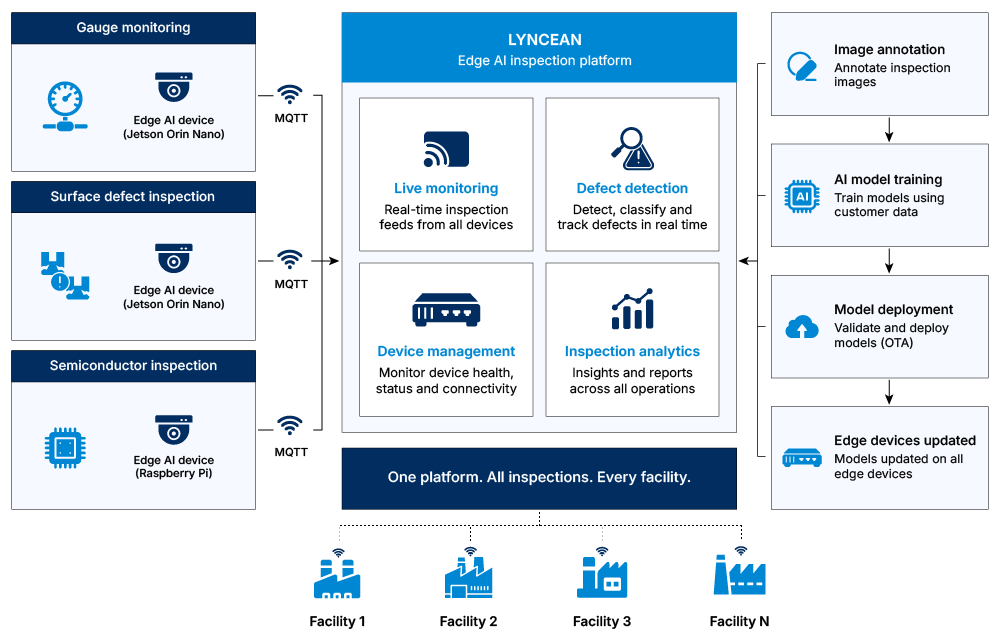
Through Lyncean, edge inference, model lifecycle management, and inspection monitoring operated within a single connected architecture. The architecture spanned every facility the client operates.
Deployed computer vision models on edge devices
We deployed Lyncean edge services on inspection devices positioned across distributed monitoring operations. Local inspection pipelines processed image data at the edge while MQTT messaging connected edge devices with centralized monitoring environments.
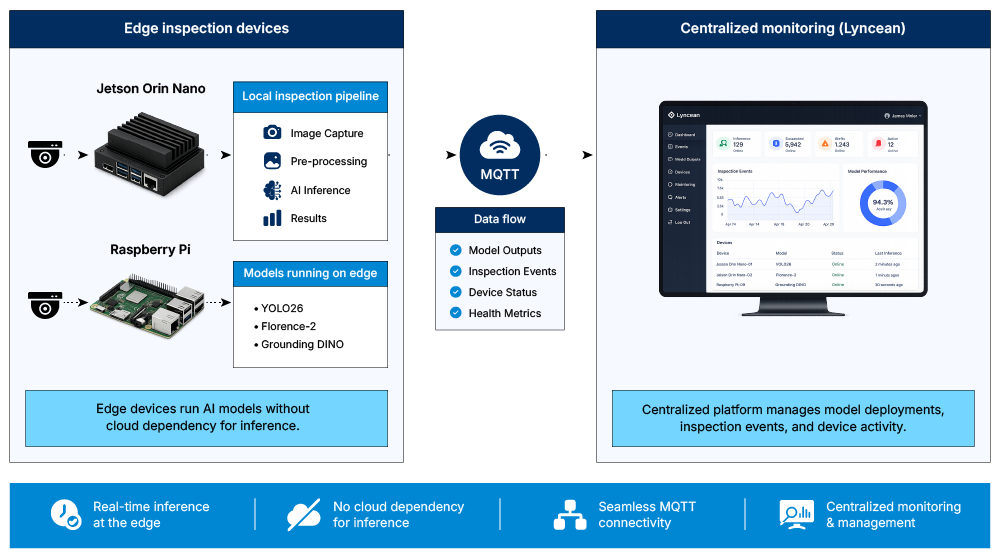
Edge devices such as Jetson Orin Nano and Raspberry Pi ran YOLO26, Florence-2, and Grounding DINO models without cloud dependency for inference. Their model outputs flowed into centralized monitoring workflows that managed model deployments, inspection events, and device activity across connected edge inspection systems.
Centralized model and deployment management
We established Lyncean as the central environment for image annotation, model training, version control, and deployment workflows across inspection systems. Training pipelines processed customer-specific datasets while maintaining controlled model versioning and deployment records.
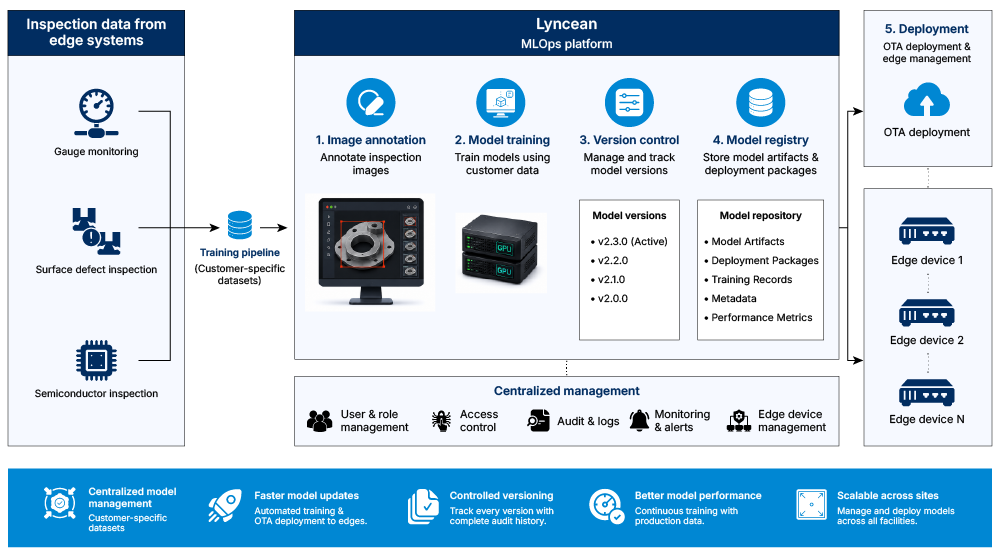
As new inspection data became available, GPU fine-tuning workflows trained YOLO26, Florence-2, and Grounding DINO models using production data collected from connected edge systems. The resulting model versions moved into centralized repositories that managed model artifacts, deployment packages, and training records through OTA deployment and edge device management workflows.
Centralized inspection and operator visibility
We deployed centralized inspection dashboards within Lyncean to support live monitoring, defect tracking, and operational visibility across distributed inspection operations. Connected edge devices streamed inspection activity into monitoring workflows that tracked detection history, inspection status, and operational records.
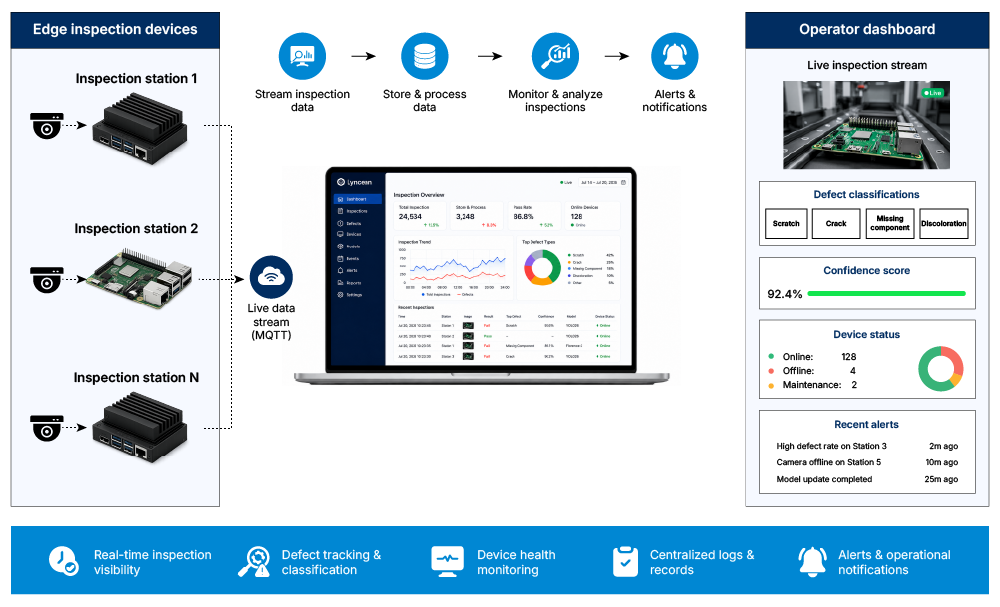
Operator dashboards surfaced inspection streams, defect classifications, confidence scores, and device status from connected inspection points. Connected monitoring workflows organized inspection logs, model activity records, and device information across edge environments.
Configured automated model retraining workflows
We implemented automated retraining workflows within Lyncean to support customer-specific model updates across connected inspection environments. The platform coordinated annotation, dataset preparation, and GPU fine-tuning through centralized training workflows while maintaining model versions and training records.
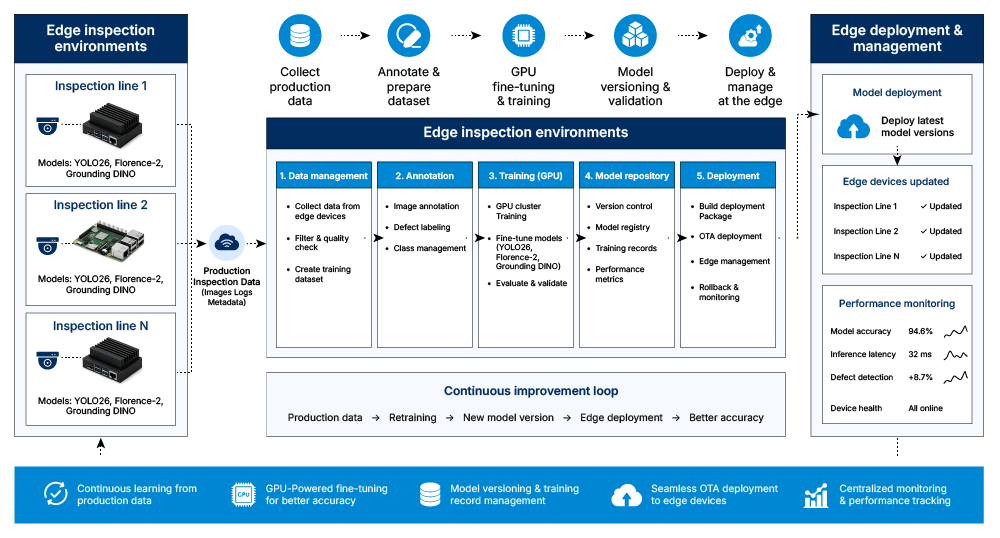
Production inspection data collected from connected edge environments continuously retrained YOLO26, Florence-2, and Grounding DINO models. Each retraining cycle fed centralized repositories that managed updated model versions, deployment packages, and training records through OTA deployment and edge management workflows.
Connected multiple inspection environments through one platform
We unified gauge monitoring, semiconductor inspection, and surface defect detection within Lyncean through a shared inspection environment. Shared deployment pipelines, model management processes, and edge communication layers connected inspection workflows across monitoring systems.
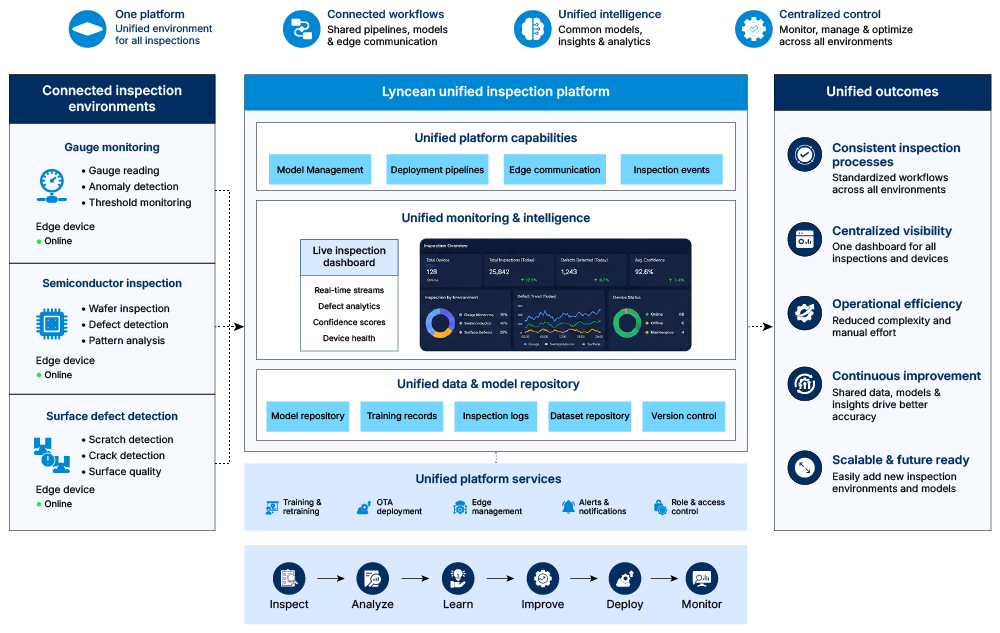
A unified monitoring architecture coordinated computer vision models, inspection events, and operational records across connected edge systems. The platform then maintained training, deployment, monitoring, and inspection management activities across gauges, semiconductor environments, and surface monitoring operations.
Business goals and measurable outcomes
| Business goals | Business benefit delivered |
|---|---|
| Reduce manual inspection dependency | Gauge reading intervals reduced from ~4 hrs to 3 sec, improving inspection coverage across operations |
| Accelerate defect response time | Sub-20ms inspection response enabled real-time pass/fail decisions across production workflows |
| Improve detection accuracy | Model confidence reached 0.93 across deployed inspection and monitoring workflows |
| Improve engineering visibility | 100% visibility into engineering information strengthened collaboration and traceability |
| Expand inspection use cases faster | New inspection scenarios were deployed using as few as 50-100 customer inspection images |
| Maintain inspection continuity | Edge-based inference sustained inspection operations during network interruptions |
| Improve inspection traceability | Searchable audit trails improved visibility across inspection records and monitoring activities |
| Consolidate fragmented inspection tools | Standardized inspection management across gauge monitoring, defect detection, and semiconductor workflows |
Tech stack
- Platform:
- Lyncean edge AI inspection platform
- AI and computer vision:
- YOLO26, Florence-2, Grounding DINO
- Edge AI infrastructure:
- NVIDIA Jetson Orin Nano, Raspberry Pi
- MLOps and model lifecycle:
- Image annotation pipelines, GPU fine-tuning workflows, Model versioning, OTA deployment
- Industrial connectivity:
- MQTT, Edge device communication workflows
- Monitoring and operational visibility:
- Centralized inspection dashboards, Detection tracking, Device monitoring
- Data storage and repositories:
- MinIO, Microsoft SQL Server
- Cloud infrastructure:
- Microsoft Azure Cloud Services, Azure App Services
- Application and APIs:
- Angular, TypeScript, HTML5, CSS3, ASP.NET Core API, C#, REST APIs
- Inspection capabilities:
- Gauge monitoring, Surface defect detection, Semiconductor inspection
Similar case studies
How Softweb Solutions eliminated days of manual invoice work for a global manufacturer

Connect Now
Our experts would be eager to hear you.

