Share
Share
 ChatGPT
 Perplexity
 Claude
 Grok
Grok
 Google AI Mode
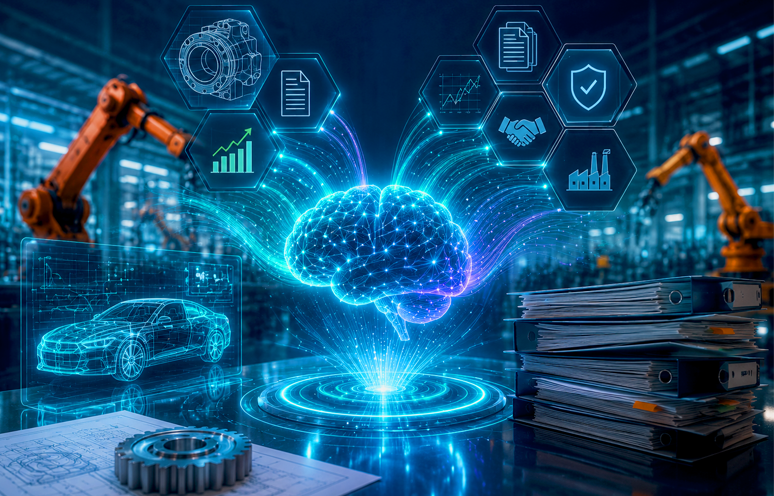
Generative AI (GenAI) eliminates manufacturing engineering documentation by acting as a centralized cognitive layer. It uses advanced search to instantly locate scattered data, real-time synthesis to combine specs into actionable instructions, and automated reconciliation to cross-check versions and resolve conflicting engineering changes.
Manufacturing produces a significant amount of engineering documentation, such as design specifications, CAD models, test reports, compliance records, and supplier documents. Most of this information remains scattered across disconnected systems, making it difficult to locate engineering information.
By finding relevant data across repositories and combining insights from multiple sources, GenAI provides engineers with a unified view of product information. This helps organizations establish a trusted source of truth that supports faster decision-making.
A KPMG study conducted in March 2024, involving over 280 manufacturing decision-makers, found that 53% of companies plan to increase their GenAI investments within 12 months. Additionally, 65% expect reduced costs, and 55% anticipate higher productivity.
In this blog, we will explore why engineering documentation has become complex for manufacturing, the role of LLMs and RAG in engineering documentation, and how search, synthesis, and reconciliation create a trusted source of truth in manufacturing.
Why has engineering documentation become more complex in manufacturing?
As manufacturing operations become more digital and interconnected, managing engineering documents such as product design, production, quality, and compliance has become increasingly difficult.
Growing product complexity
Highly customized products have significantly increased product complexity. Even a small design change can generate numerous documents, such as multiple product variants and frequent engineering changes. Managing such a large volume of documents makes the storage and retrieval of vital information challenging.
Disconnected information sources
A single product may generate thousands of documents throughout its lifecycle, including design specifications, CAD drawings, and compliance documents. These documents are spread across PLM, ERP, CAD, and shared repositories, making it difficult to access and validate information when needed.
Version control
Engineers frequently work on multiple revisions of specifications and drawings, while manufacturing and quality teams may rely on copies stored in different systems. As a result, teams can unknowingly reference outdated documents, leading to production errors, rework, and delays.
Manual traceability efforts
When a quality issue arises, manufacturers must connect requirements, design decisions, validation reports, and production records to determine the root cause. As information was stored in different repositories, teams had to spend a significant amount of time manually tracing vital information.
Compliance requirements
Manufacturing industries need to adhere to ISO, IATF 16949, and AS9100 to maintain strict control over document versions and retention policies. Also, they should be prepared for audits that often involve gathering evidence from multiple systems.
To solve these challenges, organizations must move beyond document management systems. They need a way to connect, understand, and validate engineering information at a scale.
Where does GenAI fit into manufacturing engineering documentation?
Generative AI (GenAI) enables systems to understand context, interpret technical content, and generate responses from large volumes of engineering data. It helps engineers discover relevant information, identify relationships across records, and extract insights that support faster decision-making.
A recent Google Cloud survey found that 74% of companies using GenAI are seeing an ROI within a year. 86% of these companies have also improved their revenues by 6% or more.
GenAI’s three capabilities make it valuable for engineering documentation.
- Context awareness: GenAI can interpret information within context. It understands a specific product, subsystem, engineering change, or manufacturing process. It analyzes the context and relates it across product lifecycles.
- Natural Language understanding: Engineers can interact with documentation and receive a contextual response using conversational queries. For example, an engineer can ask, “Which validation reports support the latest battery cooling system requirements?
- Content generation: GenAI can generate content by analyzing repositories. It can generate summaries, compare specifications, draft technical reports, and consolidate information from multiple engineering sources.
While GenAI provides the technology interface, its ability to understand engineering language, analyze technical documents, and generate meaningful responses depends largely on Large Language Models (LLMs).
The role of LLMs in understanding engineering knowledge
Large Language Models (LLMs) have language understanding and reasoning capabilities that are needed to interpret engineering information.
- Technical language interpretation: LLMs understand manufacturing terminology, engineering abbreviations, technical specifications, and regulatory language within the appropriate engineering context.
- Document understanding: LLMs analyze specifications, inspection reports, engineering change orders, to extract relevant insights. This enables engineers to make accurate decisions.
- Relationship discovery: LLMs identify relationships across engineering artifacts. It connects the requirements of design specifications and link validation results to product requirements, and surface dependencies that may not be explicitly documented.
Although LLMs can interpret engineering language and identify patterns across documents, they cannot automatically access engineering data stored within an organization. This is where Retrieval-Augmented Generation (RAG) becomes important.
Why is RAG critical for engineering documentation?
While LLMs provide language understanding, they lack domain-specific understanding. Retrieval-Augmented Generation (RAG) connects GenAI systems to enterprise knowledge repositories by pulling relevant and verified data from authoritative repositories. It allows engineers to query complex specifications, drawings, and maintenance histories with greater accuracy.
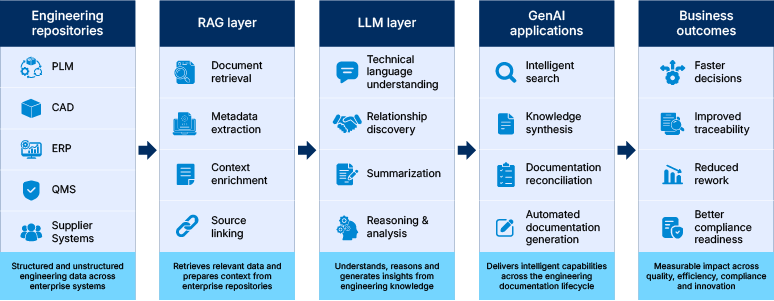
- Accessing enterprise data: RAG retrieves relevant information from PLM, CAD, ERP, quality management platforms, and supplier databases before generating a response, enabling GenAI to work with organization-specific engineering knowledge.
- Source grounding: RAG grounds responses to original engineering documents so that engineers can trace generated insights, increasing trust in the information provided.
Together, GenAI, LLMs, and RAG form the foundations for intelligent search, knowledge synthesis, and documentation reconciliation. These capabilities help manufacturers transform fragmented engineering data into a unified and accessible knowledge repository.
How do search, synthesis, and reconciliation create a trusted source of truth for manufacturing?
GenAI enables manufacturers to easily access and use information such as product requirements, specifications, design documents, validation reports, supplier records, and compliance evidence that are often distributed across multiple repositories.
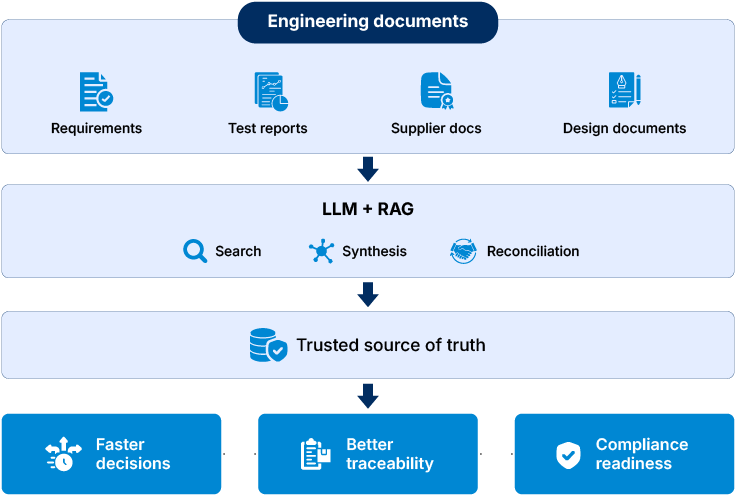
Powered by LLMs and Retrieval-Augmented Generation (RAG), GenAI enables manufacturing organizations to create a trusted source of truth. Engineers can use these technologies to conduct intelligent search, knowledge synthesis, and documentation reconciliation. Using these capabilities, engineering teams can access relevant information faster while improving visibility across the product lifecycle.
Intelligent search across engineering documents
Traditional search engines depend on exact keywords, naming conventions, and often fail when terminology differs between teams or when relevant information is buried within lengthy technical documents.
GenAI uses LLMs to understand the meaning and context behind engineering queries. It interprets user intent and identifies relevant information across documents, even when different terminology is used.
For example, a search for “battery cooling requirements” may retrieve information related to thermal management systems, validation procedures, design specifications, and testing documentation, even if those exact words do not appear in every document.
Searching across structured and unstructured documentation:
Manufacturing organizations manage both structured and unstructured engineering data.
According to Gartner, unstructured data now accounts for 55 to 65% of all new enterprise data and is growing 3x faster than structured data. As engineering data becomes more diverse, manufacturers must manage information stored in both structured and unstructured formats.
| Engineering data type | Examples | Role in engineering processes |
|---|---|---|
| Structured data | Bills of Materials (BOMs), Product Configurations, ERP Records, Engineering Change Orders (ECOs) | Captures product structures, configurations, operational records, and change management information in predefined formats. |
| Unstructured data | Specifications, CAD Documentation, Test Reports, Supplier Documents, Compliance Records, Engineering Notes | Contains detailed engineering knowledge, design intent, validation evidence, supplier information, and regulatory documentation. |
| GenAI + RAG Value | Retrieves and connects information from both structured and unstructured sources | Creates a unified view of engineering knowledge, enabling engineers to access relevant information through a single interface instead of navigating multiple systems manually. |
Enabling natural language engineering queries
One of the most powerful capabilities of GenAI is the ability to interact with engineering documentation using natural language. While searching across multiple systems, engineers can ask questions to GenAI in the same way they would communicate with a colleague.
Example:
An engineer investigating a battery cooling subsystem asks:
“Show all validation reports linked to battery thermal management requirements.”
The RAG layer retrieves relevant documents from the system. And these documents include validation reports, test results, engineering change records, and supporting specifications from enterprise repositories. The LLM then analyzes the information and generates a contextual response. It highlights the relationship between these documents. Engineers receive a consolidated view of the validation evidence associated with the specified requirements. They spend less time searching while improving traceability and decision-making confidence.
Knowledge synthesis: Transforming engineering documents into actionable insights
GenAI addresses knowledge synthesis by analyzing information from multiple repositories. It transforms fragmented engineering data into actionable insights. Using LLMs, manufacturers can consolidate technical information. They can also identify relationships across documents and gain a more complete understanding of products, processes, and engineering changes.
Combining information from multiple sources
LLMs can synthesize information across multiple sources and create a unified view of engineering knowledge. Using this technology, engineers can gather information from different documents such as specifications, testing activities, compliance evidence, and supplier records.
Summarizing complex technical content
GenAI can help manufacturing organizations generate concise summaries while preserving the engineering context. These summaries are generated from specifications, validation procedures, test results, and regulatory requirements. Teams can quickly understand key requirements, design changes, validation outcomes, and compliance implications without reading every document in full.
Supporting faster engineering decisions
Engineering teams frequently need answers that require information from multiple sources. By synthesizing information from relevant documents, GenAI can provide engineers with a consolidated view of the available evidence. This reduces the time spent gathering information and enables faster, more informed decision-making throughout the product lifecycle.
Reconciliation: Closing documentation gaps across the product lifecycle
GenAI-powered reconciliation helps manufacturers identify inconsistencies, validate relationships between engineering artifacts, and ensure information remains aligned across the product lifecycle.
Matching requirements with design specifications
Engineering requirements and design specifications have different purposes, and maintaining alignment between these documents is critical for product quality and compliance.
Using LLMs, GenAI can compare requirements and design specifications. It can also identify discrepancies, missing references, conflicting values, or undocumented changes. This helps engineering teams verify that design outputs fulfill the intended product requirements.
Connecting validation records to product requirements
Validation activities provide evidence that a product performs according to its intended requirements. GenAI can analyze requirements and validation records simultaneously to establish relationships between them. This enables teams to quickly identify which requirements have supporting validation evidence and which may require additional testing or review.
Identifying missing traceability links
Traceability is essential for understanding how requirements, designs, tests, manufacturing processes, and compliance activities are connected.
GenAI identifies missing traceability relationships and highlights areas where documentation may be incomplete. This improves visibility into product development activities and helps organizations maintain stronger engineering governance.
Detecting documentation inconsistencies before they become costly errors
Inconsistencies in documentation are a common reason for engineering rework, production delays, and compliance findings.
Example:
Requirements specify one performance threshold while designing documents to reference another.
- Test reports validate outdated design revisions.
- Manufacturing work instructions do not reflect the latest engineering changes.
- Compliance records miss supporting validation evidence.
GenAI enables proactive reconciliation by continuously comparing engineering artifacts and flagging potential inconsistencies before they affect downstream processes. This allows teams to address issues earlier, reducing risk and improving product quality.
Business impact of GenAI-powered engineering documentation
GenAI helps manufacturers transform fragmented engineering information into a unified engineering knowledge ecosystem by enabling intelligent search, knowledge synthesis, and documentation reconciliation. It enables engineering teams to access information, maintain traceability, support compliance activities, and make product development decisions.
| Engineering documentation challenge | Impact on manufacturing operations | GenAI outcome |
|---|---|---|
| Document search | Engineers spend time navigating PLM, CAD, ERP, quality systems, and shared repositories to locate relevant information. | Faster information retrieval through context-aware search and natural language queries. |
| Manual document reviews | Reviewing specifications, test reports, supplier records, and compliance documents slows engineering workflows. | Accelerated analysis through automated summaries and consolidated insights. |
| Traceability gaps | Relationships between requirements, designs, validation records, and compliance evidence are difficult to maintain and verify. | Improved visibility across the product lifecycle through automated relationship mapping. |
| Compliance preparation | Audit teams spend significant effort gathering and validating supporting documentation from multiple systems. | Reduced audit preparation effort through faster access to traceable engineering evidence. |
| Engineering rework | Documentation inconsistencies and outdated information can lead to design revisions, production delays, and quality issues. | Fewer errors through continuous reconciliation and early identification of documentation gaps. |
| Cross-functional collaboration | Engineering, quality, manufacturing, and compliance teams often work with disconnected information. | Better alignment through a shared view of engineering knowledge and documentation. |
| Product development cycles | Decision-making slows when critical engineering information is difficult to locate or validate. | Faster product development through quicker access to trusted and contextual information. |
Key considerations for GenAI adoption in engineering documentation
While GenAI improves engineering knowledge discovery and traceability, successful implementation requires manufacturing organizations to have a strong foundation of data quality, governance, system integration, and human oversight to ensure reliable outcomes.
1. Engineering data quality
GenAI systems rely on the documents provided for training. If your data includes outdated specifications, duplicate records, inconsistent naming conventions, and missing metadata, it can reduce the quality of responses generated.
2. Disconnected legacy system
Engineering information is located across PLM, CAD, ERP, MES, quality management systems, and shared repositories. GenAI requires access to these isolated systems to generate insightful responses.
3. Traceability and governance
Organizations should have governance frameworks that allow engineers to verify how GenAI-generated insights were produced and which source documents were used.
4. Security and intellectual property protection
Strong security controls are essential when deploying GenAI solutions, as engineering documentation contains sensitive product designs, manufacturing processes, supplier information, and proprietary knowledge.
5. Human oversight
Human validation remains critical for design approvals, compliance activities, and product release processes, although GenAI accelerates information discovery and analysis.
6. Change management and user adoption
Organizations should provide training and clear usage guidelines to encourage effective adoption of GenAI-enabled workflows.
7. Scalability across the product lifecycle
Manufacturers should evaluate how GenAI will support documentation activities across requirements management, product design, validation, manufacturing, quality assurance, and compliance functions.
The future of GenAI in manufacturing engineering documentation
As manufacturing products and engineering documents become more complex, the role of GenAI is expected to move beyond document search and retrieval. Future applications will focus on creating connected engineering environments where information is continuously contextualized and validated throughout the product lifecycle.
AI-native digital threads
Instead of simply retrieving information, GenAI will continuously connect requirements, designs, validation records, manufacturing data, and compliance evidence as they evolve. The digital thread becomes self-maintaining rather than manually updated.
Continuous traceability validation
Today’s traceability is often reviewed during audits or project milestones. Future GenAI systems may continuously monitor engineering repositories and automatically flag missing links, incomplete validation evidence, or broken requirement relationships.
Proactive compliance intelligence
Rather than helping teams prepare for audits, GenAI could continuously assess documentation against regulatory requirements and alert stakeholders to potential compliance gaps before they become audit findings.
Continuous engineering knowledge validation
Future GenAI systems may automatically monitor relationships between requirements, design specifications, validation records, manufacturing instructions, and compliance documentation. They could identify broken traceability links, missing validation evidence, conflicting information, and undocumented engineering changes as they occur. This would help organizations detect issues earlier and maintain greater confidence in engineering information.
Autonomous Documentation Lifecycle Management
Future GenAI capabilities may help automate parts of the documentation lifecycle by identifying outdated records, detecting documents affected by engineering changes, and recommending updates across connected repositories. Rather than relying solely on periodic reviews, manufacturers could maintain more accurate and synchronized documentation throughout the product lifecycle, improving traceability, compliance readiness, and engineering efficiency.
Bringing search, synthesis, and reconciliation together
As engineering documentation continues to grow across PLM, CAD, ERP, quality, and compliance systems, finding the right information at the right time becomes increasingly difficult. Simply storing documents is no longer enough.
GenAI helps manufacturers address this challenge through intelligent search, knowledge synthesis, and documentation reconciliation. Together, these capabilities make it easier to find information, understand its context, and verify its accuracy across the product lifecycle.
The key is to start with trusted engineering data, clear traceability, and strong engineering oversight. When combined with domain expertise, GenAI can help manufacturers build a reliable source of truth that improves collaboration, supports compliance, and enables faster, more informed engineering decisions.