Share
Share
 ChatGPT
 Perplexity
 Claude
 Grok
Grok
 Google AI Mode
AI is transforming manufacturing quality control from a reactive inspection process into a proactive quality assurance system. Manufacturers across industries are expected to deliver defect-free products, maintain production speed, and control operational costs. Failing to meet these expectations can result in production delays, higher scrap and rework costs, warranty claims, product recalls, and loss of customer trust. At the same time, as manufacturing technologies continue to evolve, products are becoming more complex, and customers expect consistent quality with every shipment.
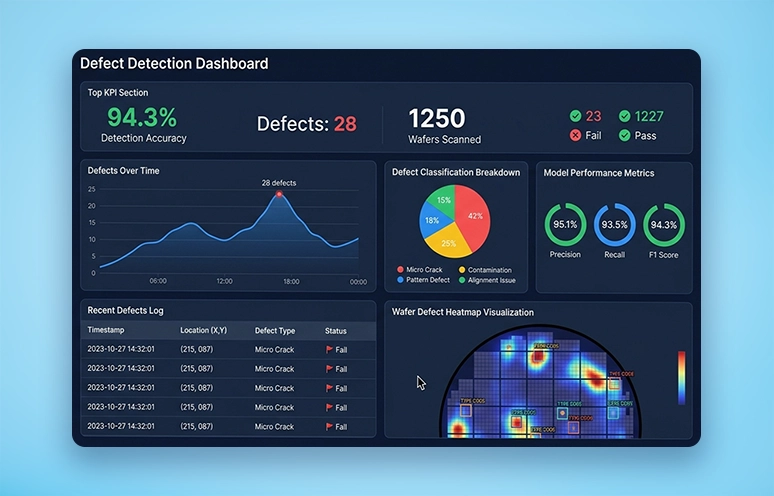
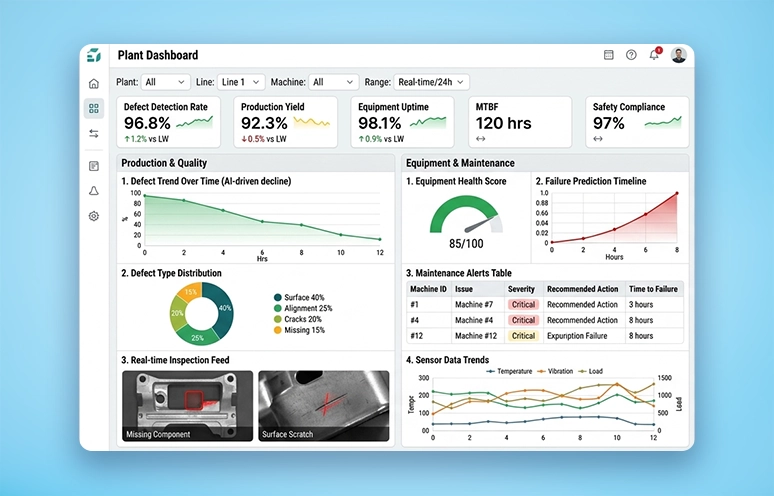
To address this challenge, manufacturers are adopting AI-powered defect detection systems. Using technologies such as computer vision, deep learning, and real-time analytics, AI can inspect every product accurately on the production line. It identifies defects with accuracy and provides immediate quality insights. By implementing AI quality inspection, manufacturers can proactively improve inspection performance, reduce quality-related costs, and make faster decisions on the factory floor.
90% defect detection accuracy can be achieved by implementing machine vision systems powered by artificial intelligence, while enabling more consistent quality inspection across manufacturing operations. – McKinsey & Company
In this blog, we explore why manufacturers are rethinking traditional quality control, how AI enhances defect detection, the implementation challenges, and how leading manufacturers are using AI-powered inspection systems to improve product quality and operational efficiency.
Why are manufacturers rethinking quality control?
Manufacturers are re-evaluating their quality control strategies to reduce defects, improve inspection consistency, and keep pace with modern production environments.
1. Products have become more complex
Modern products are becoming more sophisticated as they feature smaller components and greater customization. For example, semiconductor manufacturers have advanced from 7 nm process nodes to 2–3 nm technologies, packing more transistors into the same chip area, while high-density printed circuit boards now accommodate hundreds of miniature electronic components. Even minor defects can impact product performance and reliability.
2. Need for consistent inspection decisions
Manual inspection depends on the judgment and experience of individual inspectors. Repetitive tasks, fatigue, and increasing production volumes make it difficult to maintain consistent inspection standards across shifts and production lines. Manufacturers are adopting AI-powered quality inspection systems to improve inspection accuracy, standardize quality decisions, and ensure consistent product quality across facilities.
3. Rising cost of poor quality
The cost of poor quality extends far beyond rework and scrap. Defects can cost you millions in losses across scrap, rework, retesting, and warranty claims. For example, on a plant producing 500,000 units at $50 million a year in output, even a 1–2% gap in defect detection can mean $500K to $1M in losses annually. A defect in a single safety-critical component or electronic module can delay production, trigger costly recalls, and result in warranty claims across thousands of vehicles. Identifying defects during the early stages of manufacturing helps manufacturers reduce rework costs, minimize material waste, and prevent defective products from reaching customers.
4. Growing compliance and traceability requirements
As manufacturing operations and supply chains become global, manufacturers must maintain complete traceability of products and inspection records across multiple facilities. Industries such as medical devices, electronics, and automotive must comply with stringent quality and regulatory standards while demonstrating how every product was inspected. Manufacturers are adopting AI-powered quality inspection to automatically capture inspection data, improve traceability, and support regulatory compliance across global manufacturing operations.
How does AI enhance quality control in manufacturing?
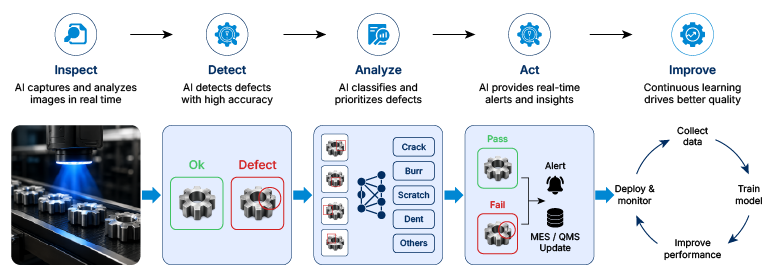
AI enhances quality control by analyzing product images and production data in real time, comparing them against learned defect patterns, and identifying deviations that may indicate quality issues. It continuously learns from inspection results and operator feedback to improve defect detection accuracy, inspection consistency, and quality decisions across the production line.
Image acquisition for complete product inspection
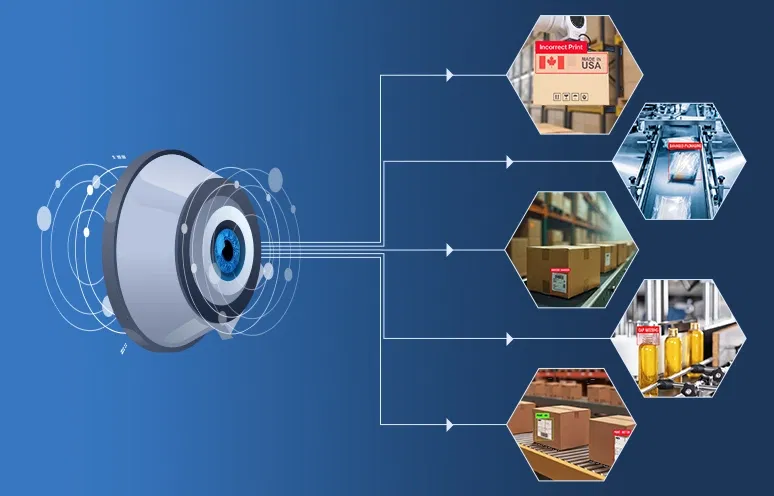
AI-powered quality control uses an industrial camera to capture high-resolution images of the product moving through the production line. Instead of inspecting selected samples, the AI model analyzes each product accurately and flags product defects, providing complete visibility into product quality. This reduces the chances of defective products escaping from the inspection process.
Computer vision identifies defects with greater precision
Identifying small defects such as cracks, dents, and surface imperfections can be difficult to detect during high-speed production. Computer vision analyzes every captured product image against the standard images to identify defects accurately. This process is also called automated defect detection. It allows manufacturers to detect quality issues at an early stage and reduce inspection errors across the production line.
Deep learning classifies defects and detects anomalies
New defect patterns emerge when production conditions change. Deep learning models learn from historical inspection data, identify abnormal patterns, and measure dimensional deviations that traditional systems can easily overlook. This technology enables manufacturers to identify abnormal patterns that can easily escape traditional inspection systems.
AI makes real-time quality decisions
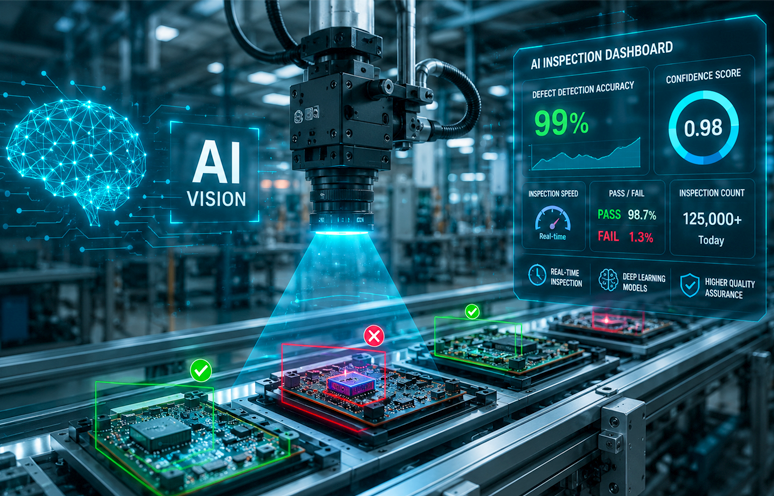
Delays in detecting defects can lead to rework or production losses. AI models analyze inspection results in real time and determine whether a product meets predefined quality standards. The system triggers pass or fail based on the inspection result. Machine vision identifies defective products and alerts the operator to take immediate action. This proactive approach enables manufacturers to resolve quality issues before they impact the entire operation.
Continuous learning improves inspection performance
Traditional inspection systems require manual updates when new defect types are detected. Deep learning technology learns automatically from inspection images and feedback from operators and improves inspection accuracy. As this technology inspects more products, the ability to identify new defect patterns improves. Moreover, it also identifies root causes and delivers accurate and consistent results. This enables manufacturers to continuously improve the inspection process that improves quality control.
What are the challenges in implementing defect detection in manufacturing?
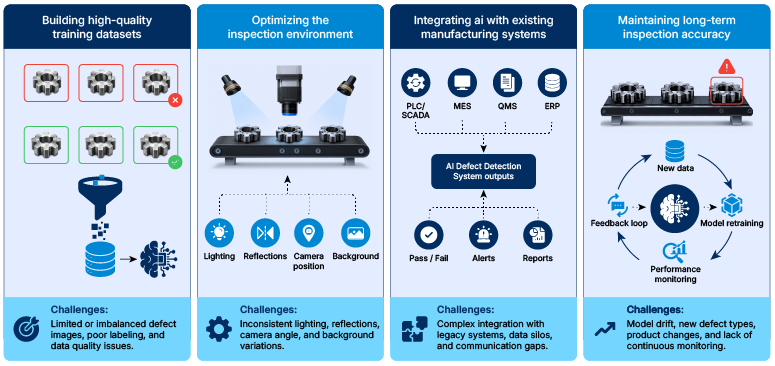
Manufacturers encounter technical and operational challenges when deploying automated defect detection, as it requires careful planning. An experienced AI implementation partner can address these challenges and ensure the system delivers reliable inspection results.
1. Building high-quality training datasets
AI models require large volumes of accurate labeled inspection images to train and identify defects accurately. Many manufacturers have limited images of defective products or rare defects on which AI models can train themselves. This limitation reduces AI’s capability to generate accurate inspection results. An experienced AI team can address this challenge by collecting historical inspection data using data augmentation techniques. Continuous image collection enables manufacturers to create robust training datasets that enhance model accuracy over time.
2. Optimizing the inspection environment
The accuracy of AI quality inspection depends on the quality of the images captured. Inconsistent lighting, reflection, and improper camera placement can impact the quality of images captured, thus generating false positives. An AI expert can optimize camera positioning, evaluate the production environment and lightning conditions that enhance your AI’s capability to capture high-quality images across the production line.
3. Integrating AI with existing manufacturing systems
AI generates accurate inspection results when it is integrated with the production system. Manufacturers face challenges integrating AI with PLCs, MES, SCADA, or quality management systems, particularly when their production facility consists of legacy equipment. Designing a scalable integration architecture can enable inspection results to trigger pass or fail decisions and production alerts. It enhances quality reporting without disrupting existing quality inspection processes.
4. Maintaining long-term inspection accuracy
Organizations fail to regularly update AI models when new materials or production processes are introduced. This increases the chances of false positives and reduces model accuracy. Model retraining and continuous monitoring enable automated defect detection systems to adapt to the evolving product variants while maintaining consistent and reliable quality decisions.
Real-world use cases of implementing AI defect detection in manufacturing
Manufacturers are using automated defect detection to improve inspection accuracy and identify quality issues before products move from the production line. We have listed four real-world examples that describe how computer vision in manufacturing is helping leaders achieve consistent and scalable quality control.
BMW reduced paint defects by 40% through AI-powered visual inspection
Defects such as scratches and surface imperfections are difficult to identify through traditional rule-based vision systems due to their reflective vehicle surface. BMW implemented an AI-powered visual inspection system that identifies paint defects in real-time from the production line. The deep learning models identify minor defect patterns and immediately alert the production teams. Implementing computer vision technology, they reduced paint defects by 40% and completed each vehicle body inspection in less than two seconds.
Bosch accelerates defect detection using generative AI
When launching new production lines, manufacturers have limited defect images to train AI inspection models. Bosch faced this challenge while manufacturing electric motor stators. To mitigate this challenge, Bosch used generative AI to create realistic synthetic images for automated optical inspection. The AI model learned from both real and synthetic defect images, thus detecting defects in the early stage of the production line. This reduced the AI model development by 6 months and improved inspection readiness for new manufacturing lines.
Foxconn achieved 99% accuracy in inspection with deep learning
Manual inspection struggled to generate accurate inspection results while inspecting smart PV controllers for issues like incorrect silicone grease application, missing amounts, and misaligned or missing nameplates. Foxconn deployed an AI-powered inspection system for a dedicated production line. Using the AI computing algorithms, they verified silicone color and quantity and confirmed correct nameplate placement in real time. The system inspected more than 6,000 devices per month and achieved an accuracy of 99%. They turned their AI inspection technology from automated to intelligent quality inspection.
Siemens reduced field failure by 46% by implementing AI-driven approach across operations
As Siemens scaled its Nanjing facility, their traditional inspection methods couldn’t keep up with the frequent production line reconfigurations and rising quality expectations. Siemens designed, tested, and optimized the Nanjing facility entirely in the virtual world before construction began. They applied digital twins and continuous AI-driven technologies across operations. The plant reported a 46% drop in field failures, and the World Economic Forum recognized it as a Global Lighthouse Factory for its performance in cost and quality.
The future of AI-driven quality control in manufacturing
Future AI systems will continuously learn from new inspection data, support autonomous quality decisions, and provide deeper insights into process improvements, enabling manufacturers to achieve more consistent quality while reducing production costs.
1. Predictive quality management
AI will identify process variations and equipment conditions that may lead to defects, allowing manufacturers to prevent quality issues before they impact production.
2. Foundation vision models
Pre-trained vision models will reduce the time and effort required to build AI inspection systems for new products, production lines, and defect types.
3. Edge AI inspection
More AI models will run directly on edge devices, enabling real-time inspection with lower latency while reducing dependence on cloud connectivity.
4. AI-powered root cause analysis
AI will correlate inspection data with machine, process, and production information to identify the underlying causes of recurring quality issues more quickly.
5. Connected quality ecosystems
AI-powered inspection systems will integrate more closely with MES, ERP, PLC, and digital twin platforms, providing manufacturers with a unified view of quality across the production lifecycle.
Transform quality control with AI defect detection
Building a quality control process that consistently identifies defects begins with improving how products are inspected. Using technologies such as AI, computer vision, and data analytics, manufacturers can inspect every product consistently, detect defects earlier, and provide actionable insights that improve quality across the production line.
According to the World Economic Forum, manufacturers implementing AI and advanced analytics across Lighthouse Factories have achieved up to a 50% reduction in quality defects while improving productivity and operational performance.
Manufacturers that integrate AI-powered defect detection into their quality control processes will be better positioned to reduce quality-related costs, improve product consistency, and adapt to evolving production requirements without compromising inspection accuracy.