Share
Share
 ChatGPT
 Perplexity
 Claude
 Grok
Grok
 Google AI Mode
Manufacturers can create a single operational view across the fab by connecting equipment and manufacturing systems that manage equipment, production, quality, maintenance, inventory, and planning. To enable consistent communication between these systems, the ISA-95 standard provides the integration framework that enables these systems to exchange information and coordinate manufacturing operations.
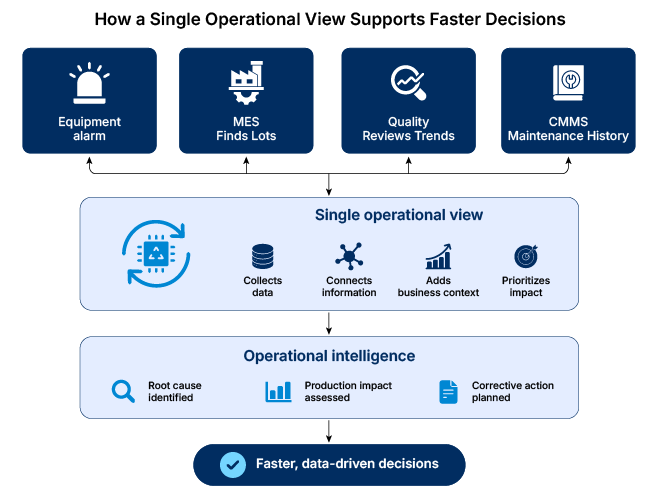
When machine events such as equipment alarms and process completions are linked with production lots, processes, quality metrics, maintenance records, and production schedules, manufacturers gain a complete picture of factory operations. This approach allows teams to understand how events in one area of the fab influence production performance, quality outcomes, and equipment availability, making it easier to identify issues and prioritize corrective actions.
In this blog, we’ll explore the building blocks, implementation phases, and best practices for creating a unified operational view that supports more efficient and resilient semiconductor manufacturing.
Why do manufacturers still struggle with fragmented operational visibility?
Semiconductor manufacturers struggle with fragmented operational visibility due to highly siloed legacy systems and complex multi-site supply chains. Siloed data prevents real-time tracking and slows down root cause analysis.
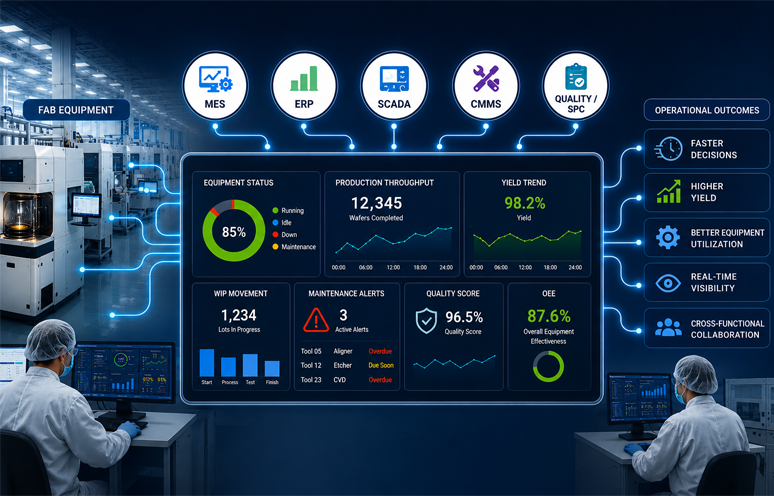
Manufacturers can solve these challenges by creating a single operational view, by linking equipment with manufacturing applications. Protocols like SECS/GEM and OPC UA enable standardized communication between semiconductor tools and higher-level systems. It ensures machine data is captured and stored at a unified source. This data then flows into MES, ERP, SCADA, and CMMS platforms, where production execution, planning, maintenance, and quality activities are coordinated. True visibility is achieved when this data is unified into an integration layer, allowing operational signals to be interpreted in a consistent format across the fab operations.
What does a single operational view look like in practice for semiconductor manufacturing?

For semiconductor manufacturers, a single operational view is a connected layer that integrates enterprise data with floor operations in real time. It eliminates silos across MES, ERP, SCADA, CMMS, and quality systems, giving stakeholders end-to-end visibility from raw silicon to finished, packaged chips. Equipment signals reach teams in real time as they are working from the same operational data at the same time.
- Real-time visibility:
Data from MES, ERP, SCADA, CMMS, and SPC flows into a unified operational layer. Process variables, tool status, WIP movement, quality metrics, and maintenance activity are all visible in real-time within a single operational layer. This enhances visibility, and decision makers act immediately, without waiting for the escalation chains. - Cross-functional decision-making:
When production, engineering, quality, and maintenance share the same operational data, there is no data conflict. They respond to the same event with the same context. This shared alignment reduces the time between identifying an issue and acting on it.
Practical framework for building a single operational view for semiconductor manufacturing
Manufacturers can establish a connected operational foundation through a single operational view to standardize data across systems and transform operational information into meaningful business insights. Here are four phase frameworks that outline the key stages for building a unified operational view that supports faster, more informed decision-making.
Phase 1: Assess your current operational landscape
The first step is to identify how data moves across the fab. Manufacturers should document existing enterprise systems, define data ownership, evaluate integration points, and examine manual reporting processes that cause delays in decision-making. Since many fabs operate with disconnected MES, ERP, SCADA, maintenance, and quality systems, they provide partial operational visibility. Assessing the current environment enables teams to prioritize integration where data is most fragmented or where connecting systems will have the greatest impact on operational visibility.
Phase 2: Connect equipment and manufacturing systems
Once you understand the operational landscape, the next step is to create a connected manufacturing environment. Manufacturers should ensure that their semiconductor equipment data flows through standardized interfaces such as SECS/GEM. They should also ensure OPC UA enables secure and interoperable information exchange between industrial systems. Integrating the standardized data with MES, ERP, SCADA, and CMMS platforms allows operational and business information to move seamlessly across the fab as outlined below.
| Integration layer | Purpose |
|---|---|
| Equipment connectivity | Collect standardized machine data |
| Manufacturing systems | Connect production, quality, and maintenance workflows |
| Data integration | Standardize operational information across systems |
Phase 3: Create context around operational data
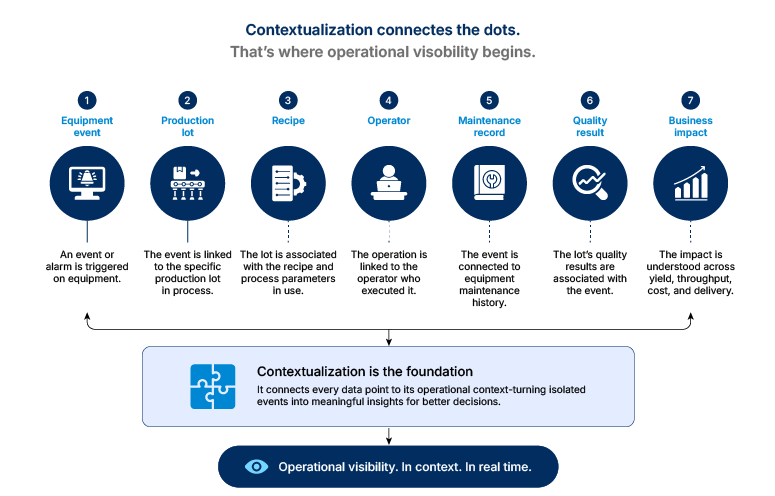
Connected systems are not enough for operational visibility. Machine events must be understood within the production and business context, so the data generated is insightful for decision-making. Associating equipment events with production, process, maintenance history, and quality results provides contextualization that transforms isolated operational signals into actionable insight. Thus, teams spend less time reconstructing what happened and devote time to taking corrective actions.
Phase 4: Deliver operational intelligence
The final stage delivers operational data as actionable intelligence. Role-based dashboards, KPI monitoring, automated alerts, root cause analysis, and AI-assisted recommendations provide engineering, production, maintenance, and quality teams with a shared operational picture. A single operational view provides a reliable foundation needed to implement these improvements. It enables faster decisions, improves cross-functional collaboration, and supports continuous operational optimization.
The measure of operational intelligence should represent how quickly teams can move from detecting an issue to implementing a corrective action.
Phase 5: Establish governance
A single operational view remains effective only when operational data is consistently managed. Establish governance by defining clear data ownership, standardizing data definitions, and implementing policies for data quality, access, and system updates. Regular reviews help maintain data accuracy, ensure consistent reporting across teams, and support reliable operational decisions as manufacturing processes, equipment, and business requirements evolve.
Real-world use cases for a single operational view across the fab
Building a single operational view delivers value only when operational data translates to measurable business outcomes. By providing a shared operational context, manufacturers can proactively identify production risks, optimize workflows, and improve decision-making at every stage of wafer manufacturing.
1. Detect production bottlenecks
Production bottlenecks rarely originate from a single machine or process step. Isolated dashboards fail to identify equipment slowdowns, unexpected maintenance activities, process variability, or material constraints in real time. A single operational view unifies production status, equipment utilization, and process data in real-time. When connected data shows production has begun to slow down at specific process steps, it alerts operations teams. Teams can now identify potential risks before they escalate and take corrective actions before throughput is affected.
2. Improve WIP visibility
Work-in-progress (WIP) passes through numerous processes before a wafer is completed. Without connected operational data, tracking lot status across multiple tools and production stages becomes unreliable. Integrating MES, equipment, scheduling, and production data provides a real-time view of WIP movement. This allows planners to identify delays, optimize dispatching decisions, and improve production flow across the fab.
According to McKinsey, fabs that have employed these analytic approaches and solutions have seen up to a 30% increase in structural bottleneck tool group availability and a roughly 60% decrease in WIP sustained for extended periods of time.
3. Correlate equipment health with yield
Equipment performance directly influences process stability and product yield. But these correlations are difficult to identify when maintenance and quality data exist in separate systems. Contextualizing equipment alarms, maintenance records, process parameters, and inspection results help engineering teams identify patterns between equipment conditions and yield performance. This allows operations teams to take corrective actions proactively before recurring issues affect larger volumes of production.
4. Accelerate root cause analysis
Root cause investigations frequently require engineers to gather information from multiple systems before identifying the source of a production issue. A single operational view reduces this effort by connecting equipment events, production history, quality results, maintenance activities, and process history within a shared operational context. Engineers can trace the sequence of events within a single operational view. This reduces investigation cycles and enables teams to implement corrective actions with greater confidence.
Best practices for implementing single operational views in semiconductor manufacturing
Building a single operational view in semiconductor manufacturing requires a unified data architecture that integrates MES, ERP, and equipment sensors into a unified operational layer. However, manufacturers that sustain operational visibility over time share a common approach. They treat data quality, system connectivity, and user adoption as priorities and core business objectives.
The following operational visibility readiness checklist outlines the practices that support long-term success.
- Standardize equipment connectivity: Implement protocols such as OPC UA and SECS/GEM across all tool types to ensure reliable machine data is captured at the source.
- Establish common data definitions: Align on how key terms such as downtime, yield, and cycle time are defined across production, quality, and maintenance teams.
- Prioritize high-value production lines: Begin data integration with the production lines where visibility gaps have the greatest impact on output, quality, or cost.
- Connect maintenance and quality data: Equipment history and quality results must be linked so that patterns across both can be identified and acted upon together.
- Automate KPI reporting: Eliminate manual data pulls from daily operations. Automated reporting reduces errors and ensures teams are always working from current information.
- Review data quality regularly: Connected systems are only useful if data is flowing seamlessly through them. Periodic audits are vital to conduct, as they prevent silent errors from affecting decisions.
- Design dashboards around user roles: Production managers, process engineers, and maintenance leads need different views. Dashboards should be designed around user roles that support role-specific decision-making.
A single operational view turns data into decisions
A single operational view is most effective when it becomes the foundation for every operational decision. This means ensuring every production event is interpreted within its full operational context. It enables teams to make faster and more reliable decisions based on shared information.
According to McKinsey’s semiconductor manufacturing analysis, implementing connected systems in fabs can improve equipment productivity by 10–20%, reduce quality losses by 30–50%, and shorten cycle times by 30–50%, highlighting the performance impact of connected and data-driven operations in semiconductor manufacturing environments.
Manufacturers don’t need to transform the entire fab at once. They should start by connecting the systems that have a significant impact on production performance. Then they can establish consistent data standards and expand as measurable improvements emerge. The organizations that invest in building a trusted operational foundation today will be better equipped to improve yield, increase operational agility, and adopt advanced capabilities as semiconductor manufacturing continues to evolve.