Share
Share
 ChatGPT
 Perplexity
 Claude
 Grok
Grok
 Google AI Mode
There is only one way to improve and sustain data quality in a manufacturing company: set up your teams with the right digital tools and the right processes.
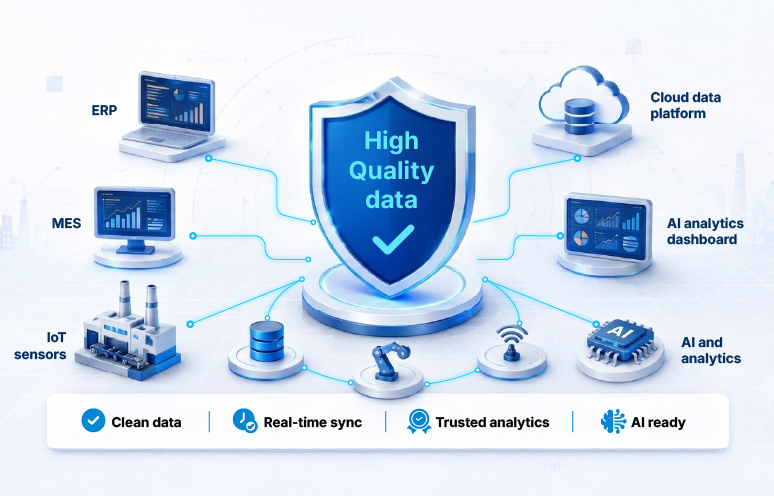
Data quality issues show up in different ways, such as duplicate records across systems, missed production entry, unstructured reports, incomplete data mapping, and delayed sync between ERP and MES. These issues compound and cause delayed production, inaccurate decisions, compliance issues, and failed AI implementations.
However, when you give your teams the right tools and implement the right processes, data quality becomes a managed practice. In this blog post, we will share a step-by-step process to improve and sustain data quality in manufacturing with technology solution recommendations to get started.
Step one: Identify the specific challenges in your data system
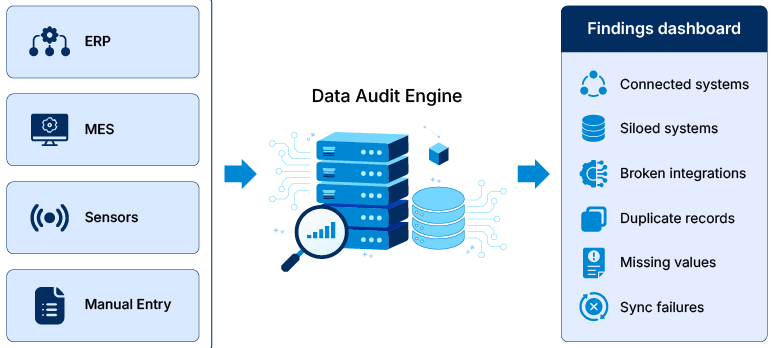
You can start by analyzing the relationship between your data and business performance. And accordingly, audit your current data sources — ERPs, MES, sensors, and manual inputs. It will help you identify where duplicates, gaps, sync failures, missing data points, and mismatched values are most frequent.
For example, if your production reports consistently show output numbers that do not match your MES recording, the issue could be a delayed sync or a manual entry. Just one discrepancy alone can skew your OEE calculations and lead to decisions based on inaccurate data. In such a situation, you can set up an integration process using an API integration tool to sync data between your ERP and MES in real time. And it will remove the lag that causes the mismatch.
Your IT team can run a full audit from procurement to production to analyze the data performance.
Step two: Define what ‘good enough’ data quality is for you
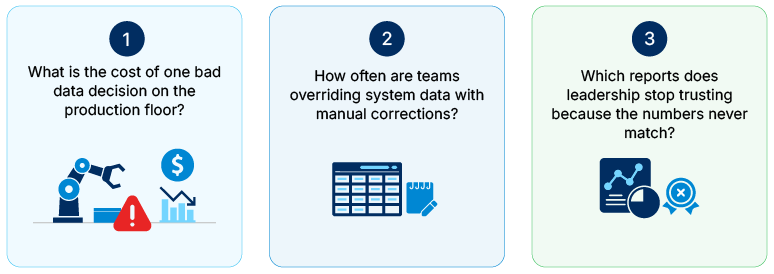
Data quality is subjective. Different companies look at it differently because its impact varies factory to factory. Therefore, once you know where your data breaks, the next step in order is to define your quality thresholds, i.e., the minimum standard your data must meet for your operations to run without disruption.
For a semiconductor manufacturer, that could mean sensor data updated every few seconds to catch micro-defects in real time. For an automotive manufacturer, it could mean zero tolerance for missing traceability records across the supply chain.
You can define these by function: what does production need, what does quality control need, what does your AI or analytics layer need to perform reliably.
Step three: Develop and carry out a data quality improvement plan
Get together with your IT team and department leaders to outline the plan: which issues to fix first, who is responsible for each fix, and which tools will support the process. You can build it for quarterly and yearly goals.
For example, if your quality control team is manually entering inspection reports, your plan should prioritize automating that process before building any AI-driven defect detection on top of it.
Simultaneously, you can define roles and assign data quality assurance responsibilities.
A CDO (Chief Data Officer) can be a top-level management professional who designs strategies for data management, quality tracking, and adoption across the organization.
A data steward can be responsible for quality control, and a data literacy leader can be a senior team member who takes responsibility for ensuring data literacy across the organization and enables data to produce value.
Step four: Deploy digital solutions that make corrections at scale
While each company has its own data quality goals and sustainability measures, there are a few systems that are must-haves for making data corrections at scale in manufacturing. They can augment people and automate processes so that you can improve the data quality faster.
1. ETL tools
When your production data stays in disconnected systems, ETL tools extract it, clean it, and load it into a format your teams can actually use. They are the starting point to remove the inconsistencies that show up between your ERP, MES, and sensor outputs.
2.Data integrations tools
Once your data is clean, integration tools keep it flowing automatically across systems in real time. For manufacturers running legacy and modern systems side by side, they help eliminate the manual syncs and delayed handoffs that cause data quality issues in the first place.
3.Data quality monitoring tools
These tools catch issues before they reach your reports or your AI models. Instead of discovering a mismatch after it has already impacted a production decision, your team gets alerted at the source.
4.Data observability tools
When a data quality issue surfaces, your IT team needs to trace it back to where it started. Observability tools give them that visibility across the entire pipeline, from data entry to final output so issues are resolved faster and do not repeat.
5.Manufacturing intelligence systems
Once your data is clean, integrated, and monitored, manufacturing intelligence systems turn it into decisions. They connect production performance, quality metrics, and supply chain data into one view, so your leadership is acting on what is actually happening on the floor, not last week’s report.
Step five: Set up long-term governance practices
While improving data quality is a project, sustaining it is a practice. Once your tools and processes are in place, you need governance structures that maintain the same data quality you set at the beginning and improve from there. Prepare a governance manual with the collection of roles, policies, workflows, standards, metrics, etc., that aligns with your business objectives. You can update it as you achieve your quality goals and your data requirements evolve with the business.
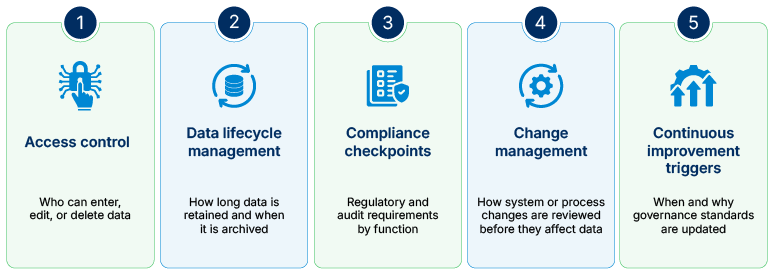
Data quality and data governance work together. While one sets the standard, the other protects it. Without governance, even the best data quality improvements degrade over time because there is no structure enforcing who is responsible, what is acceptable, and what happens when standards are not met.
Manufacturing CIOs, take an agile way to correct data at scale
You need not fix all of your data issues at once. Start with the data source that is causing the most disruption today. It could be a sync failure between your ERP and MES or manual entries skewing your production reports. Once you fix it, measure the impact and move to the next priority.
However, please know that the speed at which you move through each step depends on the expertise and tools your team has access to. Most CIOs who make meaningful progress on data quality have a digital partner who has already solved these problems in similar manufacturing environments. They bring the institutional knowledge, the right digital solutions, and the ability to sequence the work so you and your team do not have to build everything from the ground up.
If you want to start with a clear picture of where your data stands today, talk to our team.