Salesforce integration services
Connect Salesforce with ERP, marketing, and third-party apps through integration solutions that unifies data for faster decisions.
Talk to a Salesforce expertConnect Salesforce with ERP, marketing, and third-party apps through integration solutions that unifies data for faster decisions.
Talk to a Salesforce expertOur Clients



Your CRM holds valuable customer data, but when it operates in isolation from ERP, marketing, and support systems, your teams work with incomplete information. Disconnected systems result in manual entry, inconsistent records, and delayed decisions. Salesforce integration services help you connect these platforms so that you can maintain a single source of truth and respond with complete context.
Softweb Solutions delivers Salesforce integration with 25+ certified specialists who understand both the platform and complex business environments. We design custom integrations using API connections, MuleSoft, and native Salesforce tools. Our data integration services ensure accurate synchronization while addressing security, compliance, and scalability from day one.


We connect Salesforce with your ERP, accounting, and business applications to create unified customer records. Our approach includes data mapping, field synchronization, and validation rules that keep records consistent across all connected platforms.

We build secure API connections between Salesforce and external applications using REST and SOAP protocols. And we handle authentication, endpoint configuration, payload design, and error handling to ensure reliable communication.

We transfer data from legacy systems into Salesforce while cleaning, mapping, and validating records for accuracy. Our synchronization processes run on scheduled intervals or real-time triggers to keep your CRM current with connected systems.

We connect Salesforce with marketing automation platforms like HubSpot, Pardot, and Marketing Cloud to unify lead and campaign data. As a result, contacts, campaign responses, lead scores, and engagement metrics flow automatically between your marketing tools and CRM.

We build automated workflows that trigger actions across connected systems based on Salesforce events. Our configuration includes triggers, approval chains, notifications, and cross-system updates that execute without manual intervention.

We integrate Sales Cloud, Service Cloud, Marketing Cloud, and other Salesforce products into a unified environment. Our team aligns data models, sharing rules, and automation so information moves consistently between applications.

We connect Salesforce with the applications your business depends on, from collaboration tools to industry-specific platforms. Our team configures each connection with proper authentication, field mapping, and sync schedules tailored to your requirements.

We monitor integration performance, resolve synchronization issues, and implement updates as your systems evolve. Beyond scheduled maintenance, we track sync logs, address errors proactively, and adjust configurations as platforms release updates.

We connect Salesforce with desktop applications like Microsoft Outlook, Excel, and productivity tools your teams use daily. From there, email sync, calendar integration, and data import/export functions work within your existing desktop workflows.
Data silos cost you time, accuracy, and trust. The right integration pays all three back.
Discuss your integration requirements50+
Successful Salesforce projects
25+
Certified Salesforce developers
10+
Valuable clients for Salesforce
10+
Years of domain experience
8+
Countries served
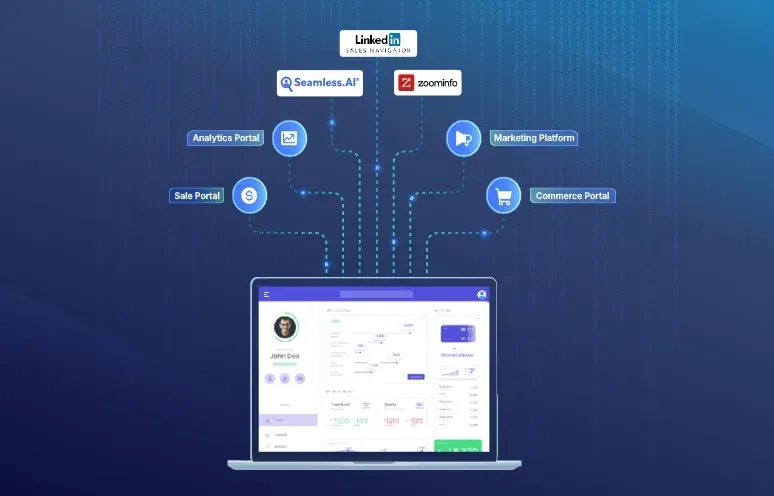
We connect Salesforce with the platforms that power your operations. Our integration solutions span ERP, email, marketing, social, telephony, and analytics systems to create a unified technology environment where data flows securely and workflows operate without manual intervention.




































We begin by understanding how your current systems talk to each other and how data moves between teams. That understanding helps us identify gaps, define what the integration should achieve, and outline the conditions for success. The assessment gives a clear picture of your setup and the relationships between your data sources.
Building on assessment findings, we design integration architecture that addresses your data synchronization needs, security requirements, and scalability goals. Our architects select appropriate integration methods (API-based, middleware, or native connectors) and create detailed specifications for implementation.
With architecture finalized, we configure connections, build custom integrations, and develop data transformation logic. Each integration component is tested individually and as part of the complete workflow to ensure accurate data exchange before deployment to production.
After deployment, we monitor integration performance, track data synchronization accuracy, and address issues as they arise. Our team provides ongoing optimization based on usage patterns and implements enhancements as your business requirements evolve.
Unified customer view
Complete customer data across sales, service, and marketing in one place
Automated workflows
Trigger actions across systems automatically when events occur in Salesforce
Real-time data synchronization
Changes in one system update connected platforms instantly without manual effort
Reduced manual entry
Eliminate duplicate data input across systems through automated synchronization
Faster decision-making
Access current data from all systems in Salesforce for informed decisions
Improved data accuracy
Single source of truth eliminates conflicts from duplicate or outdated records
Scalable architecture
Integration framework grows with your business and accommodates new systems

21+ years of enterprise software expertise with certified Salesforce developers and integration architects
120+ technology specialists delivering API integration, data migration, and custom connector development at scale
Seamless integration with ERP systems including SAP, NetSuite, and Microsoft Dynamics using MuleSoft and native tools
End-to-end implementation from integration discovery through deployment, optimization, and ongoing support
Enterprise security standards with data encryption, access controls, and compliance with industry regulations
Industry
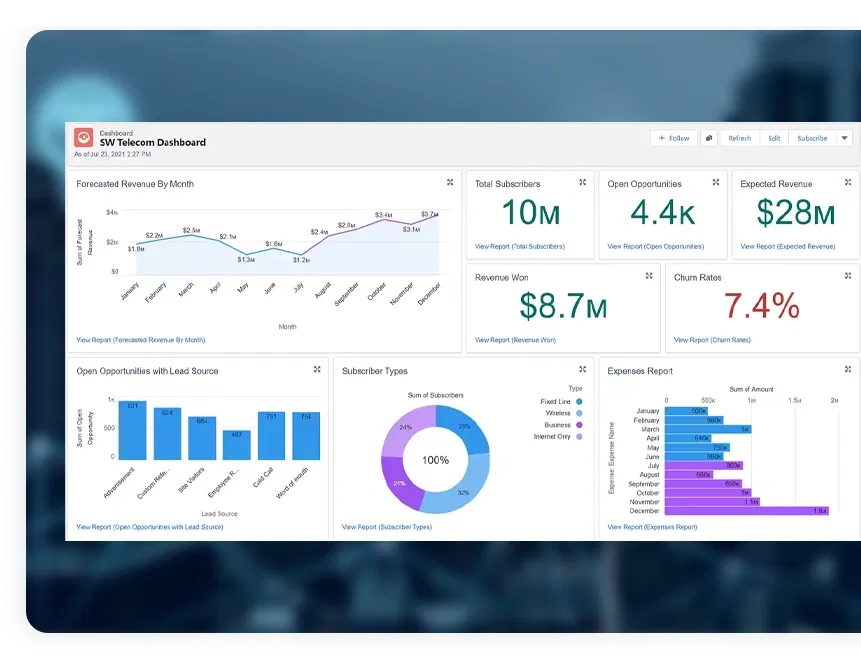
Telecom
Technologies
Salesforce Sales Cloud
Challenges
Business benefits
Client
A major player in US telecommunication industry

Industry
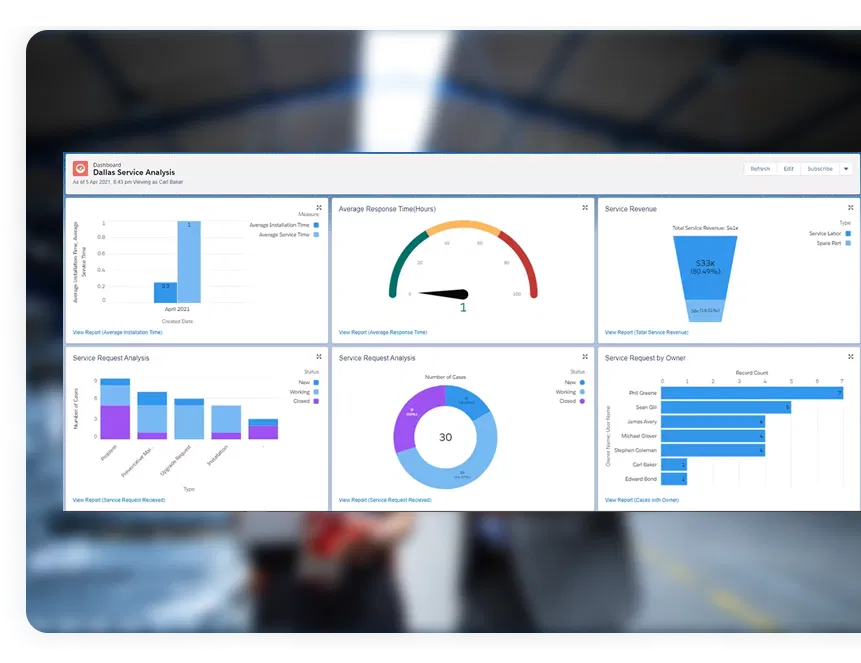
Manufacturing
Technologies
Salesforce, Salesforce FSL, APEX, SAP, Salesforce Sales Cloud
Challenges
Business benefits
Salesforce integration services connect your CRM with other business applications to create unified data flow across your organization. These services include API development, middleware configuration, data migration, and custom connector building. The result is a connected system where customer data, transactions, and workflows synchronize automatically between Salesforce and your ERP, marketing, support, and commerce platforms.
Timeline depends on integration complexity, number of systems, and data volume. Simple integrations with pre-built connectors complete in 4-6 weeks. Complex enterprise integrations involving multiple systems, custom API development, and data transformation typically require 3-6 months. We provide detailed timelines during the discovery phase based on your specific requirements.
Common challenges include data quality issues with inconsistent formats and duplicate records, security concerns around authentication and data protection, complex implementation with legacy systems, limited internal integration expertise, and maintaining synchronization accuracy as systems evolve. Working with a certified Salesforce partner helps navigate these challenges through proven methodologies.
Yes. We integrate Salesforce with legacy systems using middleware platforms like MuleSoft, custom API development, and data transformation services. For custom-built applications, we create secure connections through REST or SOAP APIs depending on system capabilities. Our approach preserves your existing technology investments while adding modern integration capabilities.
Integration tools include MuleSoft Anypoint Platform for enterprise middleware, Salesforce Connect for real-time external data access, custom Apex and API development for specialized requirements, and AppExchange connectors for common applications. Tool selection depends on integration complexity, performance requirements, and your existing technology infrastructure.
We design integration projects to minimize operational disruption. Phased implementation allows us to deploy and validate in stages rather than all at once. Testing is conducted in sandbox environments before production deployment. Data migration happens during scheduled maintenance windows, and rollback procedures are prepared before each major change.
Yes. Our support services include performance monitoring, synchronization issue resolution, system updates as platforms evolve, and enhancement implementation as your requirements change. We offer ongoing managed services or knowledge transfer to your internal team depending on your preference.
AI agents enhance integrations by automating data transformation and mapping decisions, detecting synchronization anomalies before they affect operations, and enabling intelligent routing of information between systems. Agentforce capabilities allow automated responses to integration events, reducing manual intervention and improving data flow efficiency.
Yes. We implement enterprise security standards including encrypted data transmission, secure authentication protocols, and access controls aligned with your policies. Our integration approach supports GDPR, HIPAA, and industry-specific compliance requirements through proper data handling, audit trails, and documentation.
Your business runs on many systems, but they should run on one truth.
We build integrations that unify your systems on consistent data. Share your integration priority, and we’ll take it from there.
 All our projects are secured by NDA
 100% Secure. Zero Spam.
By submitting this form you agree with the terms and privacy policy of Softweb Solutions Inc.