
 Share
Share

 ChatGPT
 Perplexity
 Claude
 Grok
Grok
 Google AI Mode
Many enterprises experimenting with AI end up in the same situation. Their ideas stay stuck in pilot purgatory because small bots, isolated scripts, and disconnected tools never reach the core of their sales or service operations. The result is slow progress, inconsistent automation, and teams that still rely on manual effort for most tasks. Agentforce 360 solves fragmentation by giving you one platform to design, deploy, and govern AI agents that work directly with your Salesforce data and workflows.
“Right now, there are thousands of customers working with thousands of agents working with thousands of humans, all in tandem. As a CEO, I’m not just managing human beings, but I’m also managing agents. There is an agentic layer around support today at Salesforce.”
– Marc Benioff, CEO, Salesforce
Salesforce is leading by example. As Customer Zero, it runs AI agents across support and go-to-market teams so that routine work can be handled in seconds so that your team can focus on complex cases. Salesforce’s internal deployment demonstrates what an agentic model can deliver at scale. The same level of efficiency is achievable for your own sales and service operations with the right Agentforce consulting partnership.
In this blog post, we explain what the Agentforce 360 platform is, how it works, the capabilities that matter most, the adoption steps you can follow, and how it connects with the systems you already use.
What is Agentforce 360 platform?
Agentforce 360 is Salesforce’s unified AI agent platform that connects humans, AI agents, applications, and data in one coordinated system. It brings AI automation and AI orchestration into daily sales, service, IT, and operations work by grounding every action in unified customer data from Data 360.
To understand how the system works, it helps to look at the four layers that form the agentic stack.
-
Agentforce Platform
The first layer provides the reasoning and runtime foundation that supports every AI agent. It interprets customer intent, plans actions, and operates across your Salesforce CRM environment so agents can understand what customers need and respond intelligently.
-
Data 360
This core data layer functions as a unified data foundation. It provides unified data from structured and unstructured sources, such as databases, documents, systems, and files, to the AI agents, ensuring they always have complete information to act with greater accuracy.
-
Customer 360 Apps
This layer includes the sales, service, marketing, and industry applications your teams already use. It contains the workflows and business logic that agents rely on to complete tasks across processes.
-
Slack
The final layer supports real-time collaboration between humans and agents. It becomes the workspace where employees interact with agents, review information, and act on results inside familiar channels.
Together, these layers move organizations beyond isolated automation by creating an integrated environment where agents can understand, act, and coordinate across your systems.
What are the core capabilities of the Agentforce 360 platform?
The core capabilities of Agentforce 360 show how its AI agents accelerate work across sales, service, and operations. Each capability supports a specific part of the workflow so teams can automate tasks, control agent behavior, and maintain consistent quality at scale.
-
Agentforce Builder
This low-code development workspace enables teams to design, test, and deploy Salesforce AI agents in one place. It supports natural language, low-code tools, and script views, so builders can refine workflows quickly and keep automation aligned with business needs.
-
Agent Script
It is a new expression language within Salesforce’s Agentforce 360. This human-readable scripting language controls how agents behave predictably. Teams define clear logic and tool use, ensuring autonomous agents remain consistent even across complex processes and edge cases.
-
Agentforce Voice
The voice capability brings agents into phone and voice channels with natural conversations and quick responses. It connects to Salesforce Voice and contact center platforms so service teams can improve customer engagement without changing their existing stack.
-
Intelligent Context and Data 360
This feature uses Data 360 to make the data understandable and usable for AI agents. Company documents, records, and customer content become actionable context for agents. AI agents can use this information to support real-time decision automation and answer detailed questions.
Together, these capabilities enable organizations to move from basic automation to coordinated AI agents that deliver measurable impact across sales, service, and operations.
How can organizations adopt Agentforce 360 effectively?
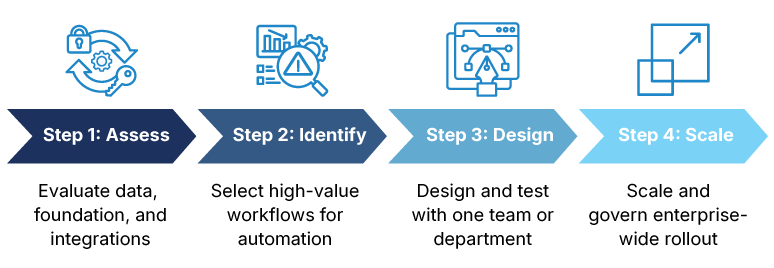
Organizations can adopt Agentforce 360 effectively by following a structured path that prepares data, selects the right workflows, tests agents safely, and scales with governance. The below framework gives you a practical way to move from early exploration to production:
-
Assess your data and Salesforce environment
Start by reviewing Data 360 readiness, current integrations, and the quality of customer data that flows into Salesforce CRM. This helps AI agents operate with accurate information from day one.
-
Identify high-value workflows
Next, move to selecting sales and service processes where AI automation can deliver the clearest impact. Case deflection, call handling, lead routing, and agent assist are strong early candidates because they show value quickly.
-
Design and test agents
After selecting workflows, design and refine autonomous service agents using Agentforce Builder and Agent Script. Piloting with one team or region helps validate agent behavior and fine-tune actions before broader rollout.
-
Scale with governance
Once pilots show consistent performance, expand to additional workflows with clear monitoring. Observability tools help track agent behavior, maintain trust, and support a standard operating model for AI orchestration.
A structured sequence like this helps teams adopt Agentforce 360 with confidence by turning early wins into sustainable, organization-wide value.
What business benefits can organizations expect from Agentforce 360?
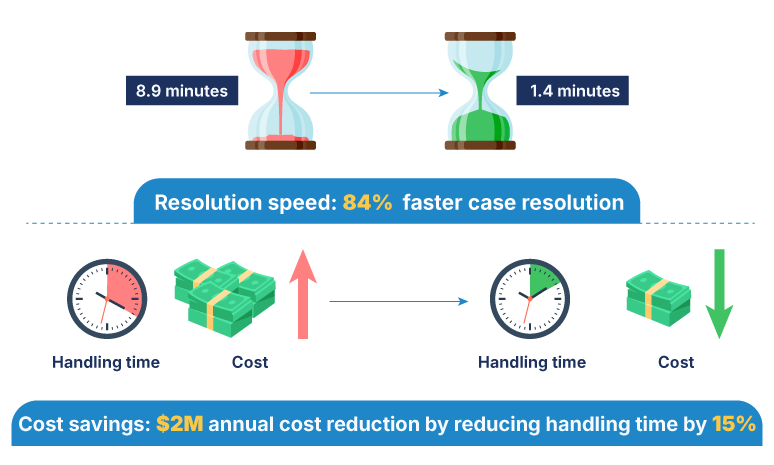
Agentforce 360 creates measurable value across sales, service, and operations through autonomous agents working on unified customer data. Let’s see how:
Source: Salesforce
-
Faster customer service and higher case deflection
Agents handle routine inquiries instantly without queue or wait time. They resolve simple cases independently, prepare context for complex cases and hand off to human teams with complete information prepared, resulting in shorter resolution times and improved customer satisfaction.
-
Lower cost to serve and higher team productivity
Autonomous service agents automate data entry, call handling, and follow-up tasks. Automating these tasks lowers operational effort and lets teams focus on work that requires human judgment.

Source: Salesforce
-
Personalized engagement grounded in complete customer data
Data 360 gives AI agents full customer visibility, including interactions, preferences, and documents. Every engagement becomes consistent and personal across channels because teams work from unified information instead of disconnected silos.
-
Smarter decisions through real-time automation
Agents analyze context and execute multi-step actions consistently across high volumes. Teams catch issues early, avoid errors from manual processes, and maintain quality even during volume spikes.

How can Agentforce 360 connect with your existing systems?
Agentforce 360 connects with both Salesforce and non-Salesforce systems so organizations can extend automation without changing their technology landscape. It works across data sources, workflows, and applications to support AI automation and AI orchestration in a unified environment.
-
Salesforce as your core CRM
Agents read and update records directly in Sales Cloud, Service Cloud, and industry apps. Your CRM stays the source of truth while agents automate routine steps that previously slowed teams down.
-
Unified customer data across all sources
Data 360 ingests structured and unstructured data from your connected systems, databases, and content repositories, not just Salesforce. Agents have complete customer context for every decision, eliminating the silos that traditionally limit automation.
-
Other operational systems through API connectivity
MuleSoft enables agents to interact with ERPs, billing systems, knowledge bases, inventory tools, and backend platforms. Cross-system processes that required manual handoffs now run automatically, from order validation to entitlement checking to field service scheduling.
-
Slack as your unified agent interface
Employees access agents within Slack instead of switching to separate tools. This enables cross-system automation for checking orders, entitlement validation, and field service updates.
Together, these connections help organizations adopt autonomous service agents without redesigning their systems. They add AI capability while keeping existing processes intact.
See how Agentforce 360 can work inside your business
The real-world applications of AI agents extend far beyond customer-facing automation. When agents can access unified customer data, execute multi-step workflows, orchestrate across your entire technology stack, and collaborate with humans in real time, they become strategic assets that transform how sales, service, and operations teams work.
Most organizations already have the data, workflows, and customer interactions needed to deploy AI agents effectively. What you need is the right platform and the right guidance. That’s where a reliable Salesforce consultant makes the difference: by helping you assess readiness, design your agent strategy, and scale confidently.
The path from isolated pilots to sustained impact is clear. What matters now is taking the first step.
FAQs:
1. What is Agentforce 360 platform?
Agentforce 360 is Salesforce’s unified AI agent platform connecting humans, AI agents, applications, and data. It operates across four interconnected layers: Agentforce Platform for reasoning, Data 360 for context, Customer 360 Apps for workflows, and Slack for real-time interaction. Together, these layers enable autonomous agents across sales, service, IT, and operations that understand intent, take action, and coordinate outcomes end to end.
2. How do AI agents in Agentforce 360 work?
Agentforce agents operate in three steps: understand customer intent, plan the best action using predefined logic in Agent Script and unified context from Data 360, then execute tasks by reading records, triggering workflows, or calling external systems. They hand off to humans when complexity exceeds their scope, with observability tools monitoring all actions for predictable, compliant behavior.
3. What are the main benefits of Agentforce 360 for businesses?
Agentforce 360 delivers five outcomes: it accelerates customer service to 70–90 percent case deflection rates, as seen in deployments at OpenTable and 1-800Accountant; lowers operational costs through automation; enables personalized engagement using unified customer data; improves decision quality through real-time automation; and provides enterprise-grade control via security, observability, and Agent Script.
4. Is Agentforce 360 different from traditional Salesforce automation tools?
Agentforce differs fundamentally in three ways. 1) Traditional tools execute predefined workflows based on conditions (if X, then Y). Agentforce interprets intent and adapts responses using complete customer context. 2) Traditional automation runs silently. Agentforce collaborates with humans in Slack, showing reasoning and accepting corrections. 3) Traditional tools handle single-system tasks. Agentforce orchestrates across your entire technology stack using real-time decision automation.
5. Can Agentforce 360 improve customer service response times?
Yes. Agentforce dramatically reduces response times through immediate agent availability. Agents respond instantly 24/7 to routine inquiries like password resets or order status checks without human involvement. For complex cases, they prepare context for faster human resolution.
6. Does Agentforce 360 require Salesforce Data Cloud?
Agentforce works best with Data Cloud but doesn’t strictly require it. Data Cloud provides unified context from structured and unstructured sources, dramatically improving agent decision quality. Without it, agents operate on data within your Salesforce org, limiting contextual intelligence.
Organizations can deploy Agentforce without Data Cloud if they have strong data governance. For maximum value across multiple systems or complex scenarios, Data Cloud is essential.
7. Can Agentforce 360 integrate with third-party systems?
Yes. Agentforce integrates extensively through multiple options. Native integrations connect to Sales Cloud, Service Cloud, and industry apps. For external systems like ERPs, billing platforms, and knowledge bases, MuleSoft API integration enables agents to query orders, validate entitlements, check inventory, and update schedules. Slack integration brings agents into team workspaces. Agents operate across your entire technology ecosystem without custom development.
8. Is Agentforce 360 suitable for small and mid-sized companies?
Agentforce suits mid-sized companies and larger organizations. Mid-sized companies benefit most with established Salesforce environments, consistent data, and high-volume processes to automate case deflection or lead routing. Smaller companies can deploy effectively by focusing on one use case rather than enterprise-wide rollout.


