Share
Share

 ChatGPT
 Perplexity
 Claude
 Grok
Grok
 Google AI Mode
Every thriving company has a quiet drag on its progress inside their walls. It is not a competitor or a recession. It is the software that was once a marvel and is now a millstone. Legacy systems age like debt, silently, steadily, and at compound interest.
When Deutsche Bank wanted to launch a new mobile banking product in 2019, its engineers estimated a six-week development time. The actual timeline ran to fourteen months. The delay wasn’t due to a flawed idea. The real obstacle was that the core banking system was built in COBOL, a language older than the ATM.
Most modernization efforts follow the same path. According to Gartner, by 2027, 75% of enterprise technology modernization projects will fall short of their intended business outcomes. The core issue is a lack of preparation. Companies are focused on selecting technology and approving budgets while postponing the harder readiness work. By the time architectural decisions are made, the project is already in motion, and business outcomes become an afterthought.
Legacy system modernization is not about chasing technology trends. Leading companies, including DBS Bank, Volkswagen, GE Oil & Gas, Rockwell Automation, and Siemens, modernize legacy systems to reclaim operational agility and future-proof their businesses. The right modernization journey begins with strategy, not with speed or hype. Here are five steps to set your transformation up for success, in the right sequence.
How the steps have been presented in this blog:
With each step, we have mentioned temptation and discipline. The temptation is the common shortcut organizations take when facing a modernization decision. The discipline is the strategic approach organizations should follow. There is also a company example attached with each step, explaining the why factor behind the step.
Step 1: Map everything before you change anything to decide what to modernize
- The temptation: Leadership sets a deadline. Engineers start rebuilding, eager to show progress. Everyone is busy, but the core objectives are missing.
- The discipline: Map every system first and align the process with clear business objectives.
DBS Bank
In 2009, DBS Bank in Singapore had some of the worst customer satisfaction scores. Long ATM queues. Slow loan approvals. Bloated outsourcing arrangements. The bank was 85% outsourced and had no understanding of its own technology stack. When a new leadership team arrived, they faced a choice every organization faces at some point: fix what is visible or understand what is actually there.
They chose to understand.
Before a single legacy system was replaced, the DBS team mapped the entire application landscape. They asked which systems generated revenue and which simply there because no one had replaced them. The team dug deeply into true ownership costs with the engineering time, the compliance workarounds, and the delays baked into every product launch. They also identified where critical knowledge resided, knowing that in legacy environments expertise lives in the mind of a single individual.
That mapping exercise became the foundation of one of the most celebrated technological transformations of the past two decades. By 2018, DBS went from 85% outsourced to completely self-managed technology. DBS became the first recipient of Euromoney’s Best Digital Bank Award in 2016 and was recognized by Harvard Business Review as one of the top ten strategic transformations of the decade.
The lesson: None of that happened because DBS moved fast. It happened because DBS mapped carefully first.
How to execute step 1:
The audit must answer three questions with precision:
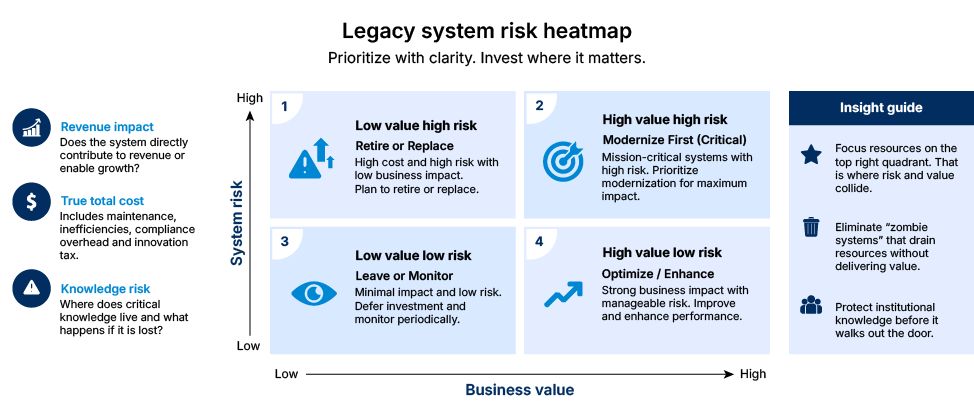
- Revenue vs. zombie systems: Which systems directly generate revenue, and which systems only exist because nothing has replaced them?
- True total cost of ownership: Include direct maintenance, indirect inefficiencies, compliance overhead, and the innovation tax of delayed market responsiveness. Most organizations underestimate these hidden costs.
- Critical knowledge dependencies: Where does institutional knowledge live? According to McKinsey, 42% of critical business logic is at risk if key personnel leave.
Step 2: Let business value drive the sequence to maximize impact from every modernization effort
The temptation: Start with the easiest systems to modernize. Build momentum. Get quick wins. Move to the harder ones later. It feels like progress, but it rarely moves the needle on the bottom line.
The discipline: Start with the systems where modernization unlocks the most business value, regardless of complexity.
Volkswagen
In the mid-2010s, Volkswagen wanted to make a shift to Electric Vehicles (EV) production. The leadership recognized that EV production required a 30% reduction in development time. LM-TAB, the company’s central parts planning and performance management system, was running on an aging AS/400 mainframe using a 1970s IMS hierarchical database. The legacy system was too slow for the dynamic requirements of the EV supply chain. And it was difficult to integrate LM-TAB with AI and cloud analytics capabilities.
Volkswagen employed a comprehensive re-architecting strategy. They knew that a failed LM-TAB migration could halt production at over 110 global facilities. The blast radius of a mistake was billions of dollars. During the modernization of LM-TAB, Volkswagen did:
- 1. Re-architecting: Transformed the monolithic application into a modern microservices architecture. This allows teams to update specific parts and functions without risking total system failure.
- 2. Cloud migration: Moved to AWS Fargate (serverless containers) and utilized Amazon Elastic Container Service (ECS). Serverless scaling ensures the system handles global production peaks without manual hardware tuning.
- 3. Database transformation: Migrated from the IMS hierarchical database to Amazon Aurora PostgreSQL. Moving to relational data unlocks the real-time analytics needed for EV transitions.
- 4. UI Modernization: Replaced terminal screens with a modern web interface built in Angular. Replacing green screens improved data accuracy for the global planning teams.
- 5. Automation & DevOps: Implemented Infrastructure as Code (IaC) using Terraform and AWS CloudFormation, alongside CI/CD pipelines. Automated deployments enable Volkswagen to ship new vehicle software updates in minutes.
For high-volume models like the Golf or Tiguan, traditional manufacturing and coordination processes exceed 20 to 30 hours per car at the Wolfsburg plant. After LM-TAB modernization, Volkswagen targets a production time of 10 hours per vehicle. This is the same target set by competitors like Tesla for their Model 3 production.
The lesson: Volkswagen didn’t modernize LM-TAB just because the hardware was outdated. They did it because the system’s limitations put a ceiling on the company’s ability to compete in the EV era. Business needs, not technical nostalgia, dictated the roadmap.
How to execute step 2:
You can govern the modernization by three value-based filters:
- The velocity impact test: Which system, if modernized, will shorten the concept-to-customer cycle for your core product?
- Identify the business value you want to achieve: Look for the systems where the cost of inaction, in terms of missed market opportunities and integration failures, outweighs the cost of the rebuild.
- Scalability of success: Start with a high-value system that serves as a blueprint for future efforts. Modernizing a core system like LM-TAB builds the foundation for broader enterprise change.
When you pass the modernization strategy through the above filters, it will help you select the right strategy.
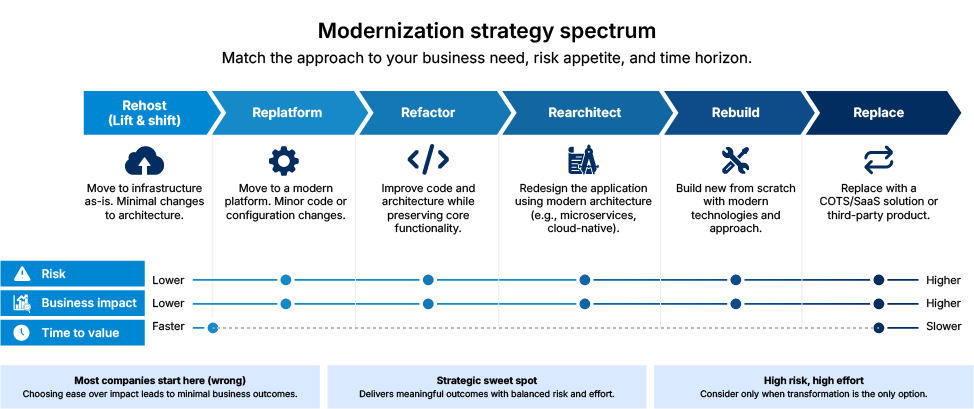
Step 3: Never rip and replace. Modernize systems through phased transitions to minimize risk while maintaining business continuity.
The temptation: Leadership wants a clean break from the past. The board approves an 18-month big bang replacement to wipe the slate clean. Two or three years later, the project is over budget, ROI is zero, and the legacy system is still running.
The discipline: Use a phased co-existence model. Let the new system grow around the old one, so business never stops moving.
GE Oil & Gas
In 2014, GE Oil & Gas was drowning in technical debt. They managed over 500 legacy applications with no clear ownership or cost structure. With the oil market in a downturn, the company needed to slash costs and increase agility immediately. While many competitors attempted risky, all-at-once migrations, GE did the opposite. They treated their technology stack as a living ecosystem and chose steady evolution over radical overhaul.
Instead of a big bang cutover, the team started with low-stakes tools like WordPress sites. As their cloud skills matured, they embraced the Strangler Fig pattern. Slowly, they diverted traffic from legacy billing and pipeline inspection systems to new microservices. By the time old servers were shut down, the transition was seamless and invisible to the business. The image shows how it looks in practice when you redirect traffic to new microservices through an API layer with zero disruption.
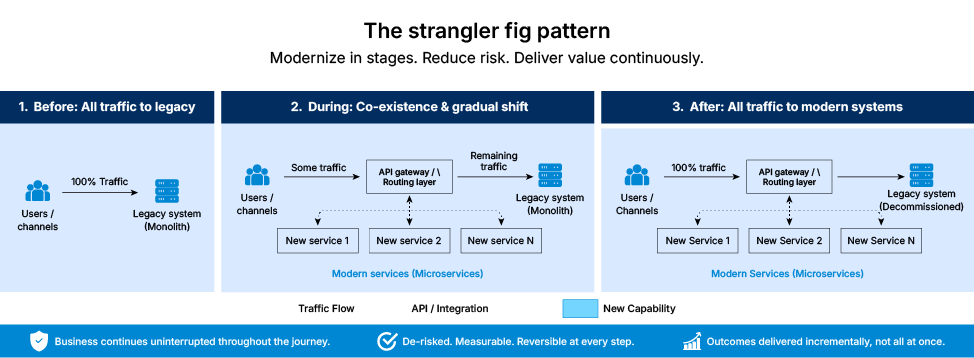
With legacy system modernization, GE Oil & Gas achieved a 52% reduction in Total Cost of Ownership (TCO). Because they avoided a single go-live date, they also avoided the supply chain breakdowns that impacted companies like Nike. Nike overhauled supply chain logic and demand forecasting simultaneously. The company lost an estimated $100 million in sales in a single quarter. Nevertheless, Nike recovered and eventually became a leader in digital supply chain management, but the cost of that lesson was avoidable. GE proved that incremental progression takes time but brings results.
The lesson: Technology should enable your strategy, not compress it into a high-risk event. The most successful transformations stay invisible to the customer. They progress through disciplined, incremental changes and not through a single disruptive replacement.
How to execute step 3:
To modernize without disruption, follow the co-existence framework:
- The Strangler Fig pattern: Build new functionality in a modern environment. Use an abstraction layer to redirect calls from the old system to the new system, so the new system slowly strangles and replaces the legacy system with minimal disruption.
- The 90-day value pulse: Don’t wait for the end of the project to see results. Every 90 days, migrate a specific workload or feature that delivers measurable business value.
- Risk-tiered sequencing: Categorize your hundreds of apps into three tiers: low-stakes (learning), mid-stakes (scaling), and mission-critical (hardening). Don’t touch mission-critical systems until your team has perfected the process on lower-risk applications.
Step 4: Know the difference between data modernization and migration to make data a usable and actionable asset
The temptation: Many organizations treat data as a storage problem. They believe that moving decades of sensor readings along with production records and quality logs from on-premises servers to a cloud data lake will make the organization data driven. It results in a data swamp, a massive collection of siloed, poorly structured data that AI cannot read and humans cannot use.
The discipline: Treat data as a product and not just a file. Before data leaves its legacy silo, structure it so it can drive real-time analytics and autonomous decisions.
Rockwell Automation
Rockwell Automation, a century-old industrial leader, faced a massive internal challenge. Their 20 global manufacturing plants were running on disparate legacy systems. They had tons of data. But it was trapped in different formats across thousands of machines. For leadership, the goal was not just to move data to the cloud. It was to bridge Information Technology (IT) and Operational Technology (OT) and create a connected enterprise.
Instead of moving their 400,000 SKUs and production logs to a new database, Rockwell implemented a unified Manufacturing Execution System (MES) as a centralized system of record. They used FactoryTalk InnovationSuite to infuse edge-to-enterprise analytics and machine learning directly at every level of operations. They identified and connected specific data sources to create machine learning models that could detect defects in minutes.
The results were transformative. By modernizing its data structure, Rockwell reduced inventory days from 120 to 82 and achieved a 30% increase in capital avoidance. They had actionable intelligence that allowed them to trace quality issues throughout their entire supply chain. It brought down recalls by 80%.
The lesson: Data migration is about where the data lives. Data modernization is about what the data does. Rockwell proved that the value of data isn’t in its storage, but in its ability to be unified, contextualized, and acted upon in real time.
How to execute Step 4:
To transform your data from a legacy liability into a modern asset, apply these filters:
- The contextualization requirement: Raw sensor data is useless without context. Tag every data point with its source, timestamp, and operational state (e.g., Machine 4, High Temp, During Batch A) before it enters the cloud.
- OT/IT convergence mapping: Identify where operational data (factory floor) intersects with business data (ERP). Modernization happens at these connection points.
- The governance protocol: Establish a single version of the truth. If production and finance teams see different numbers for the same process, your data is not modernized.
Step 5: Empower the workforce. Achieve and sustain long-term value by making technology serve people.
The temptation: Organizations view new digital tools as a way to replace human intuition or de-skill the frontline. They roll out dashboards and AI interfaces without consulting the people who use them. It results in the shelfware, expensive technology that employees bypass because it does not fit their reality.
The discipline: Modernization scales when it augments human capabilities. The goal is to put the power of data and AI into the hands of frontline workers.
Siemens
Siemens’ plant in Amberg, Germany, is one of the most advanced factories in the world. It produces over 1,200 products with 99.99% quality. As they modernized, the leadership team realized that the complexity of their digital systems was outpacing the speed of human training. They wanted to implement human-centric technology.
Instead of hiding technology behind a central IT control tower, Siemens brought it to the factory floor. They used Industrial Edge and low-code platforms like Mendix, and empowered shop-floor employees to build digital solutions. For example, an operator could spot a recurring bottleneck and use low-code tools to create an app that tracks machine vibrations or temperature, solving problems independently.
The results turned the workforce into a digital engine. By empowering over 1,000 employees to shape the digital roadmap, Siemens achieved a 9% productivity increase each year. The plant now uses predictive maintenance apps and digital twins. But it’s the frontline workers who train the AI models to capture real-world complexities.
The lesson: The best technology doesn’t replace people. It empowers them. Siemens’ success shows that true digital transformation is about people and cultural empowerment, not just software and automation.
How to execute step 5:
To ensure your workforce becomes a catalyst for your modernization, follow these principles:
- Democratic innovation (low-code): Deploy low-code/no-code platforms that allow non-technical frontline staff to build their reporting and optimization tools.
- The augmentation over replacement metric: When evaluating a new tool, ask: Does this make our experts faster, or does it try to replace their judgment? Focus on tools that provide decision support rather than decision replacement.
- Reverse mentorship: Create a feedback loop where the frontline workers, the people who see the data’s flaws every day, drive the priorities for the IT development team.
A checklist to help you get started
Here is a six-step checklist to get you started:
- Identify where to start: Not all departments carry the same risk. Begin with areas that are high-value but low-disruption.
- Audit your systems: Map what you have before deciding what to change. Surface hidden dependencies and true costs.
- Form the right team: Modernization succeeds when you treat it beyond a IT project. You need business stakeholders while strategizing modernization journeys.
- Plan phased transitions: Avoid big bang cutover. Use parallel runs and clear 90-day milestones so you can course-correct without crisis.
- Modernize data in parallel: Treat data as a product rather than a simple migration task.
- Foster a digital culture: Build continuous improvement habits to prevent future technical debt from accumulating.