How softweb modernized DevOps and cloud architecture for DoubleCheck, a US-based fintech company
Our client, DoubleCheck, is a US-based fintech company that provides technology solutions for banks, credit unions, and other financial institutions. The platform helps financial institutions modernize outdated overdraft practices and better serve businesses and consumers. They partnered with Softweb to modernize their DevOps processes and cloud architecture, enabling more predictable product releases, stronger security controls, and improved operational stability.
 Industry: Finance
 Business type: B2B fintech
- Services: Cloud and devOps modernization
- Technology: Kubernetes, Microsoft Azure, CI/CD


Client profile
DoubleCheck helps banks and credit unions modernize overdraft programs. Its patented solution allows financial institutions to notify customers about insufficient funds and provide options before transactions are declined.
The platform supports real-time notifications, configurable payment reminders, and secure integration with banking systems. These capabilities help financial institutions manage overdraft events more transparently for their customers, including small businesses and individual account holders.
Founded in 2013 and relaunched in 2019, DoubleCheck secured funding, built its technical leadership team, and brought its solution to market. The company has received patent protection, validated regulatory compliance, and built a growing pipeline of financial institution partners.

Technical challenges
Our client’s product environment relied on evolving cloud infrastructure and multi-tenant application architecture to support banks, credit unions, and other financial institutions serving businesses and consumers. Over time, limitations in integration and deployment processes began affecting performance and system stability.

Inconsistent tenant setup
Lack of uniformity in tenant configurations created compatibility issues and made scaling difficult.

Slow IT operations
Manual deployment steps and unclear DevOps coordination delayed releases and slowed updates.

Data volume constraints
Growing transaction volumes highlighted infrastructure limitations and affected system performance.

Security and access gaps
Authentication workflows and payment notifications lacked proper integration and access control safeguards.
Our solution
We updated the client’s DevOps setup and cloud foundation to support a more scalable and stable multi-tenant platform. Application components were reorganized, Kubernetes was introduced to manage containerized services, and deployment activities moved into defined CI/CD stages.

As a result, releases became more controlled, tenant configurations more consistent, and infrastructure easier to manage. Platform scaling no longer introduces the operational slowdowns that previously affected product updates and system performance.
Migration from GCP to Azure
The migration from Google Cloud Platform to Microsoft Azure covered application services, supporting infrastructure, and tenant configurations. Workloads were reviewed first to understand how each component interacted within the broader system before moving environments.

Applications and data were then migrated in planned stages, with performance checks completed after each phase instead of shifting everything at once. Downtime risks were minimized, and operations were stabilized within Azure before expanding capacity.
Microservices-based architecture
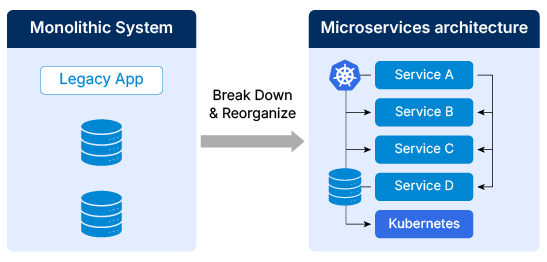
Server-side components were reorganized into smaller, independent services managed through Kubernetes. Separating application functions reduced overlap and allowed each tenant’s workload to operate without affecting others.
With clearer separation across services, issue resolution became more straightforward and less time-consuming. Database configurations and backend connections were also adjusted to better handle transaction growth and regulatory requirements.
CI/CD and release management
Manual deployment activities were consolidated into defined CI/CD stages covering build, test, and release processes. Release sequencing was structured so development work followed a consistent path across environments.
Automated builds and environment-based validations structured the release process across development stages. Updates now follow defined checkpoints before reaching production environments.

Product development and operational stabilization
Our team addressed persistent bugs, authentication inconsistencies, and workflow inefficiencies across email notifications, payment reminders, and Okta integrations. These improvements strengthened system reliability in a compliance sensitive financial environment.
By refining integration patterns and stabilizing core workflows, we improved uptime consistency and reduced support overhead. The product environment now supports evolving credit union requirements without sacrificing performance or security.

Business goals and measurable outcomes
| Business objective | Business benefit delivered |
|---|---|
| Accelerate product releases | Automated CI/CD pipelines reduced deployment friction and accelerated controlled product updates. |
| Strengthen multi-tenant scaling | Modernized microservices architecture enabled independent tenant scaling with stable performance. |
| Reduce operational downtime | Cloud restructuring improved infrastructure stability and minimized service disruptions. |
| Enhance regulatory-grade security | Authentication workflows and secure integrations reduced risk in regulated financial environments. |
| Optimize infrastructure efficiency | Migration to Azure improved resource allocation and long-term scalability planning. |
| Streamline development workflows | Backlog sequencing and automation improved release predictability and team productivity. |
Tech stack
- Frontend:
- Vue.js, JavaScript, HTML5, CSS3
- Backend:
- Microservices Architecture, REST APIs, RabbitMQ Messaging
- Containerization & Orchestration:
- Kubernetes, Docker
- Database:
- MongoDB
- Cloud Platform:
- Microsoft Azure (migrated from Google Cloud Platform)
- DevOps & CI/CD:
- Automated CI/CD Pipelines, Containerized Deployments
- Security & Authentication:
- Okta Integration, Role-Based Access Control, Secure API Authentication
- Architecture:
- Multi-Tenant Microservices Platform for Financial Systems
Similar Case Studies

Empowering wealth management operations with GenAI solutions

Implemented MuleSoft for API development for a finance company

A modern web-based solution for enhanced data control and collaboration
Connect Now
Our experts would be eager to hear you.

