Share
Share
 ChatGPT
 Perplexity
 Claude
 Grok
Grok
 Google AI Mode
There was a time when organizations wanted structured storage for their data. However, in 2026, they require scalability, speed, automation, and intelligence in addition to storage.
Data warehousing is reshaping how organizations not only store data but also manage, analyze, and leverage it for real-time insights, automation, and intelligent decision-making across their operations.
Cloud adoption continues to accelerate, real-time data processing is becoming a necessity, and automation is redefining data management. Meanwhile, businesses are moving toward fully managed data warehouse services and advanced analytics is transforming warehouses into decision-making engines.
This blog explores the five most significant top data warehouse trends that forward-thinking organizations should consider adopting in 2026.
- Trend 1: Cloud data warehouses are becoming the enterprise standard
- Trend 2: Real-time data warehousing is shifting from luxury to necessity
- Trend 3: Automated data warehousing is reshaping data management
- Trend 4: Data Warehouse as a Service (DWaaS) is gaining mainstream adoption
- Trend 5: Advanced analytics is driving modern data strategies
Whether you are a data professional looking to optimize your current infrastructure or a business leader planning your data strategy, understanding these best data warehouse trends will help you stay ahead in the increasingly competitive data-driven marketplace.
Trend 1: Cloud data warehouses are becoming the enterprise standard
The shift from on-premises to cloud-based data warehouses continues to accelerate. The cloud offers scalability that physical data centers struggle to match. Companies can scale resources up or down as needed, minimizing costs and optimizing performance.
With cloud data warehouse solutions, you can:
Scale effortlessly
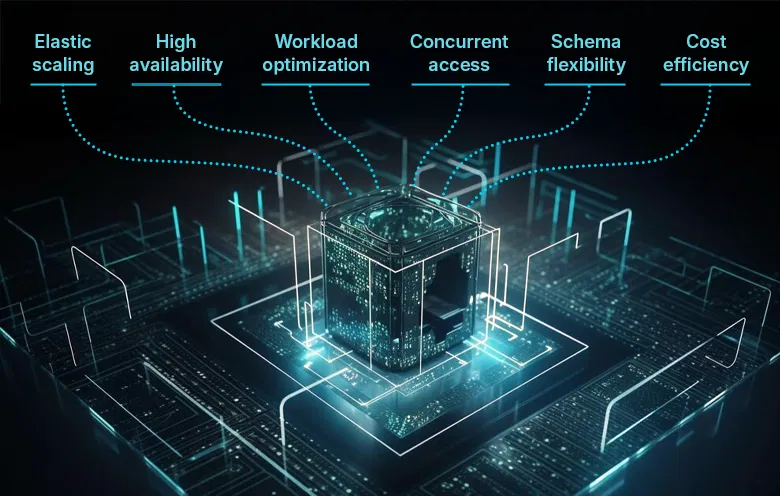
The amount of data, number of applications, and location types keeps varying. That’s why businesses prefer flexible centralized storage to support their changing demands and objectives. Scalability in a data warehouse offers several advantages:
- Elastic scaling: Compute and storage resources scale independently. Such scalability handles sudden spikes or drops in data volume without over-provisioning.
- High availability: Distributed architectures replicate data across multiple nodes. This ensures uninterrupted access even if hardware failures occur.
- Workload optimization: Data warehouses distribute query processing across multiple nodes. As a result, performance improves during high-demand periods.
- Concurrent access: Multiple users and applications run complex queries simultaneously. It does not impact performance and enables collaborative analytics.
- Schema flexibility: The system supports structured and semi-structured data. It lets businesses adapt to evolving formats without overhauling the system.
- Cost efficiency: Pay-as-you-go models avoid upfront hardware investments. By aligning costs with usage, organizations optimize their expenses.
Spend smart
Cloud data warehousing reduces costs through scalability, flexibility, a pay-as-you-go model, and a lower IT burden. It helps businesses optimize resources and cut operational expenses. Cloud data warehouses dynamically adjust storage and computing resources to handle fluctuating workloads and prevent over-provisioning.
The pay-as-you-go model offers predictable costs and eliminates large upfront investments in hardware and maintenance. Managed infrastructure reduces the IT burden and lets businesses focus more on data analytics and strategic growth.
Increase query performance
A data warehouse can optimize complex query processing with advanced architectures and efficient storage techniques. It accelerates data retrieval through indexing, partitioning, columnar storage, and materialized views.
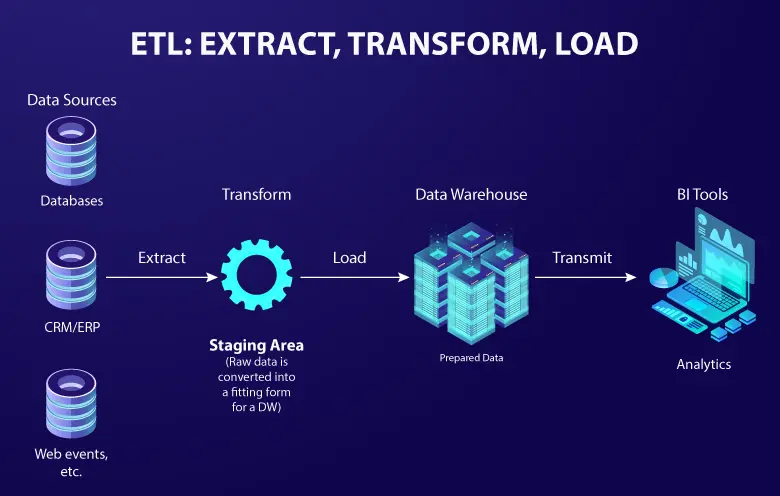
Massive parallel processing and in-memory computing enhance performance, while ETL processes cleanse and organize data for analysis.
By focusing on analytical queries, a data warehouse overcomes the limitations of transactional systems and ensures high performance for data-intensive workloads.
Trend 2: Real-time data warehousing is shifting from luxury to necessity
Industries increasingly depend on a continuous flow of data to optimize operations, spot anomalies, and provide real-time, tailored customer experiences.
The demand for instant insights to respond to dynamic, high-velocity environments has given enterprises a clear reason to implement real-time analytics.
The ability to use data on time and effectively is a differentiator in the on-demand economy. If you need data with low latency, high concurrency, and unmatched scalability, you must adopt a real-time data warehouse.
Traditional data warehouses, often called enterprise data warehouses (EDWs), store data in a batch-oriented fashion. While real-time data warehouses process data as it’s generated, enabling near-instant analysis and decision-making.
Key differences: Traditional data warehouse (EDW) vs. Real-time data warehouse
| Feature | Traditional data warehouse | Real-time data warehouse |
|---|---|---|
| Architecture | Multi-tiered structure with servers, data stores, and applications, often on-premises | Designed for continuous data ingestion and processing, often cloud-based |
| Data processing | Batch-oriented (ETL) with longer load times | Real-time streaming technologies (e.g., Apache Kafka, Apache Flink) process data instantly |
| Data refresh | Periodic (e.g., daily, weekly, monthly), resulting in less current data | Continuous updates, providing up-to-the-minute information |
| Use cases | Historical analysis, reporting, and strategic decision-making | Real-time analytics, fraud detection, operational dashboards, tactical decisions |
| Latency | Higher latency due to batch processing | Lower latency with real-time or near real-time processing |
| Data freshness | Data is not always up-to-the-minute | Data remains highly current |
| Tools | Amazon Redshift: A fast, scalable, and fully managed cloud data warehouse Snowflake: A popular and easy-to-use cloud data warehouse Google BigQuery: A serverless cloud data warehouse Azure Synapse Analytics: A cloud-based data warehouse service IBM Db2 Warehouse: A data warehouse platform |
Snowflake: Can be used for real-time data warehousing Google BigQuery: Can be used for real-time data warehousing Amazon Redshift: Can be used for real-time data warehousing Databricks: A cloud-based data analytics platform ClickHouse: A fast and scalable open-source analytics database |
Trend 3: Automated data warehousing is reshaping data management
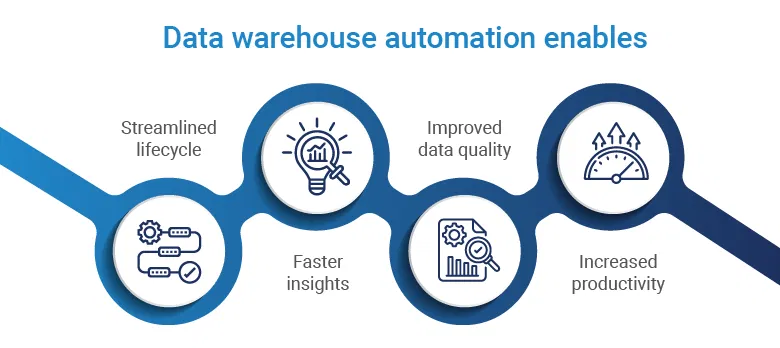
Data warehouse automation accelerates analytics-ready data by automating the entire data warehouse life cycle, from data modeling to governance. It ensures real-time data ingestion, continuous refinement, and data consolidation with consistent data quality.
With data warehouse automation, organizations can automate the steps involved in data integration, transformation, and loading. It delivers a unified data view, quickly, for analysis.
Data warehouse automation speeds up:
- Data modeling: Automate the design and structure of the data warehouse.
- Real-time data ingestion: Streamline collecting and loading data from various sources in real-time.
- Data marts: Automate creating and managing specialized data subsets for specific business needs.
- Governance: Automate processes for data quality, security, and compliance.
Benefits of data warehouse automation
- Faster insights and decision-making: By speeding up the availability of analytics-ready data, organizations can make more informed decisions quicker.
- Reduced manual effort and errors: Automation minimizes human intervention, leading to higher data quality and consistency.
- Improved productivity and agility: Teams can focus on strategic tasks rather than repetitive data management processes.
- Reduced costs: Automation can streamline data processes and reduce the need for specialized resources.
- Enhanced data quality and consistency: Automated processes ensure data is transformed and loaded consistently, leading to more reliable insights.
Trend 4: Data Warehouse as a Service (DWaaS) is gaining mainstream adoption
Data Warehouse as a Service (DWaaS) is an outsourcing model where a cloud service provider handles a data warehouse’s hardware, software, and management. At the same time, the customer focuses on providing the data and paying for the service.
DWaaS is among the top data warehouse trends because it:
- Simplifies data warehousing by outsourcing infrastructure management.
- Works with flexibility and scalability depending on the organization’s needs.
- Offers enhanced security and keeps your data reliable.
- Gives access to modern technologies and capabilities.
1. Simplified infrastructure management
- No upfront hardware or software costs: DWaaS vendors handle the underlying infrastructure, eliminating the need for organizations to purchase, deploy, and maintain expensive hardware and software.
- Reduced operational overhead: Organizations don’t need dedicated IT staff to manage the data warehouse, freeing up resources for other critical tasks.
- Easy setup and configuration: DWaaS solutions are designed for rapid deployment, allowing organizations to start quickly with their data warehousing initiatives.
2. Scalability and flexibility
- On-demand resource allocation: DWaaS allows organizations to scale their data warehouse resources up or down, based on their data processing and storage requirements.
- Elasticity: The cloud-based nature of DWaaS enables dynamic scaling, ensuring that organizations can handle fluctuating workloads and data volumes.
- Flexibility: DWaaS can accommodate a wide range of data formats and sources, making it suitable for diverse business needs.
3. Enhanced security and reliability
- Provider-managed security: DWaaS providers are responsible for maintaining the data complinace and security of the underlying infrastructure, including regular software updates and security patches.
- Data encryption and access controls: DWaaS solutions often include robust data encryption and access control mechanisms to protect sensitive data.
- Disaster recovery and backup: Cloud-based DWaaS solutions offer built-in disaster recovery and backup capabilities, ensuring data availability and business continuity.
4. Access to modern technologies and capabilities
- Real-time data processing: DWaaS solutions can support real-time data processing and analytics, enabling organizations to gain insights quickly and make informed decisions.
- Integration with other cloud services: DWaaS can be easily integrated with other cloud-based services, such as machine learning platforms and data visualization tools.
- Accelerated insights: DWaaS is optimized for performance, allowing organizations to query and analyze data faster, leading to quicker insights and better decision-making.
Trend 5: Advanced analytics is driving modern data strategies
A data warehouse is not just a repository for historical data. Organizations can make it a dynamic hub for data ingestion, transformation, and analysis, including advanced analytics.
You can ensure that your data warehouse solutions support AI and ML workloads, including data preparation, model training, and deployment.
The Integration of advanced analytics enables the use of techniques like predictive modeling, machine learning (ML), and artificial intelligence (AI). With this, you can go beyond basic reporting and descriptive analytics to identify patterns, predict future outcomes, and understand complex relationships within data.
Examples of advanced analytics techniques in data warehousing
- Predictive modeling: Use historical data to forecast future trends and outcomes.
- ML: Employ algorithms to identify patterns, make predictions, and automate tasks.
- AI: Utilize artificial intelligence to analyze data, identify anomalies, and automate decision-making processes.
- Text mining and sentiment analysis: Analyze unstructured text data to extract insights and identify customer sentiment.
- Pattern recognition: Identify recurring patterns and anomalies in data.
Why cloud data warehousing matters
If your data infrastructure was built over a decade ago, it likely operates in the following way.
- Batch processing cycles: Traditional ETL jobs often run overnight or weekly. So, reporting dashboards present yesterday’s (or older) data.
- Resource constraints: On-prem systems may lack the compute power to refresh data more frequently without impacting operational systems.
- Manual intervention: Some legacy systems require DBA involvement to run updates. It adds delays.
- Integration bottlenecks: Pulling data from multiple sources into a central warehouse takes time when systems weren’t designed for real-time sync.
What used to take hours to process now needs to happen in minutes. For example, inventory decisions cannot wait for overnight batch jobs when stock levels shift by the hour. The gap between what your systems can handle and what your business needs is widening fast.
Modern data warehouses fill this gap. The choice of moving to cloud data warehouses is not just a technology upgrade. You are upgrading to how quickly you want to respond to market shifts and to competitive pricing. With a modern data warehouse, you choose:
- Speed that changes behavior: Query times drop from hours to seconds. A cloud data warehouse turns data exploration from a two-day project into a real-time conversation.
- Costs that scale down: Cloud-native architecture lets you pay for what you use. It eliminates the hardware refresh cycle and reduces infrastructure spending significantly while handling more data.
- Flexibility when it matters: You can integrate new data sources in days, so your analytics evolve with your business instead of lagging six months behind.
Efficiency in operations or decisions comes from how fast your organization transforms data into insights.

Key challenges in embracing modern data warehouse trends
As organizations race to modernize their data ecosystems, adopting the latest data warehouse trends is not always straightforward. Several hurdles can slow down transformation if not addressed thoughtfully:
Evolving skill requirements
Modern data warehouses rely on cloud-native tools, automation, and advanced analytics. Teams accustomed to traditional SQL-based systems may need to enhance their skills. Investing in continuous learning helps employees transition into roles that focus on data modeling, orchestration, governance, and strategic analysis.
Rising implementation and migration costs
Shifting to cloud data warehouses, real-time pipelines, or lakehouse architecture requires heavy upfront investment. While long-term gains, like scalability, reduced infrastructure overhead, and improved performance, outweigh the costs, organizations must plan budgets carefully. They should also prioritize high‑impact use cases to accelerate ROI.
Complex integration across diverse systems
Most organizations run their data across a mix of platforms and systems. Integrating legacy databases, SaaS applications, streaming platforms, and unstructured data sources into a warehouse can be challenging. Therefore, it can be challenging to ensure compatibility, preserve data quality, and orchestrate reliable data flows without strong architectural planning and the right integration tools.
Governance and security pressures
As data volumes grow and regulations tighten, maintaining robust governance has become a necessity. Companies must balance modernization with strict controls around access, lineage, privacy, and compliance. Without a solid governance framework, even the most advanced warehouse can become a liability.
By proactively addressing these challenges, organizations can fully capitalize on emerging data warehouse trends and build a future-ready analytics foundation.
Turn data warehouses into business accelerators
Data warehouses have become dynamic, intelligent platforms driving real-time decision-making. Organizations that adopt cloud data warehouses, real-time processing, and automated workflows will operate with greater speed, agility, and accuracy.
With DWaaS simplifying infrastructure, businesses can shift their focus from managing data to extracting value from it. Advanced analytics will transform warehouses into strategic assets, enabling predictive insights and autonomous decision-making.
In 2026, leading organizations are not just storing data—they are using it to shape their future. The key to staying ahead lies in transforming your data warehouse from a cost center into a strategic asset. Start by evaluating your current infrastructure against these best data warehouse trends and develop a roadmap for implementation that aligns with your specific business objectives.
FAQs
1. How does data warehouse automation improve efficiency?
Data warehouse automation improves efficiency by eliminating repetitive manual tasks such as schema updates, data loading, and transformation workflows. Automated pipelines ensure faster processing, fewer errors, and consistent data quality across environments. This allows teams to focus on strategic analytics and innovation rather than routine operational maintenance.
2. What challenges do companies face in adopting data warehouse management?
The most common challenges companies face are legacy system integration, migration costs, and skill gaps. Legacy platforms were not designed for cloud-native or automated environments, migrations demand careful budgeting, and teams often need expertise in data engineering, governance, and orchestration. These challenges can be addressed with phased modernization, clear architectural roadmaps, and targeted upskilling initiatives.
3. What are the biggest trends in implementing data warehouses in 2026?
In 2026, organizations are embracing cloud‑native data warehouses that offer elastic scaling and cost‑efficient performance. Lakehouse architectures are gaining momentum by unifying structured and unstructured data for advanced analytics. Zero‑ETL pipelines, metadata‑driven automation, and AI‑optimized query engines are also becoming mainstream, transforming how data is stored, processed, and consumed.
4. What is the role of AI and machine learning in modern data warehouses?
AI and machine learning enhance modern data warehouses by automating tasks such as query optimization, anomaly detection, and data quality monitoring. These technologies enable predictive analytics that help organizations anticipate trends and make proactive decisions. They also streamline data preparation, which reduces manual effort and accelerates the delivery of insights across the business.
5. How important is real‑time data processing in 2026?
Real‑time data processing is crucial in 2026 as businesses increasingly rely on instant insights to support rapid decision‑making. Industries like finance, manufacturing, semiconductors, depend on live data to optimize operations and improve customer experiences. With rising data volumes and competitive pressure, real‑time analytics has become a foundational requirement for modern data strategies.