Share
Share
 ChatGPT
 Perplexity
 Claude
 Grok
Grok
 Google AI Mode
Customer expectations are evolving rapidly. Today’s buyers expect instant answers, responsive service, and experiences that anticipate their needs, and businesses must evolve fast to meet them. The enterprises keeping pace are embedding AI agents directly into their core operations.
40% of enterprise applications will feature task-specific AI agents by 2026, up from less than 5% in 2025 – Gartner
This projection signals a significant shift in how enterprises will operate. The gap between experimenting with automation and embedding it into core operations is where businesses lose momentum and fall behind. A strategic Salesforce Agentforce implementation helps close the gap by deploying AI agents that reason, act, and collaborate with human teams inside unified systems. The right service partner can accelerate adoption across domains, from customer service to AI defect detection visual inspection.
This blog post explores the top Salesforce Agentforce use cases across industries, from finance and healthcare to manufacturing and supply chain. You will see how organizations are applying Agentforce to accelerate workflows, reduce manual effort, and deliver faster outcomes heading into 2026.
Why Agentforce is the future of AI-driven workflows
Agentforce is the future of workflow automation because it moves beyond the constraints of rule-based systems. Traditional automation handles simple, repeatable tasks well but struggles when workflows demand context, coordination, or adaptability.
Agentforce takes a fundamentally different approach. AI agents interpret customer intent, plan multi-step actions, and operate across your Salesforce environment using unified data. When case complexity exceeds their defined scope, agents transfer responsibility to humans with full context already prepared. Reasoning-based agents make it practical to automate workflows that previously required constant manual oversight. Agentforce consolidates agent design, deployment, and governance within a single platform, enabling teams to scale intelligent automation without integrating disconnected tools.
What is Salesforce Agentforce?
Salesforce Agentforce is a cloud-based platform designed to create and deploy AI agents to automate activities in customer service, sales, and operations. It allows companies to develop intelligent virtual agents. These AI agents respond to queries, process transactions, and streamline workflows. They help minimize human effort and maximize efficiency.
Suggested: How Salesforce Agentforce platform helps you sell smarter?
Agentforce use cases across various business functions
Order and delivery management
- 1. Order status and tracking: Respond to customer queries related to order statuses, offer tracking details, inform customers of approximate delivery times, and report back on any problems or delays.
- 2. Return, exchanges, and refunds: Process orders for returns, exchanges, and refunds. They support customers through these policies and processes.
- 3. Order modifications: Support order amendments, such as changing delivery schedules, order modifications, and canceling orders.
- 4. Delivery management: Handle requests pertaining to delivery logistics, scheduling, resolving complaints about lost or delayed deliveries, and on-time fulfillment.
- 5. Inventory management: Salesforce Agentforce AI handles customer calls regarding inventory quantity, availability, and product information.

A human agent can handle 50-60 inquiries daily,while AI processes this volume in under an hour. This translates to roughly 30% reduction in support costs.
Product and service information
- 6. Product availability and specifications: Answer customer questions regarding product availability, specifications, features, etc.
- 7. Pricing and promotions: Deliver pricing information, discounts, and special promotions, answering reseller price questions and driving sales.
- 8. Recommendations: Make product recommendations, give comparisons, and suggest complementary products to help customers make well-informed purchases.
- 9. Warranties and maintenance: Respond to warranty coverage, repair services, service intervals, maintenance information, and general product support questions.
Financial and transactional support
- 10. Billing and payment support: Support customers with billing questions, payment options, invoice errors, and payment status issues.
- 11. Loan and credit services: Salesforce Agentforce AI responds to loan and credit questions, such as loan status, credit card problems, interest rates, payment terms, and existing promotions.
- 12. Transaction disputes and fraud management: Resolve transaction disputes, address fraud-related issues, and refund customers for billing errors.
- 13. Claims and warrant: Review warranty claims, check warranty validity, and assist with claim resolutions.
Technical support and troubleshooting
- 14. Technical troubleshooting: Assist with technical problems concerning software and systems, including login issues, API issues, or system malfunctions.
- 15. Device troubleshooting: Troubleshoot product feature issues, provide maintenance advice, and resolve potential malfunction issues.
- 16. Service and connectivity: Answer questions concerning service interruptions, connectivity issues, and network downtime, providing resolution steps and live updates.
- 17. Product setup: Help in product setup, installation, and product configuration, offering steps for initial setup or system updates.
79% of industry leaders believe that AI adoption will help decrease staff workload and reduce burnout.
Knowledge assistance
- 18. Automatic responses: Salesforce Agentforce AI agents automate replies to frequent questions, routine tasks such as password reset, and straightforward service requests to minimize manual labor.
- 19. Knowledge management: Grant customers and representatives immediate access to knowledge articles, FAQs, training content, and applicable documentation for resolving issues and finding information.
- 20. Content creation: Develop campaigns and content out of current knowledge bases, inputs, and data from combined systems.
Account and membership management
- 21. Account updates: Help customers to update personal details, preferences, and account settings.
- 22. Membership rewards: Process membership renewals, upgrades, and cancellations to ensure a smooth customer experience.
- 23. Loyalty program management: Handle loyalty program requests, point balances, and reward redemptions, increasing customer interaction.
Scheduling and appointments
- 24. Appointment scheduling: Schedule, reschedule, and cancel appointments, synching with calendars and sending reminders.
- 25. Event registration: Process event registrations, send event details, and handle cancellations or changes.
42% of users are keen on receiving personalized product recommendations from AI.
Top Salesforce Agentforce use cases across industries
Agentforce delivers value across industries by automating high-volume workflows and supporting teams with real-time intelligence. The following use cases show how organizations are applying AI agents to accelerate operations and improve outcomes.
1. Semiconductor
Use cases:
- Demand forecasting and planning to align production with sales signals
- Revenue operations optimization across complex sales cycles
- Equipment maintenance scheduling using predictive IoT data
- Automated quoting and pricing for high-volume component requests
Impact:
- Fewer forecasting errors and quicker response when demand shifts
- Sales, operations, and supply teams stay aligned through shared data
2.Finance and banking
Use cases:
- Automated meeting preparation that synthesizes CRM data for advisors
- Digital loan processing with 24/7 borrower assistance
- Customer onboarding automation including KYC document verification
- Claims processing and fraud detection with real-time alerts
Impact:
- Loan processing accelerates with built-in compliance tracking
- Advisors spend less time gathering data and more time with clients
Real-world example: RBC Wealth Management brought Agentforce to over 4,500 financial advisors. Meeting prep that once took more than an hour now takes less than a minute.
3. Healthcare
Use cases:
- Patient eligibility checks and benefit verifications with insurers
- Appointment scheduling and provider matching
- Clinical trial candidate identification with diversity compliance
- Automated patient follow-up and treatment adherence support
Impact:
- Patient interactions streamlined through reduced manual data work and faster insight delivery
- Reduced administrative burden on care teams
Real-world example: Precina Health implemented Agentforce to support diabetes and chronic disease management, enabling care teams to handle significantly higher patient volumes while maintaining personalized engagement.
4. Retail and e-commerce
Use cases:
- Guided shopping assistants for product search and recommendations
- Order management automation for returns, exchanges, and refunds
- Loyalty program management with automated enrollment and redemptions
- Personalized styling recommendations based on purchase history
Impact:
- Faster response times during peak hours
- Elevated customer experiences delivered at scale
Real-world example: Williams-Sonoma, Inc. uses Agentforce across its brand portfolio. One example is an AI sous chef agent on the Williams Sonoma website that helps customers plan menus, find products, and follow recipes step by step.
5. Manufacturing
Use cases:
- Production variance monitoring with automated alerts for deviations
- Inventory management and automatic replenishment across locations
- Predictive maintenance using IoT sensor data
- Field service scheduling based on technician skills and parts availability
Impact:
- Faster order fulfillment and reduced unplanned equipment downtime
- Service technicians reclaim administrative time for complex service tasks
6. Supply chain
Use cases:
- Tracking supplier delays and logistics risks as conditions change
- Forecasting demand using live sales and production inputs
- Automated procurement adjustments based on detected risks
- Supplier communication automation for onboarding and coordination
Impact:
- Shift from reactive to proactive supply chain management
- Improved delivery reliability and reduced operational costs
Benefits of Salesforce Agentforce AI for different industries
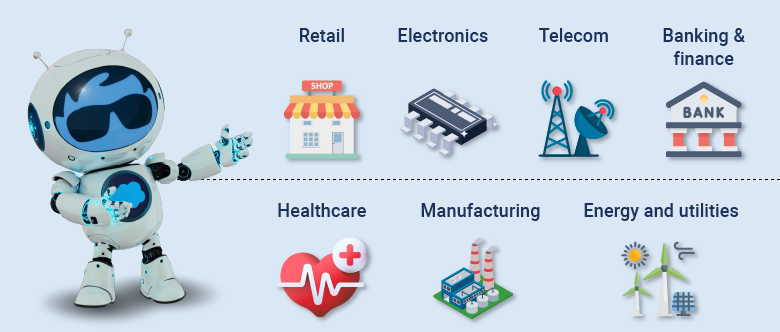
Agentforce for retail
AI-driven agents help retailers decrease operational expense and generate revenue through targeted engagement.
- Increased sales conversions
- Reduced support expenses
- Faster order processing
Agentforce for the electronics industry
Electronics brands must provide seamless post-purchase support and manage complex supply chains. AI agents optimize customer interactions and backend processes.
- Faster product support
- Lower return rates
- Enhanced inventory management
- Decreased warranty fraud
Agentforce for telecom
Automated customer interaction improves the ability of telecom operators to minimize churn and maximize service effectiveness.
- Decreased customer churn
- Reduce call center expenses
- Simplified service upgrades
By using AI for simple tasks and connecting agents to customers only when truly needed, companies can cut cost per contact by 9%.
Agentforce for healthcare
Patient engagement increase and administration automation result in better delivery of care.
- Increased patient retention
- Less administrative burden
- Improved compliance & security
Agentforce for manufacturing
AI-driven automation streamlines workflows and enhances vendor-client relationships.
- Quicker order fulfillment
- Decreased downtime
- Better supplier coordination
Agentforce for energy and utilities
AI facilitates proactive service management, minimizing disruptions and enhancing efficiency.
- Lower service costs
- Faster problem resolution
- Enhanced regulatory compliance
Agentforce for banking and finance
AI automation provides improved fraud prevention and more efficient financial operations.
- Rapid loan processing
- Enhanced risk management
Suggested: AI agent use cases across five major industries
Build smarter workflows with the foundation you already have
Many teams recognize the value of AI agents. The hesitation to adopt them often centers on whether new automation will disrupt workflows that are already delivering results, and where to start without overcomplicating what’s in place.
The right starting point depends on how your data is organized, where your teams feel the most friction, and how your systems are connected. That’s why implementation shouldn’t start with the tool. It should start with the right question: Which workflow would benefit most from being intelligent, fast, and scalable?
Connect with a certified Salesforce professional to explore your use cases and identify where Agentforce can improve your workflows.
FAQs
1. How is Agentforce different from traditional Salesforce automation?
Agentforce differs from traditional automation in how it processes work. Traditional tools execute predefined rules when conditions are met. Agentforce interprets customer intent, plans actions using unified data, and adapts responses based on context. It also collaborates with humans in Slack and orchestrates tasks across multiple systems.
2. What are the most common Agentforce use cases in enterprises?
Common Agentforce use cases include customer service automation, sales development, and field service scheduling. Enterprises also deploy agents for meeting preparation, lead qualification, knowledge management, and claims processing. High-volume, repetitive workflows with clear outcomes see the fastest adoption.
3. Can Agentforce be used for customer service automation?
Yes. Customer service is a primary use case. Agentforce resolves routine inquiries like order status and password resets without human involvement. For complex cases, it prepares full context before handoff. Organizations report 60 to 90 percent case deflection rates after deployment.
4. Can Agentforce be customized for specific business needs?
Yes. Agentforce Builder enables low-code agent creation with custom topics and actions. Industry-specific templates exist for financial services, healthcare, manufacturing, and retail. MuleSoft integration connects agents to external systems for cross-platform workflows.
5. How does Agentforce improve sales productivity?
Agentforce automates meeting prep by synthesizing CRM data into actionable insights. SDR agents handle lead qualification and scheduling around the clock. Sales teams spend less time on data entry and more time building relationships.
6. What skills are required to implement Agentforce?
Basic implementation requires Salesforce Admin knowledge and understanding of business workflows. Low-code tools reduce technical barriers for simple use cases. Advanced deployments benefit from prompt engineering skills, data strategy expertise, and familiarity with compliance requirements.