

Automate IT infrastructure
Set up automatic provisioning, workload management, and orchestration to reduce manual work. This lowers human error, improves compliance, and lets IT teams focus on important initiatives.
Keep your IT operations running smoothly with enterprise AIOps solutions that detect, predict, and mitigate IT incidents in real time.
Schedule a consultationOur Clients




Modern IT environments spread across clouds, apps, and services. They change fast, and traditional monitoring cannot keep up. Manual checks slow teams down, create operational bottlenecks, and raise the chance of outages. AIOps services solve this by adding intelligence and automation to daily IT operations. They help you keep systems stable, improve performance, and stay ahead of risks.
No matter how complex your IT infrastructure is. Whether it spans across hybrid clouds, microservices, legacy systems, or edge devices, our engineers tailor AIOps solutions for your needs. You get a smarter way to run your IT stack around the clock. Our ML models read signals across your systems, spot early warnings, automate incident fixes, and bring all monitoring into one view. This approach gives you faster resolution times, fewer manual tasks, and more room for your team to focus on high-impact work.

We audit your IT stack and understand the dependencies of each application service and infrastructure component with data. The assessment delivers immediate fixes and long-term optimization opportunities for your IT environment.

Automated remediation scripts resolve common incidents without human intervention. Our AIOps tools handle routine issues and send alerts to your team automatically when something truly requires their attention.

Our AI engineers train ML models based on IT operations' data to forecast capacity needs, performance degradation, and failures. These insights enable proactive scaling and prevent outages before they appear in production.

Intelligent routing assigns tickets based on context, severity, and team expertise. Our AIOps monitoring tools assess, diagnose, and resolve IT incidents across mission-critical workloads. They help you mitigate high-impact events.

Our AIOps workflows group related events to identify root causes. Correlation engines rank similar incidents and trace failures across applications, infrastructure, and dependencies. It helps you concentrate efforts and resolve issues in minutes.

We integrate our AIOps monitoring tools with your applications and IT infrastructure. They continuously monitor hundreds of APIs across your environment to give you a centralized view of the health and performance of the IT ecosystem.

Customized reporting and dashboards improve communication and sharing of information between your business teams and SREs. They can align KPIs, such as system uptime, network latency, ticket resolution time, with SLOs and SLIs.
Gathers data from all IT sources into one place. You get complete visibility and context.
Processes structured and unstructured data in real time. Patterns and risks become easier to identify.
Uses past data and ML to forecast failures early. Preventive actions are suggested before issues grow.
Triggers responses to issues as they occur. Manual work goes down and models improve continuously.
Automated root cause analysis
Your engineers spend hours tracing incidents across systems. With intelligent correlation engines, you can do that in minutes:

Performance trend monitoring
You’ll know your systems are healthy when your teams stop asking ‘Is it just me, or is this slow?’ Continuous performance monitoring means:

Predictive incident detection
Anticipate and prevent system failures before they impact business operations. AIOps solutions enable you to:

Capacity forecasting insights
Most organizations scale reactively. They add resources after slowdowns force their hand. You can do capacity forecasting with data:

Anomaly detection engine
Identify unusual behavior, like a sudden spike or a performance dip, that signals problems in operations. Leveraging ML capabilities, the system:

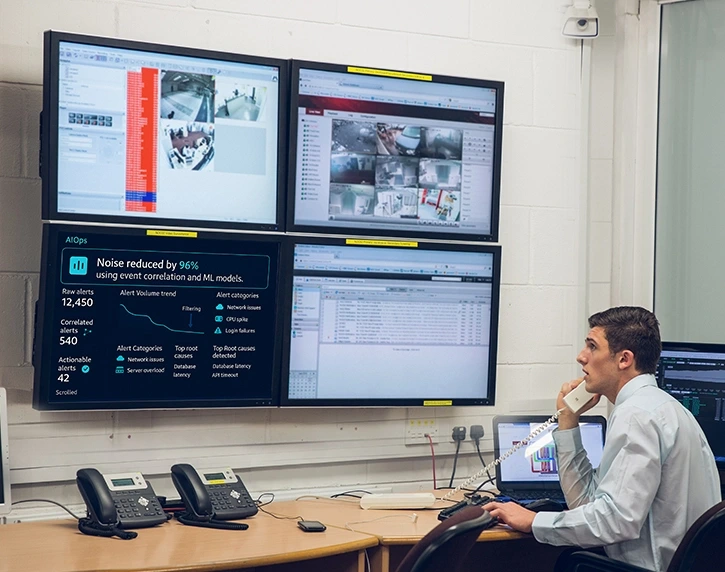
Alert noise reduction
Focus on what matters by filtering signals from noise. Our intelligent alert management capabilities can help you:
Faster incident detection
Spots issues within seconds. Metrics, logs, and traces are analyzed together for quick detection.
Reduced downtime
Lowers the chances of service disruptions. Predictive tools spot failures early so you can act first.
Accelerated mean time to resolution
Shortens the time needed to find and fix issues. Root cause analysis and event correlation speed up every step.
Improved team productivity
Removes noise by reducing false alerts. Automated routine tasks free IT teams to focus on real priorities.
Enhanced observability
Gives you a clear view across cloud-native, hybrid, and on-prem systems. Better visibility supports quicker decisions.
Data-driven capacity planning
Helps you plan resources with confidence. ML-based forecasts guide smart scaling and investment choices.
Cost optimization
Cuts overall IT costs by removing tool sprawl. A unified AIOps platform keeps everything in one place.
Better customer experience
Keeps services reliable at all times. Intelligent monitoring protects application performance for every user.
Set up automatic provisioning, workload management, and orchestration to reduce manual work. This lowers human error, improves compliance, and lets IT teams focus on important initiatives.

Use AI-driven analysis to catch early signs of performance issues that fixed-rule alerts miss. Faster detection leads to quicker resolution, fewer outages, and less business impact.

Use NLP-powered workflows and analytics to read both structured and unstructured operational data. Teams can spot hidden patterns, receive early warnings, and make proactive decisions.

Use AI models to understand risks in code or configuration updates. This helps IT teams prevent issues before they occur and maintain smoother, safer releases.
Let us show you how enterprise AIOps can step up your IT automation and operations
Connect with our experts
Data aggregation
AIOps tools aggregate and normalize data from various sources
Event correlation
Correlates events to pinpoint root causes
Automation and remediation
Automates problem resolution freeing up IT staff
Predictive capability
Allows IT teams to proactively address problems
Integration capabilities
Integrates with other IT management tools
Issue detection
Early detection of issues before they impact users
Dashboards and visualization
Provides real-time insights into IT operations
Scalability
Handles increasing volumes of data and complex operations

Our experts evaluate your IT systems, identify opportunities, and define objectives to highlight where AIOps can deliver maximum impact.

We select AIOps tools based on compatibility with your systems, required features, and desired scalability.

We develop an implementation plan, including the step-by-step roadmap, timelines, milestones, and resource requirements, and follow that.

Our AIOps engineers run a controlled pilot, track results, refine processes, and expand AIOps workflows across your organization.

Track equipment health, detect shifts in quality, and optimize resources through sensor analysis and automated workflows.

Analyze fabrication performance, monitor clean room conditions, and correlate incidents to minimize errors and downtime.

Protect patient care by monitoring health records, detecting access anomalies, and prioritizing alerts across clinical systems.

Detect fraudulent patterns, monitor banking platforms, and analyze system performance to prevent outages and threats.

Predict network congestion, assess infrastructure health, and correlate performance metrics to optimize service and satisfaction.

Safeguard infrastructure by tracking smart grids, analyzing consumption patterns, and detecting emerging cybersecurity threats.

AIOps platforms aggregate data from logs, metrics, events, and network flows in real-time. They normalize information across monitoring tools, cloud services, and on-premises infrastructure for comprehensive analysis.

Stream processing engines analyze operational data as it arrives, which enables anomaly detection. Such continuous analysis compresses incident response times from hours to seconds across complex environments.

Machine learning models identify normal behavioral baselines automatically and detect deviations. These algorithms learn from your historical data to predict failures, recognize trends, and classify incident types.

Intelligent correlation systems link related alerts across distributed infrastructure to cut through noise. By understanding service dependencies and topologies, they automatically trace incidents to root causes.

Orchestration frameworks execute predefined workflows when specific conditions trigger, like restarting services or reallocating resources. Integration with ITSM platforms enables ticket creation and resolution tracking.

Enterprise-grade AIOps tools monitor and analyze thousands of events, logs, and metrics in real time
AI models trained on millions of IT operations and incident data points for predictive accuracy
Our clients reduced system downtime by up to 40% and mean time to resolution (MTTR) by nearly 50%
Ensures full compliance with GDPR, HIPAA, and SOC 2 while safeguarding sensitive operational data
Trusted by Fortune 500 enterprises to optimize complex IT environments globally
Artificial Intelligence for IT Operations (AIOps) is the application of big data analytics, Artificial Intelligence (AI), and Machine Learning (ML) to automate and improve IT operations. It ingests and analyzes massive volumes of operational data from multiple sources to identify patterns, detect anomalies, and predict issues.
DevOps is a cultural and operational framework that unifies development and operations teams to accelerate software delivery. AIOps is a technology layer that applies artificial intelligence to IT operations, automating monitoring, incident response, and root cause analysis.
AIOps solutions collect telemetry data from infrastructure, applications, and network devices across the IT environment. Machine learning algorithms analyze this data to establish baseline behaviors, detect anomalies, and correlate events. When issues arise, automated workflows trigger remediation actions, notify appropriate teams, and provide contextual insights.
With enterprise AIOps, IT teams spend less time on manual monitoring and more time designing better IT architectures. Automated incident responses handle routine issues, allowing teams to focus on innovation and business enablement.
AIOps reduces mean time to detection and resolution, minimizing downtime and improving service reliability. Predictive analytics prevent incidents before they impact users, while automation handles routine tasks. Organizations achieve cost savings through optimized resource utilization and consolidated monitoring tools.
Yes, enterprise AIOps solutions are designed for seamless integration with existing monitoring tools, cloud platforms, and on-premises systems. They connect via APIs, agents, and standard protocols to ingest data from diverse sources. Our implementation approach ensures compatibility with your current IT stack. It provides a unified analytics layer that enhances your existing investments rather than replacing them.
Optimize your ITOps with AIOps now
From anomaly detection to automated remediation, we help your IT operations evolve from reactive to predictive, powered by AIOps services.
 All our projects are secured by NDA
 100% Secure. Zero Spam.
By submitting this form you agree with the terms and privacy policy of Softweb Solutions Inc.